All the Fish in the Sea

Cat Goodrich
Faith Presbyterian Church, Baltimore, MD
February 6, 2022

All the Fish in the Sea
Luke 5:1-11; Isaiah 6:1-6

He was exhausted, and his back ached as he crouched on the sandy lakeshore. The nets were a mess, filled with grit and reeds to be picked through, washed out, and cleaned. Another hour’s work at least. The fact that they had not caught any fish that night had one upside – at least they could go straight home to sleep instead of heading to market once the nets were clean.

His calloused hands worked quickly to tie and tighten the knots, mending holes in the nets that were his livelihood. Bending over the ropes, he strained to hear his friend’s voice ring out over the crowd that had gathered to hear him teach on the water’s edge.

It never ceased to amaze him how quickly word spread when Jesus showed up – people would appear out of nowhere, just to catch a glimpse of him, or would bring their old ones or their sick ones, hopeful for a healing. Children flocked to him, too. Luckily, his patience was endless. Peter looked up and shook his head – the villagers were crowding so close, it looked like they might push him into the lake! Another step back and he’d be in the water.

Jesus raised his arm and waved to him – and pointed to the boat. Could he teach from there? Inwardly groaning, Peter stood and shaded his eyes from the morning sun with his hand – hm. The boat might actually work – it would put some distance between him and the crowd, at least, practically the whole village was there. It was worth a try anyway – Simon shrugged and trudged over, whistling to his hired men to come help push the boat back into the water.

They’d already been fishing all night, so what was another couple of hours? The day was fair, and they’d be able to hear Jesus better this way – a front row seat. Simon had heard it before, of course, over dinner the night before, and in the synagogue before that. He’d seen demons cast out, and his own mother-in-law healed of a fever, and the crowds grew more and more each day. He understood their eagerness to hear him, because Simon never tired of hearing him either. Jesus shared good news, talking about the kingdom of God here and now, and promising liberation for the poor, for fishermen and farmers and their families. Simon couldn’t quite explain it, but the teaching filled him up, made his heart swell with something like hope, helped him forget the taxes he had to pay, and that he hadn’t made a good catch in a while.

When Jesus grew tired, he bid goodbye to the crowd and asked Peter to take the boat farther out, into the deep water. When they were far from shore, the men rested on their oars. “Cast your nets here,” he said. Peter laughed, ‘Did you forget you’re a carpenter, man? We fished all night and caught nothing.” Jesus pointed to the water, dark and deep, and again – here, he said. Peter and his men wearily gathered the net, and together heaved it out over the water, watching it splash and slowly sink beneath the waves. As they began to crank it back into the boat, the shining mass of fish startled them, practically leaping out of the water and into their boat, flashing silver, flopping against the wet wood, more than they’d ever seen in one place before. The men were dumbfounded, How could this be? Was it a trick? Their nets were breaking from the sheer weight of them!

They stood and turned back to shore, waving their arms. They cried out to their partners, James and John and their crew, waving, shouting, come, help us!

And when the other boat finally came, and they too were loaded with more fish than they should safely carry, when the wet nets were slung, dripping at the edge of the boat, and rough hands picked up the oars once more to return to shore. The work gave way to wariness. Simon looked at his friend Jesus and not for the first time, felt afraid – fearful for Jesus, for what would the authorities do to him when they knew what he could do? Afraid for himself, too, because surely this man was touched by God, and Simon was unclean – not fit for his presence. Simon couldn’t even remember the last time he’d made the trek to Jerusalem to sacrifice at the temple. Filled with fear, Simon flopped down on the bottom of the boat and cried – leave me be, Lord, I am a sinful man! I do not deserve this miracle! I never asked for it!

I’ve never witnessed a miracle like this, but I certainly know how he was feeling. It’s the feeling of inadequacy, of not being good enough, or skilled enough for the job at hand. It’s being asked to complete a task you’ve only just heard about, with not enough time, experience and resources to get it done. Or, it’s meeting the person you’ve looked up to your whole life, and feeling completely unworthy to be in their presence.

The prophet Isaiah, when called by Almighty God to speak truth to power, is overwhelmed by his own inadequacy. In the presence of God, Isaiah says, oh no, woe is me! I am a man of unclean lips! Choose somebody else!

Richard Rohr says that one of the earliest insights in the Christian tradition is the truth that we are saved by grace. There is nothing we do to earn God’s love. Rohr writes, “Not because you are so bright and light and have purged out all the darkness does God accept you, but as you are. Not by doing something, not by your works…”. There is nothing we can do or fail to do. God simply loves us, and embraces us completely – with all our imperfections, shortcomings, mistakes, and misgivings. By grace, we are good enough, just as we are.[1]

And here we see it, in the bottom of a sinking, stinking fishing boat, in the middle of the sea of Galilee, when Jesus smiles and stretches out his hand to his friend and says, don’t be afraid. Come with me, and we’ll fish for people.

Peter has every reason to feel inadequate. I imagine we all would feel unworthy to be in the presence of the one true God. His religion required regular sacrifices, visits to the temple in Jerusalem that would have been four day’s journey on foot, difficult and expensive for a poor fisherman to make to worship properly. He wasn’t lying, he was ritually unclean – and after fishing all night and hauling in more fish than two boats could hold, I’m guessing he was literally unclean, too. But Christ still chooses him.

I had a colleague in Atlanta who liked to remind elders and deacons that God promises us grace sufficient for our calling[2] – which means, I think, that whenever God calls us to a task, God also equips us to do it. Sometimes the work is overwhelming. It may feel as if our nets are breaking! Sometimes, the boat begins to sink. That is when, like Peter, we must look to shore, to find partners to come meet us and help. Because the silver flash of a miracle compels us to push onward, to push back against the inner voices that say we aren’t good enough, and the powers beyond us that would keep us in our place…God calls us to share good news with the poor, to practice forgiveness, and to work together for liberation. And God gives us to one another, to help make it happen.

I don’t know what it is for you. But I am sure that you all can think of a time when you felt inadequate for the task at hand. Exhausted, overwhelmed. Probably too many times to count over the past few years, we’ve faced fear, illness, and uncertainty. Our way of life has been completely upended. The future is still a bit foggy. But of this I am certain: God is calling us to share the good news of love and liberation with a world in desperate need of it. And God’s grace is sufficient for our calling. I wonder: will we have the wisdom to ask for help when we need it? And when we make it back to shore, will we have the courage to leave our nets behind? I pray that we will. Because when we do, God will surprise us with life abundant over and over again.

[1] Richard Rohr’s daily email, 6/16/21 “Shadow in Christianity”

[2] Rev. Sallie Ann McKenzie-Sisk

Prepare the Way

Cat Goodrich
Faith Presbyterian Church, Baltimore, MD
December 5, 2021

Prepare the Way
Luke 3:1-6

Advent is a season of waiting.

I don’t know about you, but I don’t like to wait.

There are places where a wait is inevitable…in line at the grocery. The doctor’s office. The airport. And there are times when it feels impossible to wait – waiting for a baby to be born. Waiting for news from a pathologist or oncologist. Waiting for test scores to be posted or admissions letters to arrive.

But I believe few waits are as interminable as the wait at a bus stop. Waiting for the train is one thing – there’s usually a countdown clock or board to tell you when the next train is coming. But a bus – a bus is another thing entirely. You don’t know when it’s coming. You’ve committed to taking the bus, so you’re not going to hail a cab or call an uber. It could be five minutes, it could be fifteen, it could be fifty – who knows. In my twenties, I was lucky to live in cities that had reliable public transportation – so I was able to do what far too many folks here in Baltimore struggle to do – I got by without a car. But that meant I spent a lot of time waiting for the bus.

I can still picture the gritty corner of Washington Street and Huntington Ave, where I’d wait for what seemed like hours each week to catch the 39 bus into Jamaica Plain where I lived. Does this happen in Baltimore – you wait for forever for the bus, and then three come right in a row, one after another? Who else has felt the frantic frustration of missing the bus – seeing it pull away down the street in a puff of exhaust…I can remember hightailing down the street to try to beat it to the next stop on more than one occasion.

That was all fine and good in my twenties, when I had time and energy to spare. But Lord, have mercy. Each day busses fill with mammas pushing strollers with their cranky preschoolers in tow, weary PA’s in scrubs carrying groceries in rush hour. Elderly men and women carefully navigating the crowds to get wedged in to the last available seat. Each weekday, a city bus pulls up to Maddie’s school to drop crew of rowdy Middle Schoolers off – kids who had to pull on their blue shirts and khaki pants in the dark and leave home way too early to get to school on time. Travel by public transit can be such a hassle. And what you save in money, you pay in time.

We have been to the moon. Surely we can figure out how to get people safely across town in a timely manner.

Well, in the second year of the rule of President Biden

When Lawrence Hogan was Governor of Maryland and Brandon Scott was Mayor of Baltimore, and Virginia was governed by Ralph Northam, and a crazy man named Rick de Santis was Governor of Florida, during the high priesthood of Jorge Borgoglio as Pope Francis, and J. Herbert Nelson as Stated Clerk of the PCUSA, the word of God came to the people of Faith in Baltimore: prepare the way of the Lord! Every valley shall be filled, and every mountain and hill be made low; the crooked shall be made straight, and the rough ways made smooth.

Sounds a little funny, doesn’t it? It’s interesting that Luke frames the prophetic work of John the Baptist in this way. With this list of political rulers and religious leaders, Luke sets the stage for the start of Jesus’s public ministry. He also establishes himself as the historian, situating John and Jesus as historical figures, and preparing us for the religious and political conflicts to come in Christ’s ministry. After all, four of the leaders named are familiar to us not because of their achievements, or their compassion.  They’re familiar to us because of their roles in the arrests and executions of both John and Jesus.

It’s important that the Word of God doesn’t come to those guys. It doesn’t come to the Emperor, not to the governors, not even to the high priests. It doesn’t show up in the palace, or even in the city. No, the Word of God comes to John, son of Zechariah, out in the wilderness. John is a wild-eyed prophet, a locust-eating madman, far from the halls of power. Outside the temple. Out of the religious hierarchy completely. John is in the wilderness – where God met Moses in the burning bush, where the wandering tribes were guided by smoke and fire, fed by manna and quail, and formed into a people. It is not in the center of civilization, but on the edges, out in the wilderness where God shows up and starts turning the world around.

Get ready, John says.  God is coming, so we better make way.

How do we do that? Repent, John says. He’s in the wilderness offering a baptism of repentance for the forgiveness of sins – washing people in the River Jordan as a sign that they have left their old lives behind and are starting something new. To repent is to turn around, to turn away from one thing and to another. To repent in the wilderness is to step out of the world as we know it and to start making the world into how it should be. It is to acknowledge our part in systems that oppress and politics that perpetuate the same old thing. And it is to be bathed in God’s promise that peace is coming: to mend our broken hearts, to heal our broken world.

God knows we need to name and claim this promise now. In a country so enamored with violence that kids get guns for Christmas, and too many families grieve the senseless deaths of their children. Where women aren’t trusted to make decisions about our own bodies. Where too many cannot access the care they need. What can we do to prepare the way?

John quotes the first lines from the book of consolation from the prophet Isaiah. Isaiah is promising a way home for Israelites in exile – a road that is smooth, a path that is straight and level.  Easy and swift to travel.

What if our waiting this Advent wasn’t the interminable wait like at a bus stop. What if it was active waiting, a season of and time to prepare. Not just to prepare our homes for Christmas with tinsel and trees, but our hearts. Our lives. We’re called to prepare just as John did – by looking back to the prophets of Israel and remembering God’s promises made known to us through them. Then, looking around, analyzing our current context in light of God’s promises. And repenting of that which is wrong.  And wondering, how can we make a new way, a clear path, easy and swift to travel all the way home?

Did you know that Maryland’s public transit system’s light rail and trains have the most breakdowns of any other system in the country?[1] That means our system is unreliable, difficult to use – especially for daily commutes to work. And six years ago, the Governor vetoed a bill to fund the MTA. But when the legislature meets in special session this week, they’ll take up the chance to override Hogan’s veto, to fully fund the MTA. If you believe we are, indeed, called to prepare the way, to lift up the lowly, to fill in the valleys, bring down the mountains and make the rough places smooth, surely that means helping people get from here to there, from home to work, from East Baltimore and West Baltimore to downtown quickly, affordably, safely, and with ease. If you want to write a postcard to your legislator, there will be a table downstairs in the Fellowship Hall.

Maybe our waiting this Advent, we can think about actual roads, and how to make them safer and easier to travel – for everyone, not just those who own cars and can afford to insure them, fuel them, and repair them.

Can you hear him? A voice cries out in the wilderness, prepare the way of the Lord. The prophet brings news of our God made flesh – God entering into human life, to redeem it, all of it. Let’s get ready.  Let’s make a way.

Thanks be to God.

[1] “Fully Fund Maryland Transit,” Save Maryland Transit, https://savemdtransit.org

Begin at the End

Cat Goodrich
Faith Presbyterian Church, Baltimore, MD

November 28, 2021
Begin at the End
Luke 21: 25-36

One of the bleakest books I’ve read in a long time is Octavia Butler’s famed Parable of the Sower. Echoing Cormac McCarthy’s The Road, The Parable of the Sower depicts an apocalyptic California in the not-too-distant future. Poverty, addiction, and inflation push people to the brink. The only sure jobs come by selling yourself to a corporation. Fires burn wide paths of destruction across the state and nobody leaves home without a gun. It’s a troubling read. And I can’t help but think of the main character, Lauren, as I read this passage from Luke.

Lauren lives with her family in a walled-in neighborhood outside of LA. They live in relative safety, but the world outside the walls is falling apart. She can see that their way of life, their community, will not hold out forever, that eventually the forces outside will spill over the walls and tear them apart. So, she begins to prepare, getting ready to face whatever it is that’s coming. She stores food. She saves money. She practices her aim. And she stashes a bag of essentials to grab in case she has to run. When the walls that surround her neighborhood crumble and the chaos comes home, she is ready for it. She escapes and survives the brutal landscape. She survives because she was watching and noticed the signs; she survives because she was ready.

This passage from Luke is an apocalyptic prophesy, where Jesus predicts the destruction of Jerusalem and the terror and tumult that will come at that time. There are plenty of people who respond to apocalyptic prophesies like Lauren does in the Parable of the Sower. After all, Christ himself is calling us to be alert, to be ready – ready to stand and meet him when he returns. The Mormon church advises all of its members to store three months to a year’s supply of food and other necessities – just in case of adversity, their website says. I can remember in the first scary weeks of the pandemic, empty grocery store shelves, people hoarding toilet paper. Living through the supply chain disruptions of the past year and a half has certainly changed how my family shops – we do keep more dry goods on hand than we used to. But is that really what Jesus is saying here? What kind of readiness is he calling us to? How do we prepare? And what are we even preparing for?

This is the first Sunday of Advent, the first day of the church year. Advent is a season of preparation as we await the birth of the Christ child. But we don’t start by looking back to his beginnings.  We don’t read the early prophesies of one who will bring salvation to Israel, we don’t hear the angel Gabriel say to Mary, “Greetings favored one, the Lord is with you.” Instead, we begin at the end. Here, at the beginning of Advent, we hear predictions of fear and foreboding, signs in the sun, moon and stars, and distress among nations. Advent begins with an apocalypse.

Why apocalypse now, at the beginning of Advent? An apocalypse is a revelation, it shows us something that has been hidden, allowing us to understand the world and God’s work in it in a new way. The Advent season starts with a chance for us to lament and repent, and then to remember the promises of God, to reignite our hope for the future. Starting with an apocalypse gives us a chance to name the pain of our community, and to receive the promise of transformation: A new heaven and a new earth. God present and at work in the midst of the terror and tumult. God with us until the end of time.

These short, cold days of winter are when we prepare ourselves to welcome and embrace God’s presence in the world. There are signs of desolation all around – in headlines, on our streets, in our hearts. And I don’t need to tell you, there are plenty of reasons to feel hopeless. Migrants and refugees are freezing to death on the border between Belarus and Poland right now…they come from Iraq, Afghanistan, and Syria, victims of war and who are now pawns in a game between Belarus and the EU – Belarus is using desperate men, women, and children to taunt the governments of Europe for imposing sanctions following a sham of an election last year.[1] Twenty-seven people drowned in the English Channel this week, trying to reach England in a flimsy inflatable raft, willing to try anything to get to the UKE after being pushed out of camps near Calais – through a policy of “enforced misery.”[2] Not to mention those many tens of thousands of people from Haiti and Central America trying to make their way northward to the US as we speak. People in search of safety.  Stability.  Enough food to eat, meaningful work, a roof overhead.  A chance to start a new life.  All while bullets continue to fly in Baltimore, and the Omicron variant threatens further travel bans and lockdowns as the world seeks to contain its transmission. These are difficult days.

Luke is writing in difficult days, too. He writes after the Roman armies have laid siege to Jerusalem, after the temple has been destroyed, after years of starvation and suffering. The things Luke’s Jesus describes have already come to pass. And so Jesus doesn’t make his predictions to scare his disciples into submission. Instead, he seeks to reassure his disciples that though it may seem unlikely, justice is coming. Their job is to be vigilant – faithful – even in the face of desolation.  Even when they feel hopeless.  Be on guard, be alert, he tells them.  Trust that God is hard at work, transforming this broken old world into something new. Stay true to the path and work of discipleship, Jesus says, and watch closely for what God is doing.  Look for the signs of new life springing forth. Even now, they’re all around us.

Winter brings short days and long nights. Green, growing things go dormant, to store up energy for the unfurling of spring. Anne Lamott writes, “as the days grow shorter,…we ask ourselves, “Where is the spring? Will it actually come again this year, to break through the quagmire, the terror, the cluelessness?…Meanwhile, in Advent, we show up when we are needed, with grit and kindness; we try to help, we prepare for an end to the despair.”[3] We prepare for an end to the despair. Beginning at the end helps us do this: it reminds us, we are not forgotten. Christ is coming. Lamott remembers a friend teaching her, “the promise of Advent is:…God has set up a tent among us and will help us work together on our stuff.”[4]

This is the good news: God has come to us. God will come again. By entering this world in the person of Jesus, by becoming embodied, God shows us that bodies matter, that we matter. In Christ, God reveals to us the power of love, solidarity, and service. And so in this time of year, we don’t just look back to the birth of Jesus. We look forward to the time when God’s plan for justice and peace is realized – as we do when we pray, ‘your Kingdom Come,’ in the Lord’s prayer each week.

As people of faith, we are analog people in a digital world. We read old books and light candles and sing songs. We have a long memory – remembering what God has done in the past, and gathering here in this place to remind each other when we start to forget, and shore up our faith and our hope for the future. We don’t prepare for the end by hoarding stockpiles of food, with stashes of cash. We prepare by doing the work of loving our neighbor here and now. We prepare by looking expectantly around us, to notice God’s presence in and among us even now. We welcome Christ coming to us again and again in the poor, the hungry, the sick, the suffering. Sparking compassion.  Building community. Igniting hope for what is possible. Helping us expect transformation. Thanks be to God.


[1] Ibrahim, Arwa, “What Next for the Migrants Stranded Between Belarus and Poland?” Al Jazeera, 11/24/21, https://www.aljazeera.com/news/2021/11/24/as-belarus-eu-tussle-edges-toward-war-migrant-crisis-deepens

[2] Breeden, Aurelien, Constant Mehuit, and Norimitsu Onishi, “At Least 27 Dead After Migrant Boat Capsizes in English Channel,” The New York Times, 11/24/21, https://www.nytimes.com/2021/11/24/world/europe/migrants-boat-capsize-calais.html

[3] Lamott, Anne, “Advent 2003,” Salon, 12/5/03, https://www.salon.com/2003/12/05/advent/

[4] Lamott, Anne, “I am cuckoo, but hope is coming,” Salon, 12/12/12,  https://www.salon.com/2012/12/12/i_am_cuckoo_but_hope_is_coming/

Bargaining with God

Cat Goodrich
Faith Presbyterian Church, Baltimore, MD
November 14, 2021

Bargaining with God
1 Samuel 1:4-20

The church I served in Birmingham had a big, Gothic sanctuary, with stained glass windows, and old dark wooden pews. There was a center aisle, with maroon carpet that matched the velvet pew cushions. It was the first church to be built in the city, on land deeded as part of the city charter. Like most city churches, they were locked up tight as a drum every day except Sunday. We began to wonder what might happen if we opened the doors, making it possible for people to come spend time in the sanctuary for even just a few hours during the week.

And so we did.

The occasional curious passerby or businessman would stop in from time to time, but our most frequent visitor was actually a church member, a young woman about my age. She would come to write and pray at least one or two days a week, working out all kinds of questions with God. When she would ask me to, I would sit with her and pray with her, asking for God’s care and protection. This woman had mental illness, she vacillated between being okay and – not okay, between times of lucidity and delusion. She had a son who was in protective custody, and her prayers were filled with whispered pleas for him. For his safety. For his health. And most often, she would pray, Lord let me see him again. Help me find an apartment I can afford, so I can get my son back. Please, God.

I picture her when I read the story of Hannah. Her anguish. Her grief. Her fervent whispered prayers, begging God for her child.

This is a delicate story, a difficult one. I almost don’t know what to make of it – it raises so many questions for me: why does the text say that God closed her womb? And what happened to make God change their mind, to bless her with a baby? What are we to make of that? And what is up with the men in this story, why are they so clueless?

This story is difficult. It’s not easy to look back to a time when upstanding men had multiple wives to prove their wealth and power. A woman’s value lay in her ability to have babies, and not just any babies – boy babies. Hannah was childless, but she is, luckily, loved by her husband, and he provides for her even though she is barren. But – he’s also a little oblivious. He doesn’t understand the depths of her grief over her infertility. I’m guessing most women who have longed for a child can identify with Hannah: her pain. Her grief and disappointment.

Insulted by Elkanah’s other wife, Hannah is miserable, desperate. But still she does not give up. She persists in prayer, going to her peoples’ most holy sanctuary at Shiloh, home of the ark of the covenant, to ask God for a child. Yet even there, as she pours her heart out on the altar, the priest is rude to her, accusing her of drunkenness! But not even a bumbling priest will thwart Hannah. She defends herself, and Eli blesses her and sends her on her way. And she becomes pregnant.

The story of Hannah seems like a personal one: a barren woman longs for a child, and prays until she gets one. But commentators are clear – this is a political story, the origin story for a great hero of Israel – Hannah’s child, the one for whom she prayed, is Samuel, who God calls in the night and lifts to power; Samuel, chosen by God to be the priest who paves the way for monarchy in Israel; Samuel, the priest to anoint Kings Saul and David. Samuel’s miraculous birth is the beginning of the larger myth of three heroes of ancient Israel, one piece of the arc of our salvation history.

When we read Hannah’s story as a political story, it tells us that God is present in history. Opening wombs. Listening to the pleas of the people, hearing our prayers.  Raising up leaders. Making miracles happen. God is deeply invested and engaged in what happens here on earth.

If that’s the case, I wonder: what did Hannah do that got God’s attention? How was she different from the millions of other nameless, faceless couples who have longed for a child, but did not become pregnant? The countless other women who surely suffered, who cried out and were cast out, mistreated and maligned because of their inability to give birth? We can’t know. What is clear is that despite her situation, Hannah had faith. Hannah believed that if she cried out, if she prayed, if she bargained, if she humbled herself, God would listen, and what’s more, God would grant her request. Hannah was not resigned to the status quo, she was relentless. No matter what her husband said, she would not be satisfied with Elkanah. He tried to silence her, tried to get her to be satisfied with him alone. Nevertheless, she persisted, praying and pleading with God for more, asking God for what she wanted, what she knew she deserved, praying for what she knew in her bones was possible. And God delivered.

If we read the story of Hannah not as a personal story, but as a political story, I wonder what it might mean for us. For our prayer. For our activism. For our organizing and agitating here in Woodbourne McCabe. For our engagement here on Loch Raven, and here at Walter P, and here in the city of Baltimore. What do we see that is not as it should be? What do we dare ask God to do because we know it’s what we deserve, what we know in our bones is possible?

For the past two weeks, negotiators and delegates from countries around the world have been in Glasgow, for the COP 26 climate summit. Many world leaders called the meeting the last best hope for humankind in the face of the coming climate disaster. And in the streets, activists have gathered – to call for urgent action to limit warming, to end our reliance on fossil fuels. One young activist said she wants to ask them if they understand how urgent limiting climate change is for the next generation.

She said, “In my mind, it’s like: do these people have children?”[1]

Many journalists observed the dramatic differences between the leaders and diplomats negotiating the deal in the summit and those gathered outside, crying out for immediate and drastic changes to save the earth. Those in the summit were mostly white men, older, with longer timelines for change.  ]Those outside were mostly women, younger, led by indigenous and other activists of color.

The activists are furious at the 20-30 year goals being set by world leaders. They cry out: not only do we need to stop using fossil fuels immediately, we need to work to repair the damage that is already being done, particularly to women and children in the global South, where flooding, drought, and fires have become increasingly commonplace. As one young activist proclaimed, “Now is the time. Yesterday was the time…We need action right now.”[2]

Criticizing the summit, an activist with Power Shift Africa said, “The needs of the world’s vulnerable people have been sacrificed on the altar of the rich world’s selfishness.”[3]

These stories are personal. A home lost to flooding. A farmer’s crops dried up from lack of rain. A family fleeing to the city because a fire took everything they had. But we know they are also political. And that it will take faith, deep faith, persistent prayer and courageous action to create change. But the pain of that struggle – is the pain of labor, the suffering of bringing a new world into being. That is the work to which we are called.

And thinking back to my parishioner in Birmingham – her story was personal. But it was also political. Her whispered prayers were not just calling God, they were also calling me and my congregation to work for affordable housing, better mental health care for the poor, changes to the foster care system.

We lift our community’s needs, laments, and hopes in prayer each week, is because I believe God hears our prayers. When we cry out, God listens. So we should not be resigned to the status quo; no, we must be relentless. Asking, praying for not just what we need, but for what we know in our bones is possible. Because when we do, miracles might just happen.

[1] “Clean up your mess, young activists tell leaders at the COP 26 climate summit,” Nov 5, 2021, NPR, https://www.npr.org/2021/11/05/1052707018/clean-up-your-mess-young-activists-tell-leaders-at-cop26-climate-summit

[2] “The Summit is led by older men.  The protests are guided by younger women”  https://www.nytimes.com/live/2021/11/06/world/cop26-glasgow-climate-summit-protests

[3] https://www.nytimes.com/2021/11/13/climate/cop26-glasgow-climate-agreement.html

What the World Needs Now…

Cat Goodrich
Faith Presbyterian Church, Baltimore, MD
October 31, 2021

What the World Needs Now…
Mark 12:28-34 and Ruth 1:1-18

The man is tall and lanky.  His hair is cut close to the scalp, buzzed short and spiky.  He’s wearing black sweatpants, black face mask, a maroon hoodie.  He sits hunched over in an airport chair, hands in his pockets.  The headline: “Assault on Flight Attendant one of the Worst in Airline’s History.”  It’s a little unclear what caused the fight – but it meant the plane made an emergency landing in Denver, and the man was taken into custody, the flight attendant went to the hospital, and the rest of the passengers and really the nation were left scratching our heads, wondering – what the heck is wrong with us?

There have been more than 4000 reports of unruly passengers on flights so far this year, ¾ of which relate to masks and the refusal to wear them.[1]  Our own Patrick has endured abuse and anger from passengers, simply for doing his job as a flight attendant for Spirit airlines.  And this isn’t just on airplanes – restaurant workers, nurses and hospital staff, teachers, school administrators, and school board members have all seen a rise in bad behavior.  It seems our common life has been struck by an epidemic of rudeness! Disagreements are devolving into physical altercations more often, and arguments are escalating more quickly.  What is going on???

A flurry of articles point to the stress of the pandemic, saying that it’s pushed us into perpetual fight or flight mode.[2] Time alone at home through the mess of the past year and a half has made us more selfish, warped our view of the world.  A steady diet of Facebook and other propaganda has sown division, turned neighbors into enemies, and made us quick to assume the worst of each other.

This is, of course, the opposite of what we are called to do and be as people of faith, as Christ followers.

In this morning’s passage, Jesus and the scribes have been debating for a long while.  The scribes are trying to trap him, to get him to say something for which they can bring him to trial.  But then, something amazing happens: Jesus and a scribe find common ground!  They agree that the Shma – Hear, O Israel, the Lord is our God, the Lord alone.  Love the Lord your God with all your heart, mind, and strength – this is the first and greatest commandment.  And when Jesus proclaims the primacy of the second, “you shall love your neighbor as yourself,” the scribe agrees with that, too!  You’re right, he says.  Love is primary; it takes precedence over all else.  Love is more important than the law.  More important than temple worship and sacrifices.  Our love for God is to be embodied: in our care for one another, our service, and our common struggle for justice.  We love God because God first loved us; We show our love for God by loving one another.

This is not easy.  Former moderator of the PCUSA Bruce Reyes-Chow often ends worship services with this charge: “Go forth to love God and love your neighbor.  It’s just that easy, and it’s just that difficult.” And he’s right: Love requires reorientation: focusing away from ourselves, looking instead toward others, and seeking their well-being.

But you know what?  I think if we look closely, we will see this kind of love played out every day, all around us – if we only have eyes to see it.  It’s not the kind of story that makes headlines.  It’s often much smaller and quieter than that.  But it’s worth noticing, embracing, holding on to.

When I lived in Guatemala, my family’s land had a few adjacent neighbors.  They weren’t very friendly with the people that lived closest to them.  I can remember one day walking home after running errands with my host mother, Graciela, and my sister Yadira.  Public buses would drop you on the highway, and there was a long walk up the mountain to get home.  A neighbor was walking towards us with a big bucket of corn, on her way to the mill to grind the corn into nixtamal, so that she could use it to make tortillas.  The road was rocky, and something caused the woman to drop the bucket.

Corn went everywhere.

Guatemalans are called people of maize because corn is the cornerstone of their diet.  Their creation story has God creating humans out of an ear of corn.  The corn that this woman dropped was surely going to make tortillas and tamales to feed her family.  Now it was spread out across the road, ruined.

Graciela sat down her basket.  Yadira put down her parcels.  And without a word they stooped down in the dirt and began to help their neighbor pick up her corn.  Every. last. kernel.  Graciela had a fish in the pocket of her apron that she’d intended to fix for supper, and I remember thinking – she needs to get that fish into the refrigerator if I’m going to eat it!  It took a long time.  But they wouldn’t leave her until all of the corn was back in the bucket.  Because that is what they would have wanted someone else to do for them.

Love your neighbor as you love yourself.  This is easy enough to figure out interpersonally, with your actual neighbors.  I see it on my block, with the care we show for one another.  I see it in the nurses and the teachers who keep showing up for work, even though they are exhausted, and overwhelmed by the demands of the past year.  I see it in free community fridges and food deliveries established during the pandemic, neighbors helping neighbors so no one goes hungry.  We’ll see it tonight, as we open our doors to our neighbors again and again, to share treats and celebrate as a community! In their theology of Halloween, the people of The Salt Project proclaim that the holiday shows us “what ‘neighborhood’ actually looks like… what better way to honor the dead, prepare to celebrate the saints, and enter together the darkest time of the year than to embody” love for one another[3] with creative costumes, by opening our doors to everyone and offering and fun size Kit-kats for all?

Love your neighbor as you love yourself.  In some ways it’s easy.  But in our globalized world, it can be a lot harder to figure out how to truly love your neighbor when our neighbors are half a world away, connected through our economic choices, our energy use and its impact on the changing climate, our government’s policies, our shared humanity.

The Christian realist Rienhold Neibuhr, acknowledged this problem, observing that true love of neighbor is virtually impossible, given the complex relationships of modern life.[4]

The TV show The Good Place riffs on this theme, offering a hilarious portrayal of the afterlife where as you might imagine, people end up in the Good Place or the Bad Place.  One of the main characters, Chidi, is an ethicist who is convinced he ended up in the Bad Place because of his love for almond milk.  He knew about the terrible environmental impact of growing almonds, yet he continued to drink it.  Spoiler alert: the main characters discover that these days no one ends up in The Good Place because of how complicated our economic, political, and interpersonal relationships are.

This ethical conundrum means we must rely on God.  Neibuhr says God enters in between the ideal of loving our neighbors and the reality of “clashing wills” that are part of human life.[5]  We need God’s help… to first inspire us see others as beautiful and beloved…made in the image of God.  Then, to enable us to love others as we ourselves want to be loved –those who are different, who are strangers, who are sick, who are sinners – just like you and me.

We see this kind of love in the devotion of Ruth to her mother-in-law, Naomi – commitment which saves both of their lives.  Without a husband or sons to provide for them, widows were vulnerable in the ancient world.  Naomi tries to send Ruth away, back to her people, to unburden Ruth of her ties to an old woman.  And besides, Ruth was a Moabite, her people were despised by Israelites like Naomi.  They shouldn’t even have been in the same family at all.  Yet – Ruth clings to Naomi, and ends up saving her – saving all of us, because Ruth is an ancestor of Christ.

Love your neighbor as you love yourself… it’s just that easy, and it’s just that difficult.  It would be easy enough to retreat, to let the bad news rule the day, to succumb to the epidemic of rudeness and division.  But Christ calls us to love.  And when we risk relying on God to help us love one another… miracles happen.  When we see God in others, we realize everybody is worthy of love and connection – we find healing and reconciliation.  There is suffering and pain and longing for connection all around us.  If we answer God’s call to show up with an open heart, and eyes open to see our neighbors with love, God will make all the rest possible.  It could be the very thing that saves us.

MAY IT BE SO!

Amen.

[1] Muntean, Pete, “Assault on Flight Attendant ‘One of the Worst’ in Airline’s History, American Airlines CEO says,” CNN, 10/28/21, https://www.cnn.com/travel/article/american-airlines-flight-diverted-denver/index.html

[2] Luscombe, Melinda, “Why Everyone Is So Rude Right Now,” Time Magazine, 10/15/21, https://time.com/6099906/rude-customers-pandemic/

[3] A Brief Theology of Halloween, Salt blog from The Salt Project, 10/18/21, https://www.saltproject.org/progressive-christian-blog/theology-of-halloween

[4] Bartlett, David and Barbara Brown Taylor, ed. Feasting on the Word, year B, Volume 4.  Louisville: Westminster John Knox Press, p. 264.

[5] Ibid.

Created to Love

Cat Goodrich
Faith Presbyterian Church, Baltimore, MD
October 3, 2021

Created to Love
Mark 10:2-16

Poet Miller Williams wrote a poem called compassion.  It goes something like this:

Have compassion for everyone you meet,
even if they don’t want it. What seems conceit,
bad manners, or cynicism is always a sign
of things no ears have heard, no eyes have seen.
You do not know what wars are going on,
down there where the spirit meets the bone.[1]

Yes.  Lovely isn’t it.  Difficult task.  But if Williams is right, and I think he is, what is Jesus doing here? Why does he say this?

Because I’m fairly confident that whoever you are, wherever you are on life’s journey, you can probably find something wrong with this text.  Something provocative or offensive.  If you’ve lived through a divorce, or love someone who has – you know Jesus is off the mark here.  If you believe in a spectrum of gender expression and identity, and believe that two people who love each other should have the right to marry whatever their gender identity, because love is love is love is love is love, and God is love, then you probably cringed a bit to hear this scripture refer to marriage between a man and a woman.

Why, you may be wondering, would I choose to preach this text at all?  Paula Burger, in Bible study this week, suggested we consider starting the reading at verse 13 – people were bringing children to Jesus so he could bless them, that part, because surely we can all agree on welcoming children.

But you know what?

I reckon this passage has done some damage over the years.  Damage to people who were trapped in loveless or abusive marriages because the church would not permit them to divorce.

Damage to people who escaped broken marriages but carried the weight of guilt or shame with them, in part because of this verse.

Damage to people who didn’t think they could ever marry the person they loved because they couldn’t imagine a day when their family, their community, their church would not just allow it, but bless it.

Damage to far too many.  And I believe God calls us to attend to pain where we find it.  To pay attention.  To listen, to learn.  To share love, to speak life.  At the very least, to do no harm.

I had a theology professor who suggested that our task as students was to mine the tradition in search of gold – those truths that are timeless.  Sometimes, though, that meant we had to blow up tradition completely, if there was nothing useful or true in it anymore.  And I believe this is a passage still worth mining – though some of you may want to borrow some dynamite later on, or a pair of scissors to cut it out of your NRSV.

We have a few mining tools at our disposal.  We can examine the literary context in which the story itself is told.  We can look at the socio-historical context in which Christ was speaking.  So to find some good news in this passage, we must first remember the time when Jesus was teaching.  In the ancient world, women and children had virtually no rights outside of the household.  They were considered property, belonging to the man who was the head of their family, and therefore they were completely reliant upon him for their livelihood.  In our own country, women could not hold a credit card until the 1970’s, some people still don’t trust women to make decisions about our bodies and our health even today.  Still, it’s hard to comprehend just how vulnerable women were in the ancient world – how vulnerable they still are in certain patriarchal cultures today.

Divorce was practiced in the Roman Empire and in Jewish communities in occupied Israel.  But clearly, it was a disputed practice… the Pharisees are trying to trap him with this question.  There is no good answer.  People didn’t agree if it was okay to do or not, or what grounds were sufficient reason for divorce.  There was no “conscious uncoupling.”  Wives could not divorce their husbands – that right belonged only to men.  And in many cases, if the husband found his wife displeasing in some way – if he no longer liked the look of her, or she burned his toast – he could divorce her.  Turn her and her children out on the street, leaving them destitute.  This is the practice that Jesus is opposing.  That cruelty is what he’s condemning.

The passage comes in a series of teachings about serving all people, where he says the last is first in the Kindom of God.  This is just another example of Christ’s concern for vulnerable people!  He also flips the script, shifting the conversation from divorce to marriage.  The Pharisees try to trap him with narrow legalism, asking what the law permits – he responds by uplifting God’s gift of love in creation, and marriage as an expression of that love.  Christ came that we might have life, and have it abundantly!  So a marriage that creates more harm than good is rightly ended![2]

He also talks about divorce in egalitarian terms – something that both partners can initiate.  So maybe he’s being subversive here, suggesting that the more vulnerable partner, the wife in this case, should have a voice.

There was a family in a church that I served, two moms, several high-school aged kids from their previous marriages.  These women and their former spouses and kids had survived much heartache and pain as they came to themselves and to each other. They had not walked an easy road – their courage, and love for themselves and each other was a thing to behold.  They had been married for several years when a younger cousin had a child that she couldn’t care for.  And so these women opened their hearts and their home to him.  When they agreed to be his foster family, they thought it would just be for a few months. It soon became clear that they would adopt him, and so they did.

The boy was precious, precocious, he wore his mamas out with his constant questions and won everyone over with his antics and hilarious commentary on the world. When he was about three, we baptized him.  He was wearing a little sailor suit that had belonged to his big brother.  When I proclaimed that he was baptized in the name of the Father, Son, and Holy Spirit, he shouted out, YEAH!!! Then he leaned over the font, and splashed in the water, and scooping some up, he baptized himself, and then he baptized me, too.  As the water dripped down my cheeks, and dried on his forehead, we were both blessed: blessed with the knowledge that we are children of God.  Blessed to belong to a community of loving welcome, blessed to be part of God’s family.  The church was blessed with joy and laughter.

The second part of this passage, where Jesus rebukes the disciples for turning away children who come seeking his blessing, and tells his disciples that the kingdom of God belongs to children… that story isn’t separate from his comments about divorce.  And it isn’t telling us to have a simple faith, a faith that accepts things without question.  I mean, have you ever known a child who didn’t ask a thousand questions, who didn’t go through a phase of wondering why, and how, and when, and why again?

No, I believe he is telling us something about God’s presence with and in the least, the lost, and the last.  When we open our arms to care for and protect the vulnerable -children, women in this case – and when we allow ourselves to be vulnerable – to rely on one another, to be honest about our own troubles, what we think and feel and wonder – when we do that, we draw near to the holy within and around us.  So children, in their honesty, their openness, their reliance on others, their vulnerability – children being children, splashing in the baptismal font and shouting with joy when they receive a blessing, children help all of us find our way into the kindom of God.

Which leads me to the PRAYground.

A lot of research has been done by church folks to determine what experiences enable young people build a durable faith, faith that lasts a lifetime and can bear up under the weight of the questions that come from grief, injustice, the pain and wonder of living.

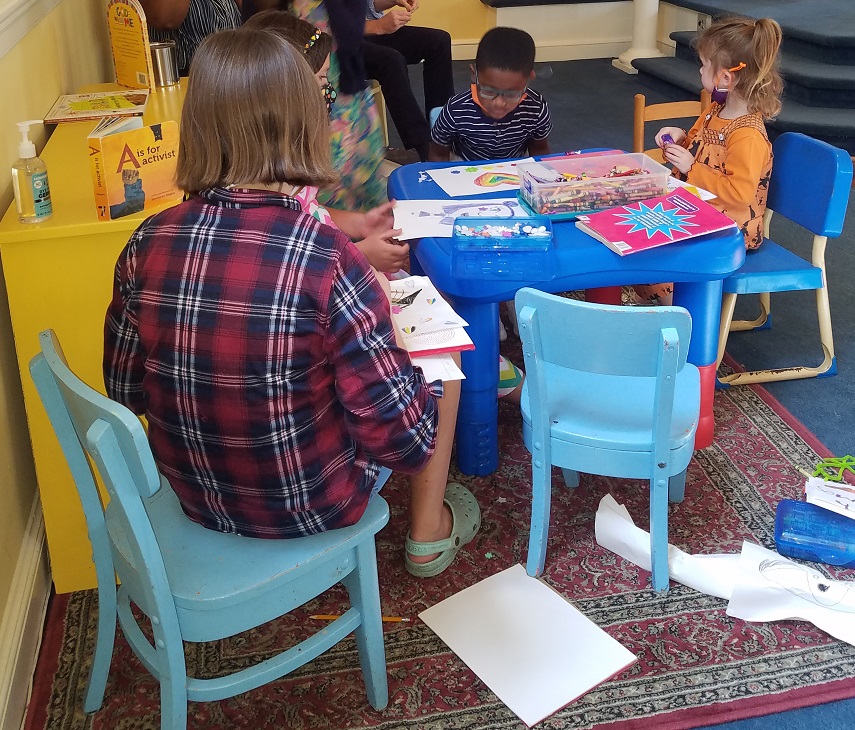
One of the things that makes a difference is regular presence in a worshipping community that not only welcomes them, but also supports their participation and leadership.  By creating a space in our sanctuary especially for children… for kids who might be a little wiggly and need to move around, with chairs and a table that’s just their size, with quiet activities to keep hands busy while ears listen, in a space right up front where little ones can see and hear and be close to what’s happening – we’re saying that children and their grownups are welcome here.  They are not an afterthought.  They are a central part of who we are as a family of Faith!

I know this is going to be a learning process.  We’ll find that some activities work better here than others.  Some kids will be more comfortable here than others – and some parents will too.  There might be a little more movement and noise than we’re used to.  But I trust that the Spirit will be present here, breathing life into this space – as older children mentor younger ones.  As kids feel more welcome in our church.  As we glimpse the kingdom here, breaking forth, right here on Loch Raven.

So will you join me in blessing this space?

Three responses when I raise my hand – please repeat and respond Bless this space, O God; Bless our children, O God; Bless our church, O God.

Bless this space: May it be a place of welcome for our children, where wiggles and giggles are at home and the pencils are always sharp and the crayons exactly the right color. May it inspire deep faith and help us glimpse your kindom.  Bless this space, Bless this space O God.

Bless our children: may they know they are loved, and may they always find welcome here.  Keep them safe, and healthy, enable them to grow in wisdom and stature and joy.  Bless our children: bless our children, O God.

Bless our church: may we be a vibrant witness to the good news of your love to all we meet, and may all people find welcome and be welcome here.  Bless this church, bless this church, O God.

And let all God’s people say: Amen, and amen.

[1] Williams, Miller, “Compassion” in Some Jazz a While, University of Illinois Press: Chicago, 1999, p. 254.

[2] Meyer-Boulton, Matthew, “One Flesh: Salt’s Lectionary Commentary for the Nineteenth Week After Pentecost” The Salt Project blog, 9/28/21, https://www.saltproject.org/progressive-christian-blog/2018/10/3/one-flesh-salts-lectionary-commentary-for-twentieth-week-after-pentecost.

Welcome!

Cat Goodrich
Faith Presbyterian Church, Baltimore, MD
September 19, 2021

Welcome!
Mark 9:30-37

The girl is dressed simply, in a pink and white flounced skirt.  Her shirt is checkered, dirty.  Her long, dark hair is tied back with a single red ribbon.  Her face is stoic, blank, her eyes wide.  Her name is Amal, and she is nine years old, a Syrian refugee who lost both her parents and is making her way from the Turkish-Syrian border to find family in the UK.  Oh, and one more detail: Amal is also over 10 feet tall.

See, Amal is a puppet.  Right now, with the help of four puppeteers and their support team, she is on The Walk: walking across Europe to raise awareness about children who are refugees.[1]  Her name, Amal, means Hope in Arabic.  According to her creators, the Walk is part performance piece, part endurance event, as so called little Amal will walk almost 5000 miles to reach her destination in Manchester.  According to the project’s producer, her message is simple: Don’t forget us.  Remember the millions of children who have been displaced by war and violence, forced to undertake difficult and life-threatening journeys in search of safety.  Along the way, as Amal travels through 8 countries, and countless cities, towns, and villages, people are being asked: how will you welcome her?  With the help of local partners: artists, performers, dancers and musicians, and ordinary folks like you and me – Amal is being welcomed along the way – raising awareness and raising money to support people seeking refuge in Europe and beyond.

What does welcome look like?  What does it smell like, feel like?  Who was the last person you truly welcomed?  Who has welcomed you?

Dary, my husband, manages the chocolate products for Equal Exchange, a fair-trade coffee tea and chocolate company.  He once visited a cocoa co-op in a rural village in the Peruvian jungle.  He had to take a plane within the country, then a boat down a river.  When he and his colleagues disembarked, they hopped into little motorbike taxis called tuktuks, and were zipped down a bumpy dirt road to the regional coop headquarters.  Farmers and their families lined the road, and they were accompanied by a marching band.  When they got to the headquarters, they were welcomed with a program put on by the co-op, with kids doing a choreographed dance to the classic reggaeton hit, Gasolina.

I don’t think I’ve ever received a welcome like that.

In a church in New Haven, Connecticut, a family slept in a library last night.  Their small beds were snug up against the shelves of books, lamps brought in to make it feel homey.  This morning, they got cleaned up with a newly installed shower, the bathroom renovated to accommodate them.  They are just a few of the tens of thousands of Afghan allies who will be making a new home here in the states in the weeks and months ahead.  In hotels around DC.  In Air B&B’s across the country.  Men and women who have in many cases left family members and friends behind, in danger, to make a new way here – some, with only the clothes on their backs.

I can’t imagine it.  But thank God, the outpouring of support has been incredible, and crosses the political spectrum.  Local Lutheran Immigrant and Refugee Services here in Baltimore has received more donations than they have room for.   And that’s a good thing, because as a country, the withdrawal from Afghanistan poses the largest refugee crisis since the Vietnam War.  The last administration worked hard to defund and dismantle our country’s robust refugee resettlement programs, and so to rise to the challenge of the present moment, agencies will be forced to rely more than ever before on nonprofit and volunteer support networks.  Families and communities are opening their homes.  Volunteers are setting up apartments and raising money and donating diapers and clothing and canned goods.  And faith communities are opening their doors… living out God’s welcome for us by opening our arms to welcome others.

Our children started a new curriculum for Christian formation this morning, a series that looks at essential practices of our faith.   The first four weeks, they are learning about Welcome – the Christian practice of hospitality; Welcoming one another and particularly welcoming those who are other is fundamental to who we are as disciples of Christ.  Throughout scripture, we hear a resounding call to welcome one another.  In Exodus, we read, “remember that you were once strangers in the land of Egypt, so you are not to oppress those who are strangers among you.”  In the letter to the Hebrews, “do not neglect to show hospitality to strangers, for by so doing some have entertained angels unawares.”  And here, in the gospel of Mark, “Whoever welcomes one such child in my name welcomes me, and whoever welcomes me welcomes not me but the one who sent me.’

Welcome a child, and you’re welcoming GOD HERSELF!  Now I feel I should remind you that in the ancient world, children did not hold a central place in the household like they do in many families today.  In Biblical times, children were an afterthought, the bottom of the totem pole.  They were to work, to help in the household, and they had no rights, they were subject to the whims and commands of the patriarch – especially girls.

Now picture Jesus, crowded into a house or a family compound with his disciples and other followers, the members of that household, and kids running around with the goats and chickens and whatever else – picture him taking a child, as he is teaching, with tenderness and care, and focusing his attention on the child – saying, welcome this child, the last and the least of the household, and you welcome me, you welcome God.

There have been a few viral stories over the past couple of years about college and graduate students who, in a moment of crisis, find themselves without childcare and have to bring their babies to class.  Instead of barring the babies from their lecture, the professors helped by holding the babies while they taught.  Making room for kids in their classrooms.  Making it okay for students to be human.  Offering what support they can for their learning.

Jesus’ disciples have been quarrelling, trying to best each other arguing about who is the greatest.  But over and over Jesus has taught them, and will show them, that the last will be first in the kingdom of God.  Under God’s reign, the path to greatness lies not with wealth and power but through humility, service, and love.  It is not an easy path.  He is seeking to overturn and flatten the hierarchy that rules the ancient world, to bring outsiders into the fold, to share power, and to find everyone a seat at God’s table.  It is the path that for him leads first to conflict with the priests and scribes, confrontation with the power of Rome, and then to his humiliation, crucifixion, and death.  But still, even in the stunning silence of holy Saturday, even from the darkness of the tomb, God is present, in and through the power of the resurrection, planting hope in our hearts that there is another way.  A way of love.  A way of peace.  A way of Welcome.

We begin each service of worship here at Faith with some pretty specific words of welcome.  I believe it’s important to be clear in our welcome because the church universal’s track record of hospitality is not great.  Too often churches have defined themselves by what they are not, by exclusion, instead of affirming the truth that we are all reflections of God’s image, each person worthy of belonging in God’s house.  How do we make our welcome known?  By knowing each other and greeting each other by name.  By making space for newcomers, inviting all into leadership and having a session, committees, and deacons who reflect the beautiful diversity of the congregation. By sharing one another’s burdens, and by sharing food and drink together.

Little Amal set off from Gazientep, Turkey in July, with a parade of handmade lanterns lighting her way through the dark city.  She has been welcomed by children waving giant flowers, by choirs and marching bands.  In Chios, Greece, an orchestra played as she made her way off the boat, a drum line danced her through the city, and she was given gifts in the town center.

In the aftermath of civil war in Syria, the US wars in Afghanistan and Iraq, and violence in Central America, Myanmar, Ethiopia, and elsewhere, there are more displaced people in the world than ever before in human history.  Over half of refugees are children, and over half of child refugees do not have access to any kind of formal lessons or schooling.  This is the tragedy on which Little Amal is seeking to shine a spotlight.  Her journey has not been without controversy – in Greece, there were protests.  A town council voted to bar her from passing through, out of fear that the performance would draw even more refugees to their overburdened community.[2]  But for the most part, people have delighted in welcoming her.  In Italy, marimbas played and young people danced in the street, there was a huge parade through Vatican City.  The Cardinal in charge of the Catholic church’s office of migrants and refugees came out for the festivities, saying, “we have to meet each other.”[3]  It is part of our faith, part of being human: To welcome one another as we have been welcomed.

Our patterns of hospitality have been upended by the pandemic – we may never shake hands freely again.  Sharing food and drink has become something we do cautiously, carefully.  Forget hugging and kissing cheeks!  But the global health crisis makes the calling to welcome others, the work of hospitality more important than ever.  As we leave this place, I wonder – where and in whom will we encounter God in the days ahead?  I pray that we when we do, we will make them welcome.

[1] https://www.walkwithamal.org/the-journey/

[2] Kitsantonis, Nikki, and Alex Marshall, “Giant Puppet Ruffles Some Feathers on Long Walk Through Greece,” The New York Times, 8/27/21, https://www.nytimes.com/2021/08/27/world/europe/greece-syria-refugees-puppet.html

[3] Bloomberg Quicktake: Now on YouTube, “Giant Refugee Puppet ‘Little Amal’ Visits Vatican on Journey to U.K.” 9/10/21, https://youtu.be/UQAbwxR958Y

God’s Green Earth: Sabbath

Cat Goodrich
Faith Presbyterian Church, Baltimore, MD
September 12, 2021

God’s Green Earth: Sabbath
Genesis 1:31a, 2:1-3; Mark 2:23-28

Every day for the past week and a half has begun with absolute haste in my house.  See, Maddie started school a week ago last Tuesday, and second graders must arrive by 8 am.  Ordinarily, I imagine a family might be a bit rusty at organizing the morning routine after a few months of summer vacation.  But we are forming a new routine after a year and a half of pandemic!  Pandemic which began with lockdowns and no school, then shifted to online learning – zoom school which started around 9, when the technology was all working properly.  We could be eating breakfast at 8:56 and still make it on time.  So the mad rush to get out the door at 7:30 sharp to navigate our way to school is new… and feels a little hectic.

All that to say it is a peculiar time for me to be thinking about Sabbath, and maybe it is for you, too.  Then again, it may be the perfect time for us to think about Sabbath.  As school ramps up and fall sports begin – go Ravens (did I do that right?)!  As the city continues to cautiously move toward reopening and my fall calendar fills up – it may be the right time to ask, “what is Sabbath for us?”  What does it mean for you?  How can we practice it this fall?

The story of creation in Genesis tells us that after the work of making the universe, God rested.  Some scholars say God rested not because God needed to, but to give us an example that could be a model for our lives – God rested because we need to.  We can’t work day in and day out without stopping, without making time to sleep and eat and relax, without space for what feeds and restores us.  Not just humans, but nature needs rest and restoration, too – We see it in the cycle of the seasons: the frenzied flowering of spring and lush harvest of summer give way to the cooler, dormant months of fall and winter.  Fields must lie fallow, crops must rotate or risk sucking all of the productivity out of the land.  Rest helps creation be more productive.

In Deuteronomy, the commandment to remember the sabbath day and keep it holy is not only a commandment to rest, but a reminder of God’s work of liberation.  While enslaved in Egypt, Israelites were worked relentlessly, perpetually, with no time off for themselves, their families; once freed, God commands that they have a day to rest, be restored, and remember.  In the spirit of Deuteronomy, Sabbath frees us: frees us from exhaustion and overwork, frees us to delight in the goodness of creation, to forge community connections, and to reconnect with our creator.

In the story Patrick read from the gospel of Mark, we hear Jesus challenge and reinterpret traditional notions of Sabbath.  Jewish law strictly forbids any kind of work on the Sabbath.  The disciples plucking grains of wheat from the field, was considered harvesting – not appropriate Sabbath behavior, and so the religious leaders disapprove.  But should hungry people not gather food to eat?  Should sick people not be healed?  Should we pay attention to the letter or the spirit of the law?  Jesus says, the Sabbath was made for humankind, and not humankind for the sabbath.  I take that to mean, our practice of Sabbath should not be punitive.  Sabbath activities should be things that nourish and restore us.

My understanding of Sabbath was challenged and expanded by a couple in my church in Birmingham, Jeanne and John Plaxco.  John was a PK, his dad a minister in the Dutch reformed church.  When he was growing up, Sunday was for going to church, and spending time with family.  Likewise, when Jeanne and John’s children Jack and Margaret were young, they couldn’t go to the movies or football games on Sundays – the activities were limited to church, food, and family.  My first year in Birmingham, I helped the deacons plan a service Sunday, organizing work projects around the church and at member’s homes on a Sunday afternoon.  When I told the Plaxcos about the day and asked if they were planning to participate, Jeanne’s eyes got wide and her mouth got small.  She gave me a little smile and said, “on a Sunday?!  Service work on a Sunday?!”  Here I was, a minister, encouraging the church to plan a workday on the sabbath.  In her own, gentle way, Jeanne let me know this was highly unusual.

But is it, really?  Not anymore.  Many of you I’m sure grew up in households where Sunday activities were restricted to church and family.  But not all.  Our concept of time, and work, are completely different from ancient Israelites living in an agrarian culture thousands of years ago.  And they’ve changed significantly since the 1950’s and ‘60’s too, thanks be to God.  These days, there are a few cultural dynamics that are challenging my idea of Sabbath – the increase of people with no religious affiliation at all makes Sunday a day for brunch or soccer tournaments.

Living in a multi-faith world means Sabbath for me looks different than Sabbath for my Jewish, Muslim, or Buddhist friends and colleagues.  With the rise of the gig economy, and more and more people working multiple jobs to make ends meet, it has become an unattainable luxury to be able to actually take time off for sabbath whatever your faith or lack thereof.

One impact of pandemic pushing church online means that we can access worship from almost anywhere, watch recordings anytime.  It makes me wonder – how do we practice Sabbath here and now?

At the end of the work of creation, God pauses and notices that everything God made is good, very good.  Sabbath begins with a pause, with noticing the good that is around and within us, and acknowledging that the good comes from God.

Maybe for you, that pause comes each morning when you wake up, or over your morning coffee.  Maybe it also comes each evening, at the close of day.  Whenever we stop to remember that we are part of something more than just ourselves.  Casper ter Huile, a consultant with the Sacred Design Lab, puts it like this: making “space in our days to feel fully big and fully small.”[1] For us, clearly, this pause happens on Sundays, when we set aside time to be together, to worship, pray, and sing praise, to connect, and grow in our faith, and be challenged to live it out when we leave this place.  And we do it again and again and again.

We humans make meaning through ritual.  Ritual isn’t something we just do once and are done with it.  Ritual becomes embodied, it forms us as we do it over and over again, training our bodies to know what it feels like to be held by community. Building our muscle memory as we are fed with the bread of life at Christ’s table.  And to rest in the mystery and wonder of God.

I know a pastor who talks about breathing in and breathing out God’s love. That’s as good a definition of Sabbath as I can think of.  A time when we stop to notice the goodness of creation.  When we are nourished by the Word of God and renewed by the Spirit.  A time to remember who and whose we are.  And a place and community where we find ways to share our gifts, our love, God’s love with others.

So this fall, I hope we will make space to practice Sabbath together.  To commit to pause together.  To breathe in and breathe out God’s love… together.

One last thing… John and Jeanne came to the service Sunday.  This is what they did: they stood in the sanctuary and they vacuumed the pew cushions, all 119 of them.  It took more than two hours, as they slowly and methodically made their way up and down the aisles.  I don’t think they even took a break.  We laughed together about my call to work on the Sabbath – but a job needed to be done, and so they did it, breathing out God’s love, serving together on a Sunday because they loved the church. Thanks be to God.

[1] Ter Huile, Casper and Angie Thurston, “How We Work: Beyond” Sacred Design Lab, https://sacred.design/how-we-work

Bless This Mess: Saul of Tarsus

Cat Goodrich
Faith Presbyterian Church, Baltimore, MD
July 25, 2021

Bless This Mess: Saul of Tarsus
Acts 9:1-22

Next Sunday will be one year since I started my ministry here at Faith Church, thanks be to God!  You do not know this, but I feel like it is a small miracle that in all this time, I have resisted using the TV show The Wire as an example in a sermon here in Baltimore.  I feel like I may need a prize of some sort.  A full year!  Such a great show, but maybe a little too close to home here.  The Wire, as I’m sure you know, aired on HBO and was written by David Simon, who started out as a journalist with the Baltimore Sun.[1]  It grew out of a book he wrote after a year of shadowing the Baltimore City Police Department. One of my favorite characters in the Wire was not detective McNulty, not kingpin Stringer Bell… it was Bubbles.[2]  Bubbles was a heroin addict, convincingly played by Andre Royo, struggling toward recovery throughout the show.  We meet him initially because he’s working as an informant for the police, helping the detectives of Major Crimes keep track of dealers.  He’s a likeable guy, funny, always scheming, looking for his next fix.  The Wire ran for six seasons, and in that time Bubbles is often clearly trying to do better, but time and again he makes a mess of things, mistake after mistake – Simon calls the addicts he writes about “at war with themselves.” The question for viewers is: can he change?  Can he overcome his addiction, and become the good guy we see he can be?  This is, of course, a key question for anyone struggling with addiction, for anyone who loves someone who is.  Can people change?

This is, of course, Ananias’s question, too.  Ananias is just an ordinary disciple in Damascus, minding his own business, when God wakes him up in the middle of the night with a vision too crazy to believe – God shows Ananias that he must go lay hands on a man named Saul so that Saul can regain his sight.  Ananias thinks – “Saul of Tarsus?  That guy?  That guy hates Christians!  You want me to go find HIM?  God, you’ve gotta be kidding me.  Why would I want to do something like that?  There’s no WAY he can change.  What a mess.”

I understand Ananias’s hesitation.  I mean, this is Saul, who we know as Paul.  He was a zealot.  In Paul’s own words, he was “…a member of the people of Israel, of the tribe of Benjamin, a Hebrew born of Hebrews, as to the law, a Pharisee; as to zeal, a persecutor of the church; as to righteousness under the law, blameless.”[3]

Blameless, that is, according to Jewish law.  But if you were a Christ believer, watch out.  When Saul first appears earlier in Acts, he is tracking down Christians and turning them over to the authorities to be put in prison, searching house after house after house – the people he caught were as good as dead.  When a mob went to stone the apostle Stephen, Saul was the guy who stood by and watched their coats.  That guy was not cool.  A hater, if there ever was one.

So what Ananias wants to know, is can people change?  Can they?  Can you, can I?  Can Bubbles?  Can Saul?

You may know that the earliest writings in the New Testament are not the Gospels.  Mark, Matthew, Luke, and John – they were writing at least 40-50 years after the death of Jesus.  The earliest writings in the New Testament are the letters of the apostle Paul – the letters Paul wrote to the house churches all over the Mediterranean, churches that he mostly helped to start.  The bulk of the New Testament comes from Paul.  He was likely a contemporary of Jesus’s, maybe a few years younger.  And he was devoting his life to targeting and stopping Jesus’s disciples.  So what happened to turn this hater, this persecutor of the church, Saul of Tarsus, into Paul the apostle who ignited the early church and spread the good news everywhere he went?

This happened.  An mysterious encounter on the road to Damascus left Paul blinded: a flash of light, a voice from heaven, and he is struck down in the road.  For three days he cannot see, cannot eat, cannot do anything except pray and think about his life and all the people he’s hurt and the mistakes he’s made… all the evil he has done to the saints in Jerusalem. Then Ananias comes and lays hands on Saul, healing his blindness and helping him see clearly that Jesus was the messiah he’d been waiting for, the most full revelation of God on earth.

I wish God always worked like this.

I wish that every time I was on the wrong path, or at a crossroads facing a difficult decision, there would be a blinding flash of light from heaven and a booming disembodied voice would offer guidance.  A message from God doesn’t have to be complicated… it could be a holy post-it note, a phone call in the middle of the night – I’d even settle for an email.  Wouldn’t you?  I wish it could be that easy.  That clear.  But for most of us, that’s not how it works.

For most of us, discernment, choice, and change happen gradually, quietly.  When we’re on the wrong path, or at a crossroads, we figure out what to do by listening to the quiet voice inside, by talking with those we know and trust, and hearing the wisdom of our community – all of us who are trying together to love God and do better.  And change is a daily choice, the building up of muscle memory over time to create new pathways in our brains to override the old ones.  Change takes time.  It’s not something we can easily do on our own.

What would have happened to Saul if Ananias had refused to go?  Had said, “no way, God, that guy’s a hater, he can stay blind for all I care.”  Ananias’s help, his willingness to trust God and go to someone who had been his enemy, allowed Saul to see again.  Ananias’s trust in God jump started Saul’s witness to Jesus as Lord in Damascus and beyond.  It wasn’t just the two of them.  Ananias helped connect Saul to a community that would give direction and meaning to his life.  As New Testament scholar Peter Berger said, “Saul became Paul in a moment of religious ecstasy, but Paul could remain Paul only in the context of Christian community.”[4]

We all need community to be able to sustain change.  It’s one reason why groups like CrossFit and Weight Watchers and AA are popular – they create communities of support and accountability when people are trying to make real changes in their lives.  The same could be said for church – or should be.

Earlier this week, Karen Meyers and I went to a BUILD meeting – the first large, in-person gathering for BUILD – that’s Baltimoreans United in Leadership Development – since the start of the pandemic.  The meeting was held outside of a school, in a field in southwest Baltimore.  Karen, God bless her, helped me find the place.  And I was worn out when I got there, but I was so glad I went – because folks from all over the city were there, from North and South and East and West, Black, white, and Latino.  All sharing what we are most concerned about in our communities.  As the sun set and the full moon rose, one of the pastor leaders of the organization, George Hopkins of SoWeBo community church, asked, what do we believe is possible for our city?  Can Baltimore change?  Can we make that happen?

Can a city change?

BUILD’s belief, obviously, is that our city can change, and it has, and it will again, through the power of people organized to call on and stand up to our elected officials and demand it.  In the next few months, leaders said, the city will receive more than $600 million dollars in Covid relief and infrastructure funding.  The state is getting more than $3.5 billion.  A lot of people are wondering, how will that money be spent?  Will it go to our neighborhoods that are struggling, to our schools that don’t have safe water to drink or working heat and a/c?  Will it help create a city that’s safe, with affordable housing, and functioning transit, and meaningful jobs?  Will it support the kids in Woodbourne-McCabe whose families are facing eviction? What do you think?  Where would you like to see it go?

BUILD called the churches and synagogues and community groups that were there to listen more deeply, more intentionally to our people, and to talk with our neighbors- to hear what keeps them up at night, what they care enough about to take action, and where they’d like to see that money invested.  So I wonder… what keeps you up at night?  What do YOU care enough about to do something about?  Where would YOU like to see that money invested?  Let’s talk about it, and listen to each other, and see what our shared interests are.  I’d like to invite you to stay after worship one Sunday in August, August 29, to have lunch together, to talk, and to listen.  Because I believe that people can change.  The core of our faith is that by God’s grace, we find redemption, transformation, resurrection – new life.  And I believe that this city can change.  And I think you probably do, too.

Thinking back to Bubbles… he was a deeply flawed character, who witnessed again and again the tragic consequences of addiction and life on the street.  After the death of his closest friend, he renewed his efforts to overcome his addiction, joining NA and getting a sponsor.  His sponsor encouraged him to find a way to give back, to find something outside of himself to care about, so Bubbles starts volunteering at a Catholic Worker House soup kitchen – styled on Viva House here in Baltimore.  And somehow, with the support of that community, he manages to stay sober.

I’m guessing there are a lot of people who’ve found similar refuge there.  Who, with the support of a community, discover that change is possible.  Change for themselves.  Change for others.  Maybe you’ve experienced change, too.  Maybe we will.  Maybe our city will, too.  Redemption.  Renewal.  Resurrection – new life!  Thanks be to God.


[1] I drew from Wikipedia’s article on David Simon for this summary, https://en.wikipedia.org/wiki/David_Simon

[2] I refreshed my memory about this character from Wikipedia’s article about him, https://en.wikipedia.org/wiki/Bubbles_(The_Wire)

[3] Philippians 3:5-6, NRSV

[4] Berger, Peter, qtd. by Marcus Borg and John Dominic Crossan in The First Paul: Reclaiming the Radical Visionary Behind the Church’s Conservative Icon, HarperCollins: New York, 2009, p 18.

Bless This Mess: Shiphrah and Puah

Cat Goodrich
Faith Presbyterian Church, Baltimore, MD
June 27, 2021

Bless This Mess: Shiphrah and Puah
Exodus 1:8-20

I just learned something amazing that I need to tell you about.  I heard it on the Radiolab podcast, which I love, though I should have known it already.[1]  Have you ever wondered how a baby breathes before it is born?  Its little lungs are developing, it’s floating in the amniotic fluid, it clearly can’t breathe air – so how does it get oxygen?  Through its umbilical cord!  All the oxygen a growing fetus needs comes from its mother!  Blood oxygenated in its mother’s lungs, is pushed by its mother’s heart down into the placenta, and through the cord, into what will become the baby’s belly button!  There’s a large vein that runs from the belly button to the baby’s developing heart, and the vein carries the oxygenated blood from the mom there.  And in my heart, and in yours, the two sides are separated.  Right side, left side.  The right side of the heart gets all of the blue, depleted blood from the body and pushes it into our lungs, where it absorbs oxygen and drops off carbon dioxide, so we can breathe it out.  Then the red, oxygenated blood flows to the Left side of our hearts, where it’s pushed back out to the rest of our bodies, carrying oxygen to our brains, our arms, our legs, our toes.  And it goes like that, pulsing through our bodies for as long as we live.

But a developing baby’s heart is different.  Before a baby is born, there’s a little opening in their heart, a trap door between the left and right sides.  The oxygenated blood from the mom and the depleted blood from the baby’s body mix together, and get swooshed around the baby’s body.  Some goes back out through the vein and cord and placenta to the mom’s body, to her lungs, where she breathes out the carbon dioxide from not just her body but from her baby’s body, too.  And again and again.

Isn’t that amazing?  But if that’s how it works, how does a baby go from inside, out?  What happens when the baby is born, and moves from breathing through its umbilical cord to breathing on its own?  From its lungs developing in the warm sea of amniotic fluid, to taking in the bright, dry air?

The magic happens during labor, when the mom’s body is contracting and pushing and opening to prepare to give birth.  As the baby moves down the birth canal, the contractions squish and squeeze its body, smooshing and pushing the water out of its lungs.  And as soon as the baby is born, into the world, the shock of the cold air hits its skin, and causes the baby to gasp, to take a big breath in.  That first gasp, and the cries that follow it, start a chain of events in its body.  The lungs inflate.  The brain sends a signal to its heart, and the door slams shut, closing off the two sides of its heart, so that the rich oxygenated blood coming from the baby’s lungs gets pumped to the rest of its body, and the depleted blood gets pushed back to the lungs – just like that, within the first few seconds of being born.  The umbilical cord has already started to close up, the connection through the placenta closes off, and we, each one of us, has learned to breathe.  And we keep breathing, in and out, for the rest of our lives.

When both of my girls were born, I remember laughing with relief and amazement as they took their first breaths and immediately began to wail, with such tiny intensity, as only a newborn can wail.  Tiny, ferocious cries, shocked and furious at the bright, cold world.  So beautiful, so LOUD, so full of life!

I’ve often wondered about the midwives and doulas, the obs and nurses who get to see this miracle over and over again.  Does it change them to see life emerge again and again?  Do they become inured to it?  Is it always a miracle?

Surely the experience of attending many births inspires a profound respect for the sanctity of life. I have to guess that was what motivated Shiphrah and Puah to defy the order of the Pharoah.  Because rule of the Pharoah was absolute.  He who would order the mass murder of infants would not hesitate to sacrifice two women who disobeyed him.  But they defied him anyway.  I can imagine their hands, strong hands that had caught countless babies, gently guiding new life into the world, suddenly clenched into fists as they steeled their courage and got their stories straight.  They couldn’t kill the boy babies.  They wouldn’t.  They would have to take a deep breath and lie, that’s all there was to it.  They would clasp hands and face him together, stand up to him together.  Pharoah was just a man, after all.  He might not know how unlikely it was for a woman to give birth alone.

There’s some debate about who these women were.  Were they Egyptians charged with helping the enslaved Israelites give birth?  Were they Israelites themselves, trained as midwives for their community?  It’s hard to say.  But they were women, so their power was limited.  The risk was extreme.  And still, they dared to defy the most powerful man in the country.  They did what they could, using their hands and hearts to protect the vulnerable.  And look at the ripple effect: their courage inspired others, which ultimately saved Moses, who went on to save his people.

Last year, in the desperate weeks after George Floyd was killed, a friend shared a list outlining methods of nonviolent protest and persuasion[2].  If you’d asked me to name them, I could have come up with a few: boycotts, petitions, picket lines.  Sit-ins, public art, protest marches.  Blocking traffic. Prayer vigils.  I’m sure you could name others.  But this list – it was long.  Almost 200 items, everything from strikes and walk-outs to creating alternative trade systems.  There are countless nonviolent ways to resist the dehumanizing forces that seek to shape our world.  Countless ways to say NO to Pharoah.  And some say acts of political defiance have their roots in this story – in the resistance of Shiphrah and Puah, two women, two midwives, saying NO.  We will not do it.  We will not kill the boy babies.  Our hands were made to bring forth life, to guide babies into the world, to save, not to kill.  To carefully clean the vernix and blood from noses and mouths so babies can breathe freely, to swaddle their tiny bodies and keep them safe, and warm.  Our hands were made for life, not for death.

I have to guess that they were terrified to defy Pharoah in this way.  Surely their voices shook and their palms were sweaty as they stood in his throne room to say, it’s impossible – the Hebrew women give birth too soon, before we get there.  Surely the midwives were afraid.  But they did it anyway.

That is the definition of courage, isn’t it?  To be afraid, but to do it anyway?

Tomorrow marks the 52nd anniversary of the uprising at the Stonewall Inn[3], a gay bar in New York, that fateful night that sparked a revolution of LGBTQ rights and gave birth to gay pride.  Regular, humiliating raids on nightclubs in the late 60’s pushed the community over the edge. And so, for five nights in the Village, men, women, trans and nonbinary folk resisted the violence of billy clubs with a can-can kick line, refusing to hide who they were, refusing to back down.  Instead, they took a deep breath, and clasped hands together and proudly went out, into the streets.  And after years of organizing, and resisting discrimination again and again – six years and one day ago, the Supreme Court finally made it legal for two people who love each other to marry regardless of their gender.  And the fight continues for trans and non-binary folx.

Just over a year ago, George Floyd’s cries of “I can’t breathe” caused us to gasp with shock and desperation, to clench our fists and move out to the street, to resist state violence and advocate for change.  To say no to policies and practices that lead to death, to use our hands, our hearts, our voices to proclaim that Black Lives Matter, and to work together to reform how we keep our communities, our people safe.

So if the pressure these days feels like too much to bear…  if the news or your work or family is just pushing and squeezing and bearing down on you until you feel wrung out… or it causes you to gasp and cry out in shock.  Remember your heart was formed for this life by the shock of a world so cold it caused you to gasp.  Remember Shiphrah and Puah.  Remember that God gives us to each other, and calls us into community so that we can take a deep breath together and say, enough is enough.  Remember all the times people of courage and faith have held hands and joined together in the sacred struggle for justice in this world.  So that we might stand together and channel the courage of those midwives, to resist the hatred of Pharoah, to use our hands, and our hearts to change the world.

[1] McEwan, Annie and Matt Kielty, “Breath,” Radiolab podcast, story produced by Annie McEwan, Matt Kielty, and Molly Webster at WNYC Studios, 6/11/21, https://www.wnycstudios.org/podcasts/radiolab/articles/breath

[2] “The Methods of Nonviolent Protest and Persuasion” post by Julia Siergiey Juarez on 6/2/20, shared by Kelsey McClure in the Faith in Action Alabama Facebook group on 6/2/20,  https://www.facebook.com/groups/210845526087728/posts/862975674208040

[3] Info largely derived from article on Stonewall Riots, Wikipedia, https://en.wikipedia.org/wiki/Stonewall_riots