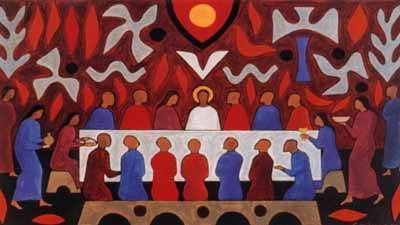
The Adversary Matthew 4:1-11

Cat Goodrich
Faith Presbyterian Church, Baltimore, MD
February 24, 2023

The Adversary
Matthew 4:1-11

Just over a decade ago, I spent a week working in a garden on the Isle of Mull, off the coast of Scotland in the Hebrides.  The garden was a windswept hill overlooking the sea – on an inlet of granite rocks reaching down into the water.  The place was once an old granite quarry, but it had been turned into Camas, an outdoors center for troubled teens and pilgrims making their way to Iona, a short ferry ride away.  The garden would produce most of the food needed by the camp once it got growing, but as it was early spring, everything had to be brought in from outside – by wheelbarrow pushed over a mile and a half of track laid over beautiful Scottish bog.

Teams took turns cooking meals and washing up, and we were instructed to be careful and frugal with what we made – everything needed to be eaten, nothing wasted.  It was the director’s job to bake the bread that accompanied most dinners.  Eager to be helpful, I offered to bake a no-knead loaf I’d been perfecting that year – my entre into bread.  “No-knead?” he scoffed at me.  “no way.  It won’t be as good.  Good bread takes time – you have to show it some love.  It needs attention.  You’ve got to knead it.”

I didn’t bake the bread.  I know now that even more than kneading, he was right: good bread takes time – and, some attention is a good thing.  The bread that comes from the supermarket, sliced and bagged for sandwiches is easy enough, but it’s completely different from bread baked at home.  It has more in common with a sponge, really.  It might be called wonderbread but it’s pretty far from wonderful.

Is this what Jesus is thinking when he refuses the tempter’s invitation to turn stones into bread?  That a miracle would be too easy?  Just turn the stones to bread? Jesus scoffs.  No way.  Takes the joy out of it.  Good bread takes time, you’ve got to show it some love and really knead it if you want it to be good.  You can take a shortcut to satisfy your hunger, sure – stop at McDonald’s or pick up the Wonderbread – but it won’t be very good for you.  It won’t be delicious.  It won’t be as meaningful as a meal prepared from scratch and shared around the table.

“Stones into bread?  No way,” Jesus says.  We live by the word that gathers us round the table together to eat and celebrate in good company – meals that feed our hearts while filling our bellies, meals that help us remember who and whose we are.

Here at the beginning of Lent, each year we remember this story of Jesus in the wilderness.  These forty days without food, wrestling with temptation, prepare Jesus for ministry – just as forty years in the wilderness prepared and formed the people of Israel from disparate tribes and families enslaved in Egypt into a single nation who trusted in God.  This season gives us, too, forty days to prepare.  Forty days to wrestle with what separates us from each other and from God.  Forty days through which to journey with Christ to Jerusalem, to prepare our hearts and minds for what will happen to him there.

Scripture tells us that after he is baptized by John in the Jordan, with his robes still dripping wet, the Spirit leads Christ out into the desert, where he fasts and prays.  This is a vision quest.  A ritual of purification.  A rite of passage to prepare him for the work ahead.

In his baptism, Jesus hears God claim him as a beloved son.  When the tempter shows up, he questions that identity, saying, “if you are really the son of God, prove it.” Evil tempts Jesus to use his power selfishly by turning stone to bread; to test God by throwing himself off the temple; and to forsake God altogether by seeking earthly power instead of the keys to the kingdom of heaven.

The temptations of the adversary are pernicious.  They would make Jesus settle for small power, self-serving power, power that would satisfy his own immediate needs and ego.  These temptations would make Jesus miss the bigger, selfless, all-encompassing work God was calling him to.  Jesus and his followers were meant to feed the world, not just ourselves – and he goes on to feed five thousand with just a few loaves and fishes.  His ministry was intended to confront and challenge the forces of evil in the world, not to capitulate to them.  He goes on to proclaim that the reign of God had come near in him, to cast out demons and heal brokenness wherever he found it.   And though he would not throw himself from the spire of the temple, he will eventually go willingly to his death, to reveal the truth that violence will never save us, and love always will.

I admit have a hard time with this story, because its depiction of evil personified as the tempter, the adversary, is outside of my experience of sin in the world.  Evil is real – the devil, not so much.  Plenty of people have opened my eyes to their experience of him, though.  In my last call, I shared communion and studied the Bible with women at a shelter each month.  Many of them were survivors of abuse, who wrestled with addiction, and were dealing with the consequences.  Some of them were not that different from me, people who had been dealt a bad hand.  Most of the time, our theologies were very different, but those women taught me more about the adversary than my theology classes ever did.

Living close to the line, every day felt like a battle – the intersecting forces of poverty and racism, addiction and misogyny were not only real, they were personified.  From their perspective, it was the evil doer who was hard at work, opposing them, keeping them from getting ahead.  The adversary made it so that no bus lines ran near the only apartment they could afford, so they couldn’t have a home and make it to their job, so they wouldn’t be able to see their kids again this month.

Though I’m well acquainted with the reality of evil in the world, I’ve never felt it was personally fighting against me and my well-being – but I’ve always had the privilege of housing, and stability, mental health, and employment.  For me, the experience of evil and brokenness is expansive – The way discrimination and white supremacy have been baked into our economic, health, housing, criminal justice, and education systems.  How retributive violence and war seem like a foregone conclusion instead of forgiveness and grace and reconciliation.

But Lent is an invitation to consider evil – that is, all which opposes the will of God for love, peace, and wholeness – as intensely personal as well.  All that is within us that is complicit and complacent with the world as it is, instead of committed to creating the world as we know it should be.  The parts in us that are impatient, unkind, selfish, greedy.  Those tendencies are within us.  We know they are.  And these days of Lent are a chance to reflect on those shortcomings, that inner and outer brokenness, and to recommit ourselves to being the people God would have us be, following Christ in living lives of love and justice.

This season of Lent is an opportunity to remember who we are and to whom we belong.  A chance to deepen our commitment to God by practicing our faith – not by taking shortcuts, but by feasting on the word that truly nourishes us – baking and sharing the bread of life with one another and the world.


The Lighthouse Matthew 17

Cat Goodrich
Faith Presbyterian Church, Baltimore, MD
February 19, 2023

The Lighthouse
Matthew 17

A couple of summers ago, Dary, the girls and I visited the Owl’s Head lighthouse on the Maine coast, near Rockland.  We brought sandwiches and ate them on a picnic blanket in the grass, and the girls clamored around on the giant rocks that made up the shoreline on an inlet nearby.  Once we’d eaten, we climbed a long set of steps to go up to the lighthouse.  It’s not a tall building; a quaint, white brick structure situated on a high bluff overlooking Penobscot Bay.

Inside the lighthouse, a winding staircase, dark and steep, led us up into the light room at the top that held the giant lens – windows all around, of course, and a tremendous view of the sea, rocks jutting out into the water, waves crashing down below.  It must have been July when we were there, because what I remember most was the HEAT – even with a breeze through the open windows – the light reflected and refracted by the lenses was intense, heating the air and shining everywhere you looked, impossible to avoid, bright and HOT.  There is a metal walkway outside all around the room at the top of the light, and I stepped outside and leaned over the railing and breathed the fresh salt air, looking out at the brilliant blue choppy sea, and I can’t really explain it, but I just was overcome with something like awe: amazement at the beauty of the ocean, and gratitude for the devoted men and women who had kept the light burning for so long – since the lighthouse was established in 1825.  The house wasn’t electrified until 1989, so for more than 150 years, a gas flame was tended through short hot summers and long, lonely winters.  How many lives had they saved?  How many ships had they safely steered through the rough waves and treacherous waters?  How many long, impossibly hot summer days and nights had they ensured that the flame continued to shine?

I can’t help but think about that lighthouse when I read this transfiguration story.  Bright, hot, impossible to miss – a beacon shining forth for all to see.  This is the vision of Jesus.  The rational part of my brain is tempted to explain this story somehow, make it make sense, or be more palatable for us 21st century Christians.  But I don’t really think that’s what we’re meant to do here. This story is important – all three synoptic gospels include it – and we revisit it in one form or another each year the Sunday before the season of Lent begins.  But why?  This vision is miraculous, mysterious, far outside our realm of understanding and belief.  Why is it central to the story of our faith?  What difference does it make for us?

Look around.  This Sunday we stand on the mountaintop together, looking ahead down the path into the valley.  In the weeks to come, we will travel with Jesus and the disciples down from the mountain, making our way through Lent with him along the road to Jerusalem, where danger and death await.  This vision is meant to give us a glimpse of who he really is, to reassure us that the terrible things to come will not be his undoing.

Seeing Jesus’ transformation, Peter, James, and John should have no doubt about who he is: the brilliant radiance of God in human form.  And yet, they seem to have a hard time believing it.  I would, wouldn’t you?  In fact, they’re terrified: the brothers cower on the ground and hide their faces – Peter on the other hand is awestruck – he proposes a building project, perhaps wanting to designate that mountaintop as holy ground.  As if we need an altar to do that.

The word transfiguration itself means a complete change in form or appearance – Jesus the man, transformed into a shining deity.  The message is clear: Christ is both human and holy, divine.  But I don’t know if the disciples are able to comprehend what that means… if having been shown his true identity, shining forth bright and hot, they know what to make of their friend and his teachings.  I wonder, once the vision goes away and the disciples head back down the mountain, what changes for them, having seen this – having heard the voice of God call their friend beloved, and calling them to listen to him.   How does a mountaintop experience – change us?

Mountains are places of mystical encounters – where truth is revealed and perspective is gained.  Moses met God on the mountain, and received rules for living.  The commandments for covenant community.  A mountaintop experience can change how we see the world and our place in it.  The overarching emotion of a mountaintop experience is AWE – “Awe is the feeling of being in the presence of something vast that transcends your understanding of the world,” according to a UC Berkley scientist.

Buddhist teacher “Sharon Salzberg defines awe as “the absence of self-preoccupation.”  Moments of awe get us out of our own heads by right-sizing us, helping us “realize our place” in the grand scheme of things.  Awesome feelings help regulate our emotions, deepen our breathing, stimulate the vagal cells around our brainstem.  Awe is good for us! It reconnects us with what is true and gives us new energy with which to go about our work in the valley.

Seeing Jesus shining on the mountain, I can’t help but remember him saying “You are the light of the world,” and his instruction for us to shine our light for all to see.  Bright, and hot.  Impossible to miss.  I remember what one of our bible study folks said as we engaged that text a few weeks ago – her take away was that we should all just let our light shine!  By being ourselves, contributing whatever it is that WE do best.

And so maybe our takeaway from the transfiguration today could be this – 1) embrace awe as a spiritual practice.  Seek it out.  Take the unknown path, make space to encounter that which we cannot explain, beauty that takes our breath away – this is part of the preparation that strengthens us for the journey ahead.  Awe builds our emotional endurance, and it is something we can find when we slow down and take time to notice the world around us with fresh eyes.

2) Christ, who shone like a beacon, hot and bright like a lighthouse guiding ships safely to shore – calls us to shine our light, too.  To be our awesome selves, to contribute whatever it is that makes us come alive, to further his work of peace, love, and justice in our world.  Trust that when you offer what you can, the spark in you glows more brightly.  Shining forth for all to see.  God tells us to listen to him – do not be afraid!  Shine!

We can’t stay on the mountain.  Just like the disciples, we’ve got to go back down, back into the fray.  Peter, James, and John were heading with Jesus towards Jerusalem, into conflict and condemnation, suffering and death, disappointment and grief.  And we are heading out into a broken world with our own faults and frailties, our worries, shame, and doubt.  But awe quiets the voice within, puts our worries in perspective and helps us hear the voice of the one who made us, whose love is strong enough to sustain us through whatever may come – you are beloved.  Let your light shine!  Do not be afraid!


Good Things Come to Those Who Wait? Micah 6:1-8, Matthew 5:1-12

Cat Goodrich
Faith Presbyterian Church, Baltimore, MD
January 29, 2022

Good Things Come to Those Who Wait?
Micah 6:1-8, Matthew 5:1-12

About fifty years ago, a psychologist at Stanford named Dr. Walter Mischel devised an experiment to examine the relationship between self-control and success.  The results shaped research and changed teaching and parenting for decades.  The experiment involved – marshmallows.  Maybe you are familiar with it.  A young child, 4-5 years old, is seated at a table in an otherwise empty room, and the researcher places a single marshmallow on the table in front of them.  The child can choose to eat the marshmallow right away, but if they wait 15 minutes without eating it, they will be rewarded with TWO marshmallows.  Then the scientist leaves the room.  The kid stares at the marshmallow.  Do they eat it?  Can they wait?  Can they trust that the scientist was telling the truth and will return with another?

As you might imagine, some kids don’t wait.  I don’t know if I could have.  But those who did, who could distract themselves by singing or playing with their hands or turning around in their chair – those who resisted eating the marshmallow performed better on almost every marker of success years later than the kids who ate it right away.  Higher test scores.  Less likely to use drugs.  Managed stress better.  More advanced degrees.  Turns out self-control is an important ingredient for success – if a child can delay gratification, and work hard without an immediate reward, it pays off in the long run.  As the old Heinz 57 commercial goes… it appears that good things come to those who wait. 

Now, because I am almost certain I would have eaten the marshmallow immediately, I’m relieved to learn that things are not always what they seem.

This experiment laid the groundwork for more recent scholarship about the importance of grit, stick-to-itiveness, and a growth mindset for achievement.  We know that hard work and self-control are crucial skills for all of us to learn.  But we know now also that they can be learned.  Your ability to resist a treat at age 4 does not necessarily pre-determine your long-term outcomes.  In fact, Dr. Mischel’s experiment has suffered from the problem of replicability.  The initial group of kids were from affluent families who worked or taught or were enrolled at Stanford, kids from the Stanford day care.  In every way, they were set up for success.  When the experiment was run in larger, more diverse groups of children, with kids of different races and from a variety of incomes, the ability to wait is half as likely to predict success than in the original experiment.  When scientists control for variables like income, academic achievement of parents, and other factors, the impact of a child’s self-control on future outcomes decreases even more.

Think about it: kids in families that are food-insecure, where every meal is not guaranteed, know that if you see food, you eat it.  Kids in families where adults can’t always be relied on to deliver on promises for future treats know to eat the treat in front of them.  Turns out, it’s a lot easier to wait to eat if you aren’t hungry to begin with.

Blessed are those who hunger and thirst for righteousness, for they shall be filled.

Three weeks ago, Tyre Nichols was brutally beaten by police at a routine traffic stop, and three days later he died from his injuries. There is a lot of hunger and thirst for righteousness on the streets of Memphis this weekend, on the streets of Baltimore, and across our country.  When will we be filled?  Turns out, it is a lot easier to wait if you aren’t really hungry to begin with.

Blessed are those who grieve, Jesus says, for they will be comforted.  Many, many people are grieving the death of Tyre, just as we grieve the deaths of William Brown, Jr, and Deonta Dorsey, and so many others.  When will their families be comforted?  Why must they wait?

People came to Jesus and crowded around him for healing.  Scripture tells us from across Galilee, people suffering from every malady, illness and injury, have flocked to him so that he can make them well.  They are poor, and desperate, living hand to mouth in an occupied land.  Why does Jesus offer these blessings only in the future tense?  Why must they wait?  If God is loving, and just, and powerful, why must we wait for justice to roll down like waters and righteousness like a mighty stream?  Why can we not be filled with righteousness and find comfort in our grief right here, right now, today?

Grief does not feel like a blessing.  On Friday, I was with my family, hugging my cousins after they buried their mama.  There was nothing I could say that would lessen their pain, or to fill the void of her absence.  Words offer little comfort.  But it does help to be together.

What is Christ talking about here?  Why is this unsatisfying list of blessings so crucial to Christ’s ministry that Matthew puts it front and center, right at the beginning of this sermon that forms the core of his gospel?

This scene tells us who Christ is and what he came to accomplish.  He was a teacher, a preacher, and a healer.  He came to bring about these blessings, because in and through him, the reign of God is near.  Isn’t that what John says, Get ready, the kingdom is coming near?  Jesus is calling us to realize that when we follow his call as disciples, we find ourselves blessed.  Show mercy, and you will receive it, he says.  Share love, and it comes back tenfold.  Hunger and work for justice and righteousness, and God will bring it about through our efforts.

It might look like Rome is in charge.  It might look like violence and division and cruelty and military might rule the day … but things are not always what they seem.  Because Christ came to testify to the truth that God is in charge.  Christ calls us to open our eyes, and see that the reign of God is here, within you and me and the community we create.  And when we do that, when we work with God to create it and live it, uplifting the poor, building peace, seeking justice, acting with mercy and kindness, we don’t have to wait for these blessings.  We experience them.  Here, and now.

I love the message’s version of the gospel of John: God’s word became flesh and moved into the neighborhood.  Christ knew what it was like to be us.  He knew what it felt like to wait.  He and his people endured the brutality of militarized police.  He loved and lost.  He grieved.  He suffered.  He taught and healed wounds wrought by violence and division. He knew the pain of living in a world that is broken but loved by God and destined ultimately for wholeness, healing, and joy.  He knew that in and through him God’s work was begun, but not complete – and so it is true for us, as we exist in this in-between space, where the reign of God is here but not fully realized.  And so we trust his promise that good things will come to those who wait, and work, and seek them.

Yesterday was Holocaust remembrance day, so I want to share with you that Walter Mischel, the Stanford psychologist, is Jewish.  He was born in Austria.  He was a child, just 8 years old, when Nazi Germany annexed his country.  He remembers moving quickly from sitting in the front row of his classroom, to the back row, to standing in the back, to no longer being allowed to go to school at all.  His family survived because they were able to flee to Brooklyn, where they were able to scrape by but only through hard work, and struggle.  He talks about learning from his Yiddish grandmother the importance of sitzfleisch: continuing to work, regardless of the obstacles –today, we would call it grit.

This childhood experience of overcoming trauma shaped his research, and drove his inquiry into what builds grit in children, how self control and delayed gratification can set kids up for success.

And I can’t help but wonder if this is what Christ is seeking to instill in his disciples, too.  Grit, sitzfleisch, stick-to-itiveness.  A willingness to continue to work, to delay gratification, to keep on showing mercy, and loving kindness, and walking humbly – despite all obstacles.  Even when the fury of Rome or the Memphis police is unleashed on you.  Continuing to work for reform even when it seems that the system is so broken it needs to be scrapped completely.  Hungering and thirsting and striving for justice, and holding fast to love, and mercy, because that is how we find the blessing of God’s love, and mercy all around us.

Lucky for us, this patience, this self-control, and stick-to-itiveness doesn’t have to be something we have from the start – it’s a skill that can be learned, cultivated.  One marshmallow at a time, one day at a time.  Choosing to find the blessing each day in loving kindness.  Seeking mercy.  And trusting Christ’s promise that the reign of God is near, if only we have the courage to see it.  If only we have the courage to be it.  May it be so.

How We Prepare

Cat Goodrich
Faith Presbyterian Church, Baltimore, MD
December 4, 2022

How We Prepare
Matthew 3:1-12

Dary grew up in Maine, which means he has spent a lot of time downhill skiing.  He was on the ski team in high school, skied on weekends through college, and even worked as a ski instructor for a winter after he graduated.  As a result, I’ve watched a few more downhill ski races than I might ever have anticipated before he and I met.  One Olympics a few years ago, I remember watching Lindsay Vonn before a giant slalom race, utterly focused – eyes closed behind her orange goggles.  She was sitting, but bobbing and weaving on her skis as she waited her turn at the top of the mountain.  “What’s she doing?” I asked my more knowledgeable husband – “Visualizing the race,” he said.  It was her second run, and she knew the course, so she prepared by running it in her mind’s eye – seeing the turns, tensing and moving and visualizing success as she waited for a chance to actually make it down the mountain.

Visualization is a common strategy for athletes to prepare for competition.  It primes your body and mind to respond quickly.  Studies have shown that if you can envision yourself succeeding, you are more likely to actually succeed at what you’re attempting – envisioning yourself attaining a goal, you can convince yourself it’s possible.  Call it the power of positive thinking – or just smart preparation – visualizing success can help ensure it.

In one of the most watched TED talks of all time, social psychologist Amy Cuddy describes the impact of power poses: ways you can move your body that actually boost confidence and lead to a greater likelihood of success.  Take a superman pose for a minute or two before a difficult phone call or an interview, and you’ll feel more powerful, more equipped to handle what is to come.  What we do with our bodies and what we picture in our minds prepare us for the future, and lead to better outcomes. Incredible, isn’t it?

Chefs prepare for busy meal service by prepping their mise en place, chopping, shredding, slicing, peeling, measuring ingredients so they’re all close at hand, clean and ready for the mad rush to come.

Musicians and actors get ready to perform with practice – playing a piece or running a scene over and over until it’s perfect, going over the sticky tricky parts until the notes become muscle memory, imbedded somewhere deeper than conscious thought.  This is what preparation is, isn’t it?  Learning, practicing, anticipating, imagining success, and building experience so that the work feels natural, second nature – easy, even.

Last Sunday, we heard Jesus give us a wake-up call – shaking us from our slumber so we might open our eyes to the reign of God appearing all around us.

In case we hit snooze, or need another nudge, we hear the hoarse cry of John the Baptist this week – happy Advent, you brood of vipers!  He quotes the prophet Isaiah, saying: prepare!  Prepare the way of the Lord! The valleys will be lifted up, the mountains made low, and rough places made a plain!

Now Isaiah was speaking to people who were in exile in Babylon, longing to return to their homeland.  The prophet is casting a vision of a holy highway through the desert, promising the people that God would move mountains to bring them back home. He’s giving them hope for a different future.

John is another story. John cries out in the desert because the one for whom they’ve waited is coming, and people need to get ready!  We don’t know much about where John came from or why he starts preaching when he does in this gospel.  But somehow, John saw the signs and knew –the messiah was coming.  And though he is out in the wilderness, crunching cicadas in a hairshirt with sticky honey hands – or maybe because he is out there, on the margins, John knew that the advent of God would change the world forever.

So John tells the people they need to make some changes to be ready for Christ when he comes.  He calls them to repent – to turn away from the old ways, away from religion of laws and hierarchy that exploits the poor and excludes the broken, away from acquiescent faith that bows down to Rome’s military might and worships wealth, turn away from all of that – and turn back towards God: God who makes a way in the wilderness.  God who promises peace.  God who uplifts the poor and provides for the hungry.  Turn back to God, John calls, and be baptized.

Baptism was a ritual used for converts to Judaism, a symbolic washing away of the old life so that a new life in the religious community could begin.  But John is calling everyone to be baptized.  Even faithful religious folks need to change, he says – if you’re not bearing good fruit, the whole tree needs to be chopped down.

What do we make of these angry verses?  Do we write off John as a sweaty toothed madman out in the desert, a crazy relic of ancient Israel?  Or can we hear him as a herald of the reign of God, a new era that we still hope for, still look for, still long for today.  What I hear John saying is: what we do matters.  How we care for one another.  How we honor God.  How we work for the future we envision.  As the modern translation, The Message puts it:  “What counts is your life. Is it green and flourishing? Because if it’s deadwood, it goes on the fire.”

What counts is your life.  Our preparation during this Advent season often becomes domesticated, doesn’t it?  We clean up, and decorate with branches of evergreen and holly.  We hang lights, pull out the ornaments, put up the tree. We bake and buy, wrap presents, and plan.  But the preparation to which John calls us is so much bigger than that.  Bigger than a day of celebration.  Bigger than getting our homes or even our hearts ready.

We’re called to prepare for the reign of God!  To prepare for peace!  To prepare for an end to suffering, forever!  They will not hurt or destroy in all my holy mountain, says the Lord!  And when we envision God’s promise of peace as possible – watch out!  Because we know the power of vision and visualization!  That’s the dangerous, the incredible gift of the prophetic imagination!  Visualizing success can help ensure it!

So how do we prepare?  We prepare for the arrival of the reign of God by acting as if it’s already here.  Because we know how this story goes – we know that Christ was born not as a prince but as a pauper, and his ministry began not in the halls of power but out in the wilderness, with John, being baptized alongside everyone else.  And so out on the margins is where we meet him – and we serve him when we serve those in need.  We prepare by embodying those values that he held dear – values of love, generosity, hospitality, belonging.  By seeking the justice we know is coming.  By making a way where there seems no way is possible.  By trusting that the promise will be fulfilled, and acting as if it were so.  We prepare by envisioning and working for the future God promises is coming, the future we glimpse in the life and ministry of Christ.

I wonder – how will you prepare this Advent?


Begin at the End

Cat Goodrich
Faith Presbyterian Church, Baltimore, MD
November 27, 2022

Begin at the End
Matthew 24:36-44

Maddie got a Choose Your Own Adventure book for Christmas last year – do you remember these books?  It’s a story with many different plotlines all in one book.  As you read, you decide after each page how you want the story to go: do you explore the underwater cave? Turn to page 40.  Or do you stay in your submarine and continue to move along the sea floor?  Turn to page 45.

I remember loving these books as a child, and reading with Maddie, I saw that she did exactly as I used to do – she would make a choice, but mark the page so she could return to that point in case the story went south and she needed to retrace her steps and go in a different direction.  Many of the storylines do not end well, the main character dies or something else happens to end the adventure.  So invariably, when reading together, Maddie and I will flip back to an earlier fork in the story, to see if we can get to a better ending, by making different or better choices.

How will the story turn out?  This is the motivating question for those of us who read, or watch, or listen to stories.  What’s going to happen?  The end matters!  We want things to work out in the end, for conflicts to be resolved, people to reconcile, for justice to be done; I want love to win.  This curiosity is a great motivator, it’s enabled me to push on to finish more than one book with a meandering plot line.

Today, on the first Sunday of Advent, the beginning of the church year, we begin with the end.  We start the new year by looking towards the end of time, the promised second coming of Christ and the culmination of God’s work in history.  The question of when Christ would return was a serious one for the early church, because they believed the end of the world was imminent.  This apocalyptic eschatology, a big word our children learned in Sunday school a few weeks ago – this thinking that the end of the world was near, was the dominant worldview in Biblical times.  The gospel writer’s community was growing restless – wondering, is this ever going to happen? How much more time would pass, how much more suffering would they have to endure before Jesus returned to make all things new?

We are living in what seem to be perilous times.  We know that because of climate change and industrialization, we are living through the sixth great extinction.  We know more now than ever before about the epochs of life on earth, the millions of years that our planet has existed, the rise and fall of the dinosaurs and the ice ages, we give them names like the Pleistocene and Cretaceous period and so on.  We can see that earth will likely exist far into the future.  This age of the Anthropocene is just a tiny blip in a very, very long timeline.  If we have read any books from the Left Behind series, it is likely out of cultural curiosity and not because we really believe the end is nigh.  So what do we make of the apocalypticism that we read in today’s text, and the promises of the prophets about the peaceable kingdom to come?

First, the truth: Matthew is right; Jesus is right: we cannot know when the end will come.  Not for us, nor for those we love; and not for our planet, either.  We can only live and know in the present. Right here.  Right now.  In this moment.  So this is the time for faithfulness.  Right here, right now is the time for us to act with compassion.  For us to love one another.  For us to serve our neighbors.  For us to forgive and admit our failings.  For us to seek peace.

The temptation, of course, is to wait… wait for it to be easier, wait for some unknown time in the future when we have more time, or more money, when the need is greater or the path more clear.

Mary Oliver, patron saint of wonder, wrote these brief “instructions for living a life” in her poem “Sometimes”: “Pay attention./  Be astonished./  Tell about it.”[1]

I believe she’s right.  We are called to pay attention – not to sleepwalk through our days, just to go through the motions, but to be present in the world.  Awake, and aware that life is precious.  Precious precisely because it can be precarious, fragile, and unpredictable, even as it is beautiful, and filled with moments of awe and open-mouthed joy.

Two days ago, Dary and I watched the orange of a blazing sunset fade away and a tiny sliver of a moon appear in the night sky over the Blue Ridge Mountains that ring the Roanoke Valley.  It was absolutely ordinary.  To share that moment with him, out of the happy chaotic jumble of our family, was an absolute gift.

I saw a graph the other day that mapped the average time we spend with other people in our lifetimes: how much time we spend with our parents and family of origin, with our partners, our own children, our friends and colleagues.  Time with parents and family peaks, obviously, in our early years, dramatically decreasing after age 18 for most people.  A friend of ours said he tries to hold this in mind when he’s with his family, and his in-laws – how many more dinners will we have together, all crowded around the same table?  Twenty?  He says it helps him let go of the minor annoyances, and to better appreciate what each person means to him.

The marching drumbeat of this Advent season is the words “keep awake.”  “Keep awake, therefore, for you do not know on what day your Lord is coming.”  In the gospel of Mark, it’s repeated again and again – keep awake!  It is tempting to allow our daily routines to lull us into a somnolent daze.  Easier than ever, really, to be numb to the relentless deluge of news that pours from our televisions and smartphones – somewhere, someone is hungry.  Somewhere, someone is sick.  Somewhere, someone is suffering.  But the message of the gospel is to keep awake!  Pay attention!  Keep at the work of discipleship, trusting that God is at work, that Christ is coming and will come again and again and again.

See, I’m not sure that I believe in a cataclysmic, apocalyptic second coming.  I ascribe to Dorothy Day’s belief that Christ comes to us over and over in the people whom we meet – in those with whom we break bread around the table.  In those whom we serve, and in those who serve and help care for us.  And, when we wake up and pay attention, we can see God’s beauty and the sacred that shimmers right in the midst of the ordinary routine of each day, and the ritual of our traditions.  The reign of God, breaking through all around us.

We cannot know for sure how the story will end.  But we can trust in the promise of the prophet: that one day the weapons of war will be made into garden tools.  When we choose to invest in food security instead of artillery.  We can trust in God’s promise that we will know peace… if and when we wake up to Christ’s holy presence within and around us, coming to us in moments of ordinary transcendence.  Every day.  So we can make choices that lead to the end that is promised.  We can be faithful, here, and now.  We can love one another and work for peace here, and now.  We pay attention and notice the sliver of the moon, be astonished, and tell about it. Thanks be to God.

[1] Oliver, Mary, quoted by Jenna Barnett, “10 quotes from Mary Oliver, Patron Saint of Paying Attention,” Sojourners Magazine, https://sojo.net/articles/10-quotes-mary-oliver-patron-saint-paying-attention

The Promise of Renewal

Cat Goodrich
Faith Presbyterian Church, Baltimore, MD
November 13, 2022

The Promise of Renewal
Isaiah 65:17-25

When I was serving a church in Birmingham, the Equal Justice Initiative opened their National Memorial for Peace and Justice in Montgomery, Alabama. The Equal Justice Initiative, or EJI as it’s called, is Bryan Stevenson’s law firm that seeks to exonerate wrongfully accused people on death row, fights to free children locked up in adult prisons, and works for prison reform.  The National Memorial, and the accompanying museum, seeks to memorialize the thousands of people killed by racial terror lynching in our country, and to educate visitors about the impact and legacy of lynching in our criminal justice system, in our culture, communities, families, and more.  EJI has done this work because they believe, “America needs a deeper and broader narrative shift to move from mass incarceration into an era of truth and justice: we need to honestly confront our history.”[1]

In EJI’s offices and at the Legacy Museum, there are jars of soil collected from sites where people were lynched – each jar bearing the name, location, and the date the person was killed.  These jars, row after row of them, lined up on gently illuminated wooden shelves from wall to wall and floor to ceiling, are a collective testimony to the sheer horror of this era in American history – each jar representing a life, and another family, another community torn apart and traumatized by racial hatred and violence.  Some members of my congregation in Birmingham participated in the soil collection project, going early one Saturday morning to EJI’s offices in Montgomery, to meet with activists from across the country, to get a jar, the name of the person, and the location of their death, so they could travel to collect the soil.

Imagine their surprise, their shock, and their shame, when they, this group from First Presbyterian Church of Birmingham, discovered that the young man’s body had been found at the First Presbyterian Church of Tuscaloosa.  His name was Henry Burke.  And he was 19 years old.

They told me that they went to the church and stood awkwardly outside, not sure if they should let someone know what they were doing.  We all knew members of this congregation, knew the pastors, they are us.  And so they knocked on the doors, walking all around the building like you do trying to get into a church on a weekday.  When they finally found the weekday entrance, they told the person who answered who they were and what they were doing.  They asked about Henry Burke – did the church know that this had happened?  Was there some connection?  What was the story they told about it?  The person wasn’t sure.  There was some vague recollection, a rumor here or there – but nothing concrete in the historical memory of the congregation.  Not a story they told willingly to folks on their doorstep.

So the group thanked the woman, and went to the lawn, and dug up some earth, and filled the big glass jar.  Then they prayed, and carried it back to Montgomery, and added it to the exhibit.  Henry Burke.

This work of EJI’s is the recovery of historical memory.  Their team researches and documents the victims of lynching, and partners with community groups to put up historical markers at locations where the murders took place.  This brings the haunted history out into the open, a public commemoration and acknowledgement of the harm done; gives testament to the lives lost, and the courage of the surviving family and community.

People who research trauma tell us that giving voice to painful memories is often a necessary part of the healing process.  Traumatic experiences fracture our memory; they get imbedded in our psyche deeper than our thinking, speaking brains can go, way down in our lizard brains, our limbic systems.  This leaves us in a constant flux state of fight – flight – or freeze, and can cause painful memories to reemerge when triggered by a sound or smell connected to the trauma – what we know as PTSD.

But, when we speak about the harm we’ve survived, bring truth out of the shadows and shine a light on our wounded places, a path opens up to healing.  The past stays past – we aren’t doomed to repeat it.

This is the intention of the National Memorial of Peace and Justice, commemorative markers and soil collection project.  Their work is inspired by the truth and reconciliation commissions in South African following the end of apartheid, and in Guatemala at the conclusion of the civil war there.  We must name the truth of the past as we’ve experienced it, to honor the memory of those who died, and to ensure that we never repeat it.  This remembering enables us to heal.

All of this to say that the words of the prophet Isaiah strike a strange chord for me today.  Particularly the promise that the former things shall not be remembered, nor brought to mind.

Isaiah paints a beautiful vision of the world to come, a new heaven and a new earth!  The peaceable kingdom!  And yet, one of the things that makes us human – that enables us to form lasting relationships, to learn and grow and build community – is our memory.  One reason why dementia can be so painful, so difficult.  When we forget, it erases our memories of who we are, where we’ve been, and how we are connected.

Why is this erasing of memory part of Isaiah’s vision of the new creation?

The prophet was writing to people who had survived the trauma of exile.  He’s writing in Judah, after his people have returned to the home of which they’d dreamed for so long.  But they discovered it was not as their parents and grandparents had remembered.  Devastated by war, and generations of enslavement, they do not flourish back in their homeland.  They eke out a living, barely scraping by.  Hence the promise of the day when they will build houses for themselves and live in them – produce food that they themselves will be able to eat.  Reminds me of the bitter irony that in the rich, coffee growing regions of Guatemala and Mexico, farmers often drink Nescafe instant coffee, because they cannot afford to drink coffee from the beans they grow.

The prophet offers a vision of human flourishing – people able to build and produce for themselves, without exploitation, with enough for everyone.  Safety, health, a life to old age without fear of harm.  Peace.  Trauma theory aside, perhaps the promise of a clean slate, where the suffering of the past will not need to be remembered or come to mind, is what these families who have returned from exile need to be able to go on.

There was a Presbytery Gathering yesterday, and I had the pleasure of presenting two candidates for ministry on behalf of the CPM so that they might be certified ready to seek a call.  One of them wrote in his statement of faith that a central task of the church is that of remembering: remembering who God is, and who we are – remembering that we are loved, and remembering the promises of God; remembering that as we wait for the fullness of the kindom, we are called to the work of forgiveness and healing, justice, and reconciliation.  Remembering, after all, is part of what we do each week – remembering the promise of grace at the font. And when we gather at the table, we remember the words and the work of God in Christ; when we break bread together, we physically re-member his broken body, becoming the body of Christ in the world again.

Can you remember when you first learned to ride a bike?  All of the different directions you had to pay attention to, the balance, the speed, how to move the pedals, how to brake, how to turn, where to put your hands on the handlebars.  But once you got the hang of it, you really didn’t have to think about it anymore.  It just became second nature.  Your body remembered, so you didn’t have to – now you just hop on and go.  Maybe this is the kind of knowing, this deep, embodied knowledge, that the prophet is talking about.  We don’t have to work to remember the former things, they don’t even come to mind.  Because deep down in our bones, we know the fundamental truth – that God is the ground of our being, whose love holds us no matter what.

As far as I know, there is not yet a marker at that church in Tuscaloosa, bearing the name and story of Henry Burke.  Not yet.  But he is remembered.  And I have to think that this hard work of remembering is what sustains us and carries us forward in this in-between time, as we long for the fulfillment of God’s promises of healing, and wholeness, and peace. And the recovery of historical memory, telling the truth of what has happened to us and others, acknowledging harm done and seeking to repair it, is how we make space for healing now, as we look towards the time when we won’t have to remember anymore – we will just know the truth of God’s love, the abundance of God’s grace, the embrace of the whole holy family.

[1] Equal Justice Initiative, https://eji.org

Church Reformed, Always Reforming

Cat Goodrich
Faith Presbyterian Church, Baltimore, MD
October 30, 2022

Church Reformed, Always Reforming
2 Thessalonians 1:1-4, 11-12

First, a history lesson!  Today is Reformation Sunday, when Protestant churches around the world celebrate and remember the men and women who challenged the Catholic church and eventually broke away from it, creating a new way of following Christ and honoring God in community.  If you’ve studied this, you’ll remember that the Reformation was ignited in 1517 when Martin Luther nailed his 95 theses to the door of Wittenberg Chapel in Germany.  He was protesting the sale of indulgences, amongst other excesses and injustices wrought by the church at that time.  One would think that those days are far behind us, and they are – we get on beautifully well with our neighbors at St. Matthew’s, but there are still a few cultural flashpoints on which we differ with the Catholic community at large – who can be ordained, and a woman’s right to choose chief among them.  Our Presbyterian practice has grown distinct from the others even in our Protestant family: the Lutherans, the Congregationalists, the Methodists, the Baptists and so on.  Still, we all trace our roots back to the nail in the door at Wittenberg, back to that furious cleric courageous enough to criticize the church.

Luther, Calvin, Zwingli, Knox, and the other reformers didn’t believe that people needed an intermediary between themselves and God.  Instead, they taught people to read and put Bibles into peoples’ hands, so for the first time, ordinary folks had the chance to see and interpret scripture for themselves.  Before this time, education was restricted to the clergy and aristocracy – but the Reformers saw the importance of literacy and learning for everyone, which led to greater access to education for poor people across Europe.  Part of what drove the reformation was the invention of the printing press –when people had access to Bibles printed in their native tongue and could read the Word for themselves, it changed them, opening their imagination to new ways of building faithful community, to be in relationship with God.

We still believe that Christ alone is Lord of the conscience – that we can determine what is right and wrong, discern God’s will for ourselves and our churches through prayer and reflection, discussion and debate.  We see this at all levels of the Presbyterian church, in the work of the session, the Presbytery, the General Assembly.  And we believe that we are the church reformed, always being reformed…. Thanks be to God!  That is, the reformation wasn’t a one-time event.  God is still at work: shaping, changing, pushing us to adapt to new challenges and circumstances.  We are a confessional church, which means that at critical moments in history, we stop and assess, to reaffirm what we believe about who God is, who we are, and what we are called to do.

Accordingly, we should remember that today is the 40th anniversary of the Belhar Confession: a statement against apartheid by the Dutch Reformed Mission Church in South Africa, calling the church to stand unified together against racist division and discrimination.  Belhar was written in 1982, and was adopted in 1986. Nelson Mandela was still in prison; this was 8 years before the end of apartheid and the first free, integrated elections there in 1994.  The confession was written not only because of the political and social horrors wrought by racist separation policies in their country, but because these divisions existed within and were perpetuated by the church, too.  So Allan Boesak and the other religious leaders had the courage to say that the church belongs not to humans but to God, and therefore “must stand where the Lord stands, namely against injustice and with the wronged;…[and] must witness against all the powerful and privileged who selfishly seek their own interests and thus control and harm others.”[1]  As you might imagine, this call to unity was not universally well-received.  One of the authors of the confession was jailed and tortured, and people denounced it as a communist document.  Still, the wheels were set in motion, and the change that many longed for was coming… in both the church and in the wider society.  And, within ten years, it did.

The Belhar confession was added to our own PCUSA book of Confessions in 2016.  It is worth remembering that it took more than twelve years of study and at least one failed attempt to include this statement and its powerful call to unity against racism in our book.  As the PCUSA’s history of the confession notes, “Apartheid is the human context for the Confession of Belhar, yet it is never mentioned in the confession. Rather, Belhar lifts up the heart of the Gospel as a bringer of hope for the human condition. Belhar presents a Christian view of racism, separation, and suffering by those who had experienced the realities of these evils.”[2] It was eventually included because leaders in our church here in the US hoped it might strengthen our common witness and work to build a more just church, and a more kind, loving, and just world.

So why remember this today?

In part, because it’s important to know our history.  But also because this letter to the early church in Thessalonica is problematic!  You heard, as I read it, the part that the lectionary leaves out: the promise that God will wreak vengeance on the church’s enemies; the threat that God will repay with affliction those who cause suffering.  The writer’s belief that suffering and persecution make us worthy of the kingdom of God!

The fledgling community to which Paul is writing WAS suffering persecution at that time in the declining Roman empire; Paul himself was imprisoned because of his efforts to spread the faith.  But that is not our context!  Looking around, we can see the problems that come from equating ourselves here in the US in the 21st century with that persecuted Christian minority – the justification of discrimination against women, LGBTQ people, people of color, other religions on the grounds of our religious beliefs.  The embrace of violence as a means to protect a particular community or belief system.  The flag of the crusaders flying over a riot on the steps of the US capitol.  A man with a hammer attacking the spouse of the Speaker of the House.  This kind of thinking leads down a dangerous road.

But Paul’s letter to the church in Thessalonica should not be dismissed outright. Paul affirms the love and peace of the community as signs of their faith and persistence despite the challenges they face.  Our love for one another and commitment to unity in the midst of struggle are gifts from God, who promises to give us grace sufficient to the work to which we are called!  This letter is a snapshot, a window into a time as the church was just beginning to discover what it looked like to seek to hold fast to faith in the midst of adversity.  It affirms that justice matters to God, that though God is merciful, our actions have consequences.  As Americans in the 21st Century, we would do well to remember that.

And also, there is room, space for us to change: just as Zaccheus was changed by his encounter with Jesus in the road – to atone for his wrongdoing, to become a person of great generosity.

In its exploration of the Belhar Confession, the PCUSA observes that “[Ours] is a faith and tradition that must be continuously liberated from its own failures and idolatries, but also a tradition with an enormous liberating potential.”[3]  That is, we don’t always get it right.  Luther was antisemitic.  Calvin’s Geneva was not a fun place to live – he was terribly harsh, and left no room for artistic expression or play-  he himself was sent away at one point for being too exacting.  We don’t have to look far back in the PCUSA’s history to find a reluctance to embrace integration, the leadership of women and LGBTQ people, and so on.  And so I am grateful that we are a church reformed and always being reformed.  That we have the capacity to change, and that this is in fact the work of the Spirit within us and through us!  I’m grateful for the promise that the Spirit continues to be at work, breaking open our hearts and our notions of what church looks like, or sounds like, or acts like – so that we can continue to become the beloved community God intends for us to be.  MAY IT BE SO!!!

[1] The Confession of Belhar, https://www.presbyterianmission.org/resource/belhar-confession/

[2] PCUSA History of the Confession of Belhar, https://www.pcusa.org/site_media/media/uploads/theologyandworship/pdfs/the_belhar_confession-rogers.pdf

[3] Smit, D.J., “The struggle against apartheid and its significance for Reformed faith today,” Reformed World (Volume 55/4, December 2005) pp. 366-367, quoted by Eunice McGarrahan, “A Study of the Belhar Confession and its Accompanying Letter,” Office of Theology and Worship, PCUSA, 1/28/2008.

It Takes a Village

Cat Goodrich
October 23,2022
Faith Presbyterian Church, Baltimore, MD

It Takes a Village
Joel 2:23-32

I have a friend who, when her kids were little and still a bit squirmy and rambunctious, remembers one Sunday when she and her family just barely made it to church.  They were just a little bit late, and once they got settled in the pew there were a lot of shuffled papers and dropped toys.  She says she and her husband cringed through much of the service, hoping that they weren’t being too disruptive.  Every parent knows this feeling, right?  Wondering if your child is going to be too much for this place – will you make it to the end of this, or are you going to have to pick the child up like a football and just get out of there?  Miraculously, they were able to stay until the end of the service.  As they gathered their belongings, picking up legos and toy cars from the floor, a matriarch of the church made her way “purposefully over to them.”  My friend braced herself, ready for some passive aggressive barb about children in church.  She was surprised when the woman smiled and said, “I’m so glad you made it today!”  When my friend apologized for being so unruly, the woman laughed and surprised her again by tearing up.  She said, “Honey, I can remember a time when it was too quiet in here. You keep coming back, and don’t you worry. Y’all can bother me anytime.”[1]

They did keep coming back.  It made all the difference to know they were truly welcome.

We don’t often get to be part of communities that are truly welcoming, where we can really show up with our whole selves – mess, noise, baggage, and all.  And we don’t often get to be part of authentic communities that are truly intergenerational.  Some of us are lucky enough to be part of families who span multiple generations. Some jobs – teaching, or work in a university, or parts of health care – allow us to interact regularly with people who are much younger or much older than we are.  But for the most part, we engage with and build community with our peers: in work, in our social lives.  This makes sense: we’re often thrown together with those in our same stage of life; it’s easy to connect with those who are going through the same joy, the same stress, whether it’s parenting young children, or caring for an aging parent, or grieving the death of a spouse, or enjoying retirement.

But for me, one of the gifts of church is the chance to be part of a truly intergenerational community.  Where we can learn from and support one another in all the different stages of life we might be in.  Where my children can know and be known by amazing people like Marilyn, who makes 90 look young.  Where we can learn with and appreciate the giftedness of someone like Samuel, who has lived and taught and played music all over the world.  This is a place where our old ones can dream dreams and our young ones can see visions together.  The real magic happens when the wisdom of the past connects with clear-eyed vision in the present, to give rise to a common hope for the future.  This is part of the vision of salvation shared by the prophet Joel, isn’t it?

I can remember convening a parent circle in my church in Atlanta, where parents of college students and twenty-somethings shared their experience parenting young children and kids in elementary school.  We crowded into a Sunday school room, the room filled with people clutching paper cups of coffee and overflowing with questions: How did they prioritize church in the midst of so many competing demands for their time?  How did they make a home for Faith?  It was so reassuring, to share and learn from one another.

We have a wealth of knowledge and experience here, right?  You people have been through a lot – this congregation has been through a lot.  You know the pain of grief, the shock of sudden loss, the difficulty of long-term illness.  You know what it’s like to lose a job, to be stalked by depression, to learn to thrive despite mental illness, or to have someone you love struggle with the demon of addiction.  Many of you have made it through the early days of parenthood, you’ve survived divorce, and most know what it means to retire, or to change jobs, or move houses, or send a child off to school.  How do we sustain faith through all of these changes?  How have we made it through political crises, how do we support each other as we fight the dehumanizing forces of white supremacy and racism?  What can we learn from each other?

God calls us into community because God shows up in and through our relationships with one another.  In our hands and feet.  In our listening, in our sharing, in our learning.  In our presence with and for each other.

The prophet Joel knows this.  It’s why, in the midst of the devastation wrought by a locust plague, he paints a picture of intergenerational community, and casts a vision of abundance, of hope for the future.

You may not be very familiar with Joel, and to be honest, I’m not either.  This is one of the only times in the three-year lectionary that we hear anything from him, and we don’t actually know a lot about him.  We don’t know when he was writing, and his location is lost to the winds of time.  But his words are meant to reassure, to give hope to people who are devastated after three years of locust plague.  Vegetation and crops have been stripped bare, threatening the lives of humans and livestock.  The people don’t know if they would survive.  Desperation looms large in Joel’s world. And he has a scary apocalyptic worldview, we hear that too in this passage, believing that the end of time is near.

Cast your memory back to the summer before last, to the great cicada emergence of 2021 and you’ll have a small idea of what his people were experiencing.  The noise of the mating calls filling the hot summer air, the deafening drone rising and falling in waves.  Cicadas covering every leaf, their bodies crunching under foot.  The way the trees drooped later in fall, sickened and weak from the leaves the bugs stripped bare and the nymphs nesting under their bark, and burrowing down in their roots.  Ugh.

Here in 2022, we know something about plagues and pestilence, more than we ever imagined we might need to, far more than we ever wanted to.  Think back to the scary early days of the pandemic, to the fear, confusion, and worry of March and April 2020: the world changing in an instant, shifting to weeks of lockdown and uncertainty.  Not knowing how to stay safe, not knowing when it would end, too many people getting sick and dying too quickly.  Disinfecting groceries, isolating from friends, and family, and church.  We didn’t know if we would survive, and many did not.

Yes, we can imagine something of what Joe’s community is going through: their fear, their stress, their worry.

We know, of course, our brains feel stressed and worried by uncertainty and scarcity all the time for lessor threats.  Will we make it to the end of this interminably long lecture, or worship service?  Will we survive?  Will there be enough money to do what we want to do, or to accomplish what we feel called to do?  Will there be enough people to show up to get the work done?  Will there be enough?  Try as we might to hold on to the truth of abundance, we have a tendency to believe the myth of scarcity – and suffer the anxiety and stress that go along with it.

So in times that are challenging and in the ordinary, everyday times, it’s important to remember Joel’s vision of God’s promise: The threshing floor piled high with grain, the wine jars and the oil press overflowing.  The whole community, old and young, enslaved and free, sharing their dreams and visions for the world that is coming to be.  What hope!  This promise of enough for everyone.  This radically inclusive promise that God’s spirit will be poured out on all flesh, that everyone who calls on God will know salvation.

We are beginning a visioning process here at Faith, with a small group of leaders taking a close look at our mission, vision, and values over the next few months.  We are pretty confident we know who we are as a congregation, but our world has changed through plague and pandemic and fractured politics, and we want to listen closely to how God is calling us to respond in the years ahead.  What is our vision of abundance, the threshing floor filled with grain, the wine vats brimming, the oil overflowing, here in North Baltimore?  How do we listen to the wisdom of each generation here, to respond to the needs both within and outside our congregation?  How will we strengthen our common witness to the God of hope, and deepen and expand our experience of beloved community?  All of these questions are worth exploring.

If the prophet Joel’s words are familiar at all to us, it’s because Peter quotes him at Pentecost, saying that Joel’s prophesy is fulfilled with the presence of the Spirit like tongues of fire, bringing dreams and visions to young and old, giving rise to the community of the church.  My hope and prayer for us in the months ahead, is that we, too, young and old and in between, will dream dreams together, and begin to share a common vision: of a congregation where all find welcome, meaning, and wholeness; where together we work to make our dreams reality of a city where each person can flourish.  Of a country free from the shackles of racism, a world where all know peace.  May it be so.

[1] Goodrich, Elizabeth, “Please, Bother Me,” Macedonia Ministry, https://mministry.org/please-bother-me/

Why Does It Have to be Hard?

Cat Goodrich
Faith Presbyterian Church, Baltimore, MD
October 9, 2022

Why Does It Have to be Hard?
2 Kings 5:1-15c, Luke 17:11-19

In November of last year, Disney released a film that swept the nation…at least, every household with a child between the ages of 3 and 13 – the movie is called Encanto. A musical with incredible, fast-paced lyrics that could only come from the brilliant Lin-Manuel Miranda, Encanto is set in a remote village hidden in the mountains of Colombia. It tells the story of the magical Madrigal family: matriarch abuela Alma Madrigal, her triplets Julieta, Pepa, and Bruno, and their families – each one gifted with magical ability by the miracle that protects their family and village. All, that is, except one: Mirabel, the 15-year-old at the center of the show. As the movie unfolds, we realize that the Madrigals are faced with an identity crisis: who are they apart from their powers? What will become of them if they lose their magical gifts? What trauma, what rifts must be healed in order to restore the enchantment and save their beloved little home?

If you ask my girls what the movie is about, they might tell you it’s about a family with magical powers – and if you’re lucky, they’ll sing you a swinging rendition of “we don’t talk about Bruno.” But thinking about it this week, I realized it’s also a healing story, not unlike the two healing stories we heard this morning. All three stories involve miracles. All three stories involve social isolation and stigma. And all three stories involve crossing borders that divide us in order to find healing. Amazing!

Granted, there is no leprosy in Encanto. But the character of Bruno is ostracized, demonized, and run off because of his magical gift – Bruno is a prophet who can see the future…and he runs into trouble when people do not like what he sees, or misunderstand his predictions.[1] When the movie begins, Bruno hasn’t been seen in 10 years, and the family refuses to say his name or mention his disappearance.

People afflicted with leprosy in Biblical times were considered ritually unclean – stigmatized and socially isolated because of their disease. They were not able to worship in the temple. And they were not allowed to be part of the wider community. That is why Jesus is met by the 10 men with leprosy on the outskirts of town, why they shout to him from far off. Perhaps, even, why they are healed from a distance, too.

Namaan, however, is a bit of a different story. Namaan is wealthy, powerful – a general in the Syrian army. We can presume that his skin condition was problematic for him, why else would he go to such great lengths to seek healing? But he seems like he is not as socially isolated as a poor person with the disease might be – he retains access to power, gains an audience with the King, and still has family and servants around him. Today, we know that wealth and privilege do not inoculate a person against illness, injury, or death. But money does open doors in our privatized healthcare system. Good insurance ensures access to lifesaving preventative care, and means that problems can often be caught earlier, leading to better outcomes. Healthy food is expensive. Research and common sense have shown that people living in distressed neighborhoods have higher instances of asthma and heart disease, the impact of stress on our bodies and the reality of food deserts in urban America lead to shorter lifespans and higher instances of disease.

All of that to say, Namaan is a bit of an exceptional case – he’s powerful enough to appeal to the king for help, and wealthy enough to be able to travel across borders to seek healing. A member of Bible study observed – even in Biblical times, you had to go to great lengths to get a referral to see a specialist! But really, this raises a question. Surely there were people in Israel with leprosy. Why doesn’t Elisha heal them? The question could be asked a million times a million times over, from hospital beds in every city, in every country, on every continent – why do some people find healing, while others suffer?

The short answer is – we don’t- I don’t- know. I do know that our bodies are beautiful, and fragile, and imperfect. That life is short, and precious, so we must love and care for one another as best we can in the limited time that we have. That the world can be an unfair place. As for Namaan – this story is functioning in a couple of different ways in the larger story. It’s a healing story, yes. But it’s also a story of God’s universal power. It testifies to the truth that God’s love knows no bounds – so much so that this man, Namaan, a general in an army that until recently had been attacking Israel, is able to be healed – not on his terms but on God’s terms. When he is healed, Namaan is overcome with gratitude – so much so that he humbles himself, transformed both outside and in. He acknowledges the ultimate power and sovereignty of God, and returns to thank the prophet Elisha.

Namaan has crossed from the land he knew into unknown territory to seek healing, and he returns a changed man. The gospel story testifies to the boundary-crossing power of God, too. Jesus is in dangerous territory, somewhere in the borderlands between Galilee and Samaria, when he is approached by the men who seek healing. Jesus must be in a hurry, taking a shortcut, because there’s no other reason why he would be in this region known to be unsafe for travelers. Still, he allows his journey to be interrupted, stopping to listen to the lepers when they cry out to him. And even though they are ostracized, sick and suffering in the street, or maybe because they are…he heals them with the instruction – go and show yourselves to the priest.

It is not a coincidence that the tenth leper – the one who realizes what has happened and turns back to say “thank you” – is a Samaritan. Like Namaan, he is an unsympathetic character – feared and reviled by Jesus’ community. The one you’d least expect to be the hero of the story.  Like Mirabel Madrigal, the one without power is the one who saves the day. The Samaritan is the one who realizes that he is in the presence of the living God, the one who stops, and falls in the road in gratitude. Demonstrating to all of us the outer and inner transformation that comes when we encounter the healing power of God.

Martin Luther called worship “the 10th leper turning back,” to offer his thanks and praise to Jesus for being healed.[2] And so we gather here, too – Each one of you has made a choice to be here, interrupting a culture that has no time for church by gathering together in this space to give thanks to God for the blessing of this life, and I am so very grateful for that!

I don’t want to completely ruin the story for you who haven’t yet seen it, but in Encanto, it isn’t a person but relationships that are healed: the rift between Bruno and the rest of the family, and the divide between Mirabel and her sister, Mirabel and her formidable grandmother. And I think this relational healing is more often the kind of healing that we all have access to, the kind of healing that God promises us, healing that leads to flourishing and fullness of life.

I think I’m a little like Namaan, I expect it to be hard. There must be some mumbo jumbo, hocus pocus that will resolve the differences between us, soften the hardness of our hearts, help us speak to those on the other side of the aisle, the other side of the city, the other end of the spectrum, or even across the dinner table.  But how else can we heal the fractures that divide us? Does not God call us to cross the borders that exist to keep us apart?

Wash in the Jordan seven times and you will be made well.

Go, and show yourselves to the priest, and you will be made well.

It’s not difficult. It just takes a willingness to be changed. To listen, to humble ourselves, to admit when we need help! My prayer for us is we might find the humility of Namaan. The gratitude of the 10th leper. The courage and wisdom of Mirabel Madrigal to talk about Bruno, to ask hard questions, to seek healing for the trauma that we carry. Because God’s will for us healing, and wholeness, and fullness of life. May it be so!

[1] as cousin Delores sings – grew to live in fear of Bruno stuttering and stumbling, always left abuela and the family fumbling, grappling with prophesies they couldn’t understand.

[2] Lose, David, “Commentary on Luke 17:11-19,” Preaching this Week on Working Preacher.com from Luther Seminary, 10/10/10, http://www.workingpreacher.org/preaching.aspx?commentary_id=783.

You Gotta Have Faith

Cat Goodrich
Faith Presbyterian Church, Baltimore, MD
October 2, 2022

You Gotta Have Faith
Luke 17:5-10

Our passage this morning needs a bit of context, because it begins in the middle of a conversation between Jesus and his disciples – and also because the text could possibly go into a narrow little file I have labeled “things I wish Jesus had not said.”

He’s teaching, expanding the idea of discipleship. What does someone need to do to be a disciple? First, they must be on guard against sin, and make sure they don’t cause anyone else to stumble. Then, they’ve got to forgive others. Not just once, but countless times. Okay…then our passage begins. Listen:

Right away, a question: How do we respond when we hear the language of enslavement in the mouth of Jesus? As far as insults go, calling someone a ‘worthless slave’ is not one I want to hear coming from my Lord and savior. I don’t know about you. And what is he doing here, putting the disciples in the role of enslavers? What?

We know that the Bible is both a living word and a culturally enmeshed document. That means, we can find new meaning and understanding in it, but we need to remember that it is a book that’s bound in part by the culture and time in which it was written, and slavery was common in the ancient world. Jesus is using a reference and example that people would understand – one he uses several times at other points in the story. Some translations soften the Greek and use the word servant – this translation, I think appropriately, uses the word slave. What do we do with it?

We must read scripture with both curiosity and a critical eye, constantly sifting through the stories to find what is relevant, meaningful, and true for us today. I don’t know about you, but I want Christ to write it on a tablet, to make it plain for all to see that slavery was wrong, and human beings deserve a fair wage for their labor. But he doesn’t. So we hold passages in tension with one another, remembering that more than anything else Christ was motivated by the call to love God and love neighbor. We can reject the example of enslavement here, even while we dig beneath it, asking what we think Christ was trying to say. The whole passage is expounding on the nature of discipleship. What does it take to be a disciple? With the examples Jesus gives here, we see that discipleship can be difficult. God calls us to lives of loving service, service that can be unglamorous and exhausting, that can feel more like a duty than a joy. Remember that the road Jesus is on leads to Jerusalem, into conflict with the authorities, and then right to Calvary, to the cross. Maybe he wants the disciples to realize that he is asking a lot of them when he calls them to pick up their cross and follow him. He’s asking for everything, their whole lives.

I don’t know about you, but the disciples hear his call to service, his commandment to forgive others relentlessly and ask – how can we do that? How do we have enough faith to follow him?

The disciples seem to be of the opinion that more is better. If a little faith is good, more must be better. But is that how faith works? I can think of plenty of examples where more isn’t better, it’s just more. A little ice cream is good, but more quickly becomes too much. Exercise is good in reasonable amounts, but we’ve probably all overdone it before, strained a muscle or ended up with an injury that put us out of commission for a while. How about time with our extended family? A little of it is wonderful. A lot of time…well, let’s just say that probably depends on the family!

Faith is like love – it’s impossible to quantify! If you have it, even a little bit, even faith just the size of a mustard seed, Jesus says – that’s enough. Enough to do something utterly unbelievable – enough to uproot a tree and throw it into the sea.

Is faith power? Is it like the force, the ability to move people and objects where we want them to go?

I heard someone pray, asking for more faith: “I don’t need faith to move mountains, God, I just need enough to move myself.” I just need enough to move myself. I like that.

We’re all familiar with a sense of inertia when starting a new project or embarking on something new. We feel anxiety that the project might fail or the work will be too hard; we fear we won’t be up for the challenge. Faith is what inspires and enables us to take the first step, and then the next and the next. Faith is trusting the future God has promised us, even when we can’t see it yet. Faith is trusting ourselves enough…trusting GOD enough…to risk trying something new. It’s the midwife of creativity and courage. It is the antidote to fear.

The images coming out of Florida this week, from Ft. Meyers and Sanibel Island and Cape Coral, are just heartbreaking. Whole communities wiped off the map, homes and businesses destroyed, neighborhoods flooded, livelihoods demolished, and human lives lost. There’s one county that has seen more deaths than others, in part because officials delayed issuing a mandatory evacuation order until it was, for some, too late. The state and local municipalities are in the process of assessing the damage and rescuing those in distress, and I’m amazed by remarkable local firefighters, police, emergency responders, public works, and the people from FEMA and the electric company who are doing that good, hard work. There’s even a ragtag group of folks that have come from Louisiana, and Mississippi, who call themselves the Cajun Navy. Have you heard of these guys?

They are not professionals. They are volunteers with boats. Their politics are probably a little different than yours and mine. But they go in after a hurricane has caused catastrophic flooding and use their boats to ferry people to safety. The first Cajun Navy was formed after Hurricane Katrina slammed into the Louisiana coast and flooded New Orleans and a zillion other little towns in the region. The work started with a group of about 30 people with 23 boats. Now there are almost 50 different groups calling themselves a Cajun navy, comprised of hundreds, thousands of volunteers who rush in when disaster strikes. To save lives. To use what little resources they have to help others. They saw a need, and realized that they had a way to help. That’s faith.

There’s a philosopher named Blaise Pascal who famously made a case for the existence of God – pascal’s wager – basically, in a universe of infinite possibility, you are better off believing there is a God, because you lose nothing if you’re wrong. He said, even if you don’t have faith, act as if you do. Do the things a faithful person would. Serve others. Forgive others. Be a part of a community of faithful people. You may find, he says, “your actions leading your heart and mind in faithful directions.”[1] And one day, you might surprise yourself, discovering just a tiny seed where there wasn’t any before.  Pascal says, “Don’t worry about what you believe! Focus on your actions and convictions will follow!”[2]

By acting as if we have faith, we just might find we have enough – maybe not enough to move mountains, but enough to move ourselves toward where God is calling us to be. Faith, then, is not a thought exercise, it’s not an ascription of belief, saying or reciting the right words to please God. Faith is an action, it’s what we do! It’s how we respond to the gift of grace, and the experience of love. We extend forgiveness to others! We show compassion to others! We build communities like this one, where we are reminded of the love God has for us, of the grace God offers us, and share those gifts with our neighbors. This, Faith, is faith.

David Lose says, “Faith is a muscle that gets stronger the more you use it.”[3] The joy and challenge of everyday life in the Anthropocene gives us plenty of opportunities to practice our faith – I’m so grateful we get to do this work of discipleship together.

[1] Pascal, Blaise, quoted in the Theologian’s Almanac for the Week of June 19, 2022, The Salt Project, https://www.saltproject.org/progressive-christian-blog/2022/6/13/theologians-almanac-for-week-of-june-19-2022.

[2] Ibid.

[3] Lose, David, “Everyday Faith,” Dear Working Preacher column, September 30, 2013, https://www.workingpreacher.org/dear-working-preacher/everyday-faith