
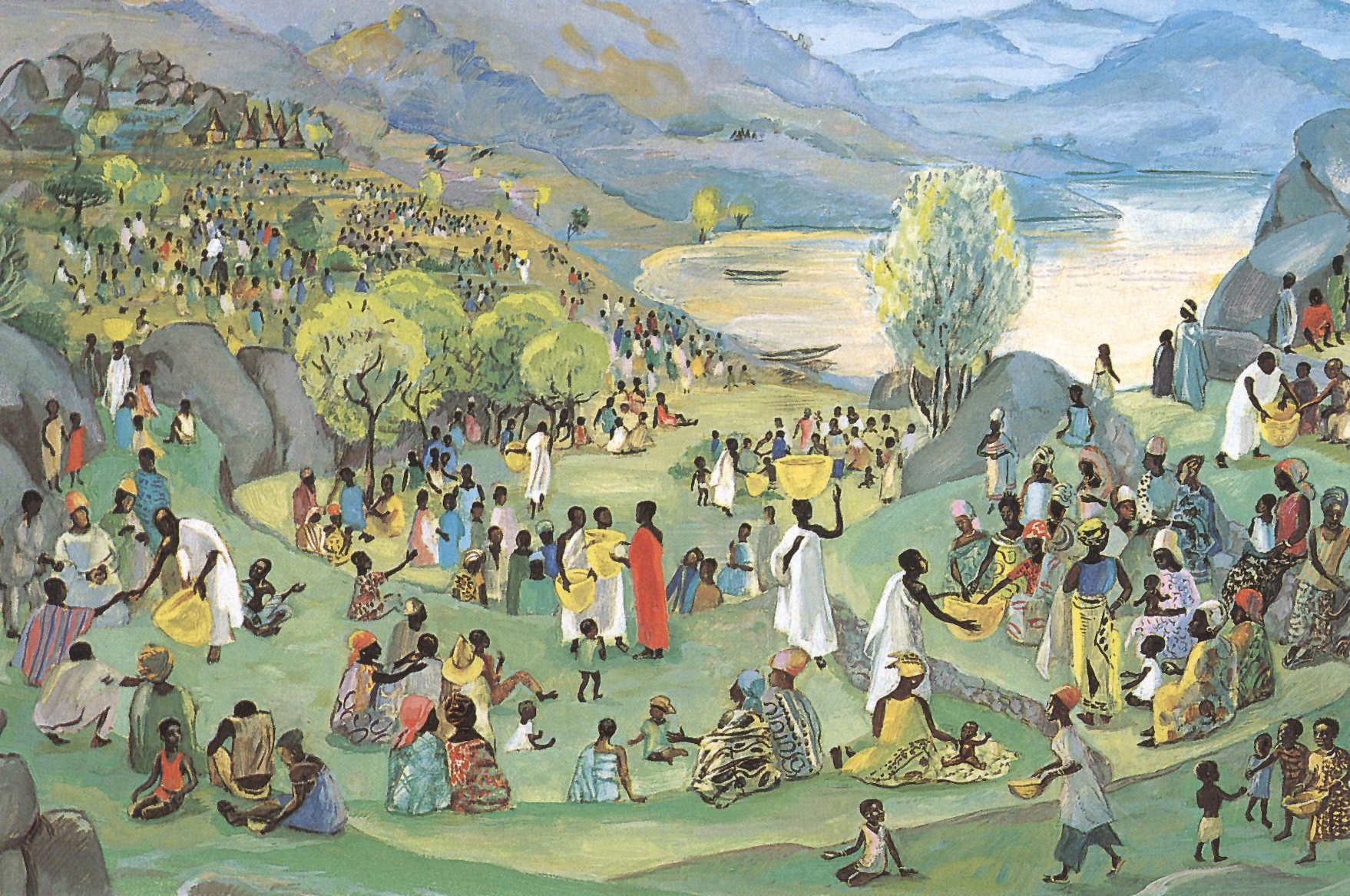
Year W: Trust in Providence Matthew 15:29-39

Cat Goodrich
Faith Presbyterian Church, Baltimore, MD
June 20, 2025

Year W: Trust in Providence
Matthew 15:29-39

Yesterday, three people were killed and many more were injured at a food distribution site in Gaza.  As you may know, Israel has blocked food, medicines, and other aid from entering Gaza for more than three months, to prevent what it believes is theft of supplies by Hamas militants – something UN agencies say is extremely rare.  The blockade has created a horrific humanitarian crisis, with the entire Palestinian population – 2.1 million people – “facing acute food shortages, with nearly half a million at risk of famine by the end of September.” [1]  This is a manufactured crisis, entirely preventable and easily averted.  There are new aid distribution sites run by an NGO and supported by the US and Israel, but they have been plagued by violence, with more than 300 people killed and thousands more injured since they were established in late May. Palestinians say, “they face the choice of starving or risking death as they make their way past Israeli forces to reach the distribution points.” [2]  This is just one of the places around the world where our fellow humans face hunger.

You know that DOGE stopped all US-AID funding to many life-saving international programs.  Included in that was the cessation of funding to the World Food Programme, which has led to millions more malnourished children, acute hunger, and food insecurity in Afghanistan, Yemen, Haiti, Sudan, and Kenya – to name a few.

My children cannot go from breakfast to lunch without a midmorning snack – and for that matter, neither can I!!  We do not travel away from home without a protein bar, a piece of fruit, or at least a packet of peanut butter crackers.  And sometimes, sometimes in my less proud parenting moments, when a child is begging for a snack because they are starving even though we just finished a meal – which they left half eaten on their plate – sometimes I snap, you don’t know what hunger is.  A distended belly, a listless child, too tired even to cry or whine.  Stunted growth, sallow skin, black hair turned the color of rust by lack of nutrients.  That is hunger.  Entirely preventable in this world of abundance.  And yet – The UN’s Food and Agriculture Organization’s Director-General says “hunger today is not a distant threat – it is a daily emergency for millions,” There was a report released earlier this week on hunger hotspots around the globe, and according to the UN, Sudan, South Sudan, Palestine, Haiti, and Mali are all under the threat of starvation thanks to conflict, weak economies, and climate change.

Food insecurity and hunger were a daily reality for many in ancient Israel, too.  The Israelites came to live in Egypt because Joseph, sold into slavery by his older brothers, gave them and their families refuge many years later, when they were threatened by famine in their homeland.  Remember?

And in the years of wandering in the wilderness, after Moses leads the people of Israel to freedom, God provides manna and quail: miracle food, to sustain them in the desert.  The image of a feast, an abundant table, of food provided to quell hunger and sustain life – this is one way the kingdom of God is portrayed in scripture.  God sets a table before us in the presence of our enemies; our cups overflow.  You know the words of that Psalm.  In the face of hunger and want, God provides not just enough, but more than enough – more than we could hope for.  That is what life is like in the kin-dom of God.

So it makes sense, then, that in addition to healing those who were sick, and teaching about God, Jesus feeds people.  And not just a few, but thousands of people, with next to nothing.  You might be more familiar with the feeding of the 5000, a similar miracle to the one we read this morning, where there are just 5 loaves and two fish.  Faced with a hungry crowd, Jesus instructs the disciples: YOU give them something to eat.  This is a story that we find in all four gospels.

Just a chapter later in the gospel of Matthew, Jesus again is faced with a hungry crowd – one that has gone without food not just for an afternoon, but for three days – surely exhausting whatever small snack supply they brought with them.  And it seems like the disciples are learning their role, though they don’t quite yet believe or understand what God is capable of.  Again, Jesus shows compassion for the people, and miracle of miracles – there is not just enough for everyone, there is an abundance: seven loaves and a few fish turn into a feast for all, with seven baskets left over.

I had been living in Mexico for about a month when I went to my first quinceañera.  It was in a grand hall, the biggest salon the family could secure, and it felt like the entire town had come to celebrate.  A quinceañera is, of course, a 15th birthday party, maybe a combination of a bat mitzvah and a sweet 16 soiree.  The community gathered was fairly stoic – Presbyterians in Mexico don’t really drink or dance, at least not before the minister leaves.  This was not a wealthy community by any means, but a celebration needs food! So before too long, Styrofoam trays began to be passed through the party, piled high with chicken, rice, and beans – a plate for each person, passed from hand to hand.  I was amazed as everyone found a seat at the edge of the wide salon, lining the room, and began to eat.  There was not only enough for everyone – people left with extra plates that night, taking home an extra meal for those at home.  The experience stayed with me, because at parties I’ve been to in the US, meals at weddings, or cocktail parties with fancy hors d’oeurves, not many have ended with such abundance that families return home with an extra plate of food.  This felt like extravagant generosity, a family providing for their community in a tangible, compassionate, sacrificial way.  It’s stayed with me as an image of God’s kin-dom – enough for everyone, and more to share.

Yesterday, our nation acted in concert with the state of Israel to bomb three sites in the sovereign nation of Iran.  This is an unprovoked act of war, based on the premise that Iran was developing a nuclear weapon – something that the director of national intelligence Tulsi Gabbard said was NOT happening just a couple of weeks ago.  We are on a precarious road that will lead to great suffering, a road that will be not only difficult to follow but has few, if any, safe exit ramps.

Meanwhile, at home, the budget bill under consideration in the Senate contains enormous cuts to the Supplemental Nutrition Assistance Program (SNAP) and the Special Supplemental Nutrition Program for Women, Infants, and Children (WIC)… $295 billion will be cut from SNAP over the next 10 years.  Advocates say these cuts will leave an enormous hole in the safety net meant to ensure hungry people are fed in this country, in a landscape that has seen a tremendous increase in food insecurity since the pandemic – food pantries in NY have seen an 85% increase in monthly users since 2019, for example.

A friend’s church in Boston started a food program during the pandemic that feeds hungry people by collecting unsold food from the biggest grocery chain in town and the big public market at Haymarket – and redistributing it through meals and grocery deliveries each week, feeding about 450 families monthly.

The truth is, hunger is not a food production problem.  It’s a food distribution problem, and a compassion problem.  The text tells us: Jesus looked out at the crowd and he had compassion for them, and found a way to feed them.  But people in leadership in our country, men who claim to be Christian, say compassion is a liability.  They are cutting programs that feed hungry children to give big bucks to billionaires, and dropping bombs to fuel the growth of the military industrial complex.  This is happening on our watch.  With our tax dollars.  In our name.

It feels like we are in the wilderness, like we are out in the desert, without more than just a few loaves and fish to respond to the spiraling crisis of need all around us.  But listen: look around.  God has no hands and feet but our own, no voices but ours to call for compassion in the public square.  God calls us to trust that our meagre offering of letters, or the loaves and fishes we provide for the CARES pantry or the men of Harford House – will lead to an abundance.

On Wednesday of this week, as I was heading out to a meeting, a woman came to the fellowship hall door with a bag full of canned goods.  She lives across the street, she said, and was eager to hand them off, frenetic, said her mom had more than she needed and she just wanted to give back.  So I let her in, and showed her where we collect items for CARES. And one by one, she emptied the bag of cans into our basket, filling it up.  An abundance, poured out.  Thanks be to God.

[1] UN Warns of Starvation in ‘hunger hotspots’.” Al Jazeera, June 16, 2025, https://www.aljazeera.com/news/2025/6/16/un-warns-of-starvation-in-hunger

[2] “The deadliest day of attacks on Gaza’s food distribution centers,” Al Jazeera, June 17, 2025 https://www.aljazeera.com/gallery/2025/6/17/the-deadliest-day-at-gazas-food-distribution-centres

What does it take to change? Luke 9

Cat Goodrich
Faith Presbyterian Church, Baltimore, MD
March 2, 2025

What does it take to change?
Luke 9

I started going to a functional fitness gym in Hampden almost three years ago, and I can remember feeling so anxious before I first walked in the door.  Would it be too hard?  Would I be able to keep up?  I’ve learned a lot since then, about Olympic weightlifting, and metabolic conditioning, and building my engine with low-intensity work – also known as zone two… I’ve learned about myself, my strengths and weaknesses, and my capacity to grow and change.  One important lesson is that consistency is key – I’ll have good days, and meh days, but ¾ of the challenge is just showing up.  It’s become clear that over time, if I continue to show up, if I put in the time and effort, I will get stronger.  One of my coaches told me the story of Milo – a legendary Greek athlete, who competed in six different Olympic games.  The story goes that Milo started training by picking up his neighbor’s calf and carrying it around for a bit.  Surprised that he could do it, he started a daily practice of picking it up and hauling it around on his back.  Each day, the calf would get a bit bigger, until finally, Milo was carrying not a calf, but a full-grown bull on his shoulders.  Incrementally, day by day, over time, he got stronger.  It’s the concept of progressive overloading… Change often happens slowly – so gradually it can be hard to believe it’s happening at all.  Then all of a sudden: the baby walks; the child is reading; the teen is taller than his dad; the bull is hefted up and on your shoulder.

But, change can also happen quickly, in the blink of an eye.  An acceptance letter can change a person’s trajectory in the time it takes to read “Congratulations!”  A car accident can bring tragedy.  We’re just six weeks into a new administration and so much has changed – lauded public servants are now vilified, allies seem to have become enemies, while aggressors have inexplicably become friends. Our European partners in NATO are reeling – it’s hard to comprehend.  Change can happen so very quickly.

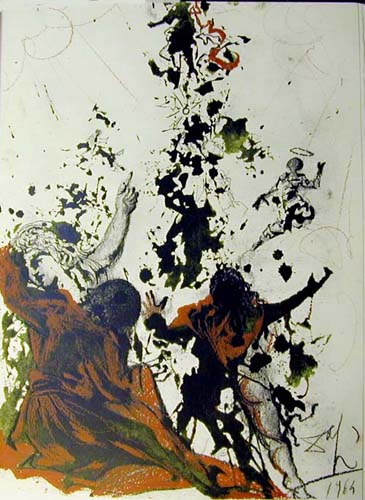
The Transfiguration story is a turning point in the gospel of Luke – all the action has been leading up to this point, and from here, Jesus turns his face to go to Jerusalem.  When Jesus and the disciples head back down the mountain, they begin the descent into his final conflict with Rome and the religious leaders.  Here at the edge of Lent, we, too, are turning toward Jerusalem, to make our own journey to face the pain of Good Friday, the grief of Holy Saturday, and the mystery of Easter morning.

From high on the mountain, Jesus can see the challenge and life altering change that awaits him off in the distance, in Jerusalem.  Maybe that’s why he offers his closest disciples a glimpse of who he really is: a shining, radiant diety, the one to whom the law and the prophets (Moses and Elijah) were pointing.  A quick change, to sustain them through the hard change to come.  That’s what all the commentaries say, at least.  But the truth is, we don’t really know.  This is a perplexing story.  There’s no explaining it.  It’s confusing, just as the tale of Moses returning from Sinai is confusing – the text says he had to veil his face, so close was he to God; when Moses came down the mountain, he was shining.

The truth is that God is a mystery.  We can draw near to the holy… we know when we see it, when the light shines through the leaves just so, and our breath catches with awe; we know when we feel our spirits soar, when we get a lump in our throat and tears fill our eyes because of the beauty, or the kindness, or the sense of being part of something greater than ourselves.  Yes, we can get close to the holy, but the heart of who God is?  It’s too much to comprehend.  Too much to behold.  Too bright, too radiant – we have to shield our eyes, or look away.

It’s hard, maybe impossible to understand what happens up on the mountaintop What I can relate to is the story that comes after.  As soon as Jesus and the others come down, they meet a man in search of healing – a parent, searching for a cure for their child.  That I can understand:  a parent begging Christ to come cast out the evil afflicting their child so that the child has a fighting chance for survival.  Who among us hasn’t faced illness or injury we are desperate to heal?   Most parents would climb a mountain to find a cure if that’s what it took.  Spending the past several days with a child in pain – I can promise that’s true.

And who among us hasn’t come back from retreat and immediately found work that demands our attention?  I think Luke wants us to notice the contrast between the ethereal, mystical revelation on the mountain and the ministry that continues in the valley – The vision of Christ transfigured changes our understanding about who Jesus is; but the work of healing, of love, of justice – the work doesn’t change.  Down here in the valley, it’s clear: our hands and hearts are needed more than ever.

The truth of this story is that the life of faith moves between the mountaintop and the valley. We are always moving between encounters with the radiance and transcendence of God and the hard work to which God calls us, between the broad perspective we get from being high up and the day-to-day work down in the weeds.  Between the certainty of faith and the reality of doubt.  It’s a cycle – up, then down, again and again.

I’ve shared with you before, I believe our weekly worship reflects this cycle – we come, seeking God’s presence.  Some weeks, in prayer and silence and scripture and song, we find it.  Then, we step outside, back to the street… hopefully fortified, refreshed, and ready for the week ahead, confident of who and whose we are, clear about what God is calling us to do.  We come back again, to be reminded.

And I’ve come to believe, in this life of faith, consistency is key.  It is how our hearts and minds and lives are changed – slowly, over time, incrementally.  Through prayer, and silence, and sacrament, and song, held by community, our neural pathways are re-wired, and we become capable of more love than we thought possible; we get stronger – our faith becomes stronger than it was when we first walked through the doors.  We are able to withstand the chaos and tumult, because we know that God is still at work – in us, in the world.  We are able to hold on to hope because we have glimpsed what is possible when grace guides us to share what we have in beloved community.  We just might be strong enough to heft a bull, which is good, because the way things are going lately, we might have to!

Grace Luke 6:27-38

Cat Goodrich
Faith Presbyterian Church of Baltimore, MD
February 23, 2025

Grace
Luke 6:27-38

One of the only times I can remember my dad getting upset with me about schoolwork was an essay I was supposed to write for Martin Luther King Day.  I don’t remember what I’d written, but I’m guessing I’d waited until the last minute.  Dad was always my editor, offering comments, encouragement, and suggestions for clarity.  Reading the essay, he heaved a big sigh through his nose.  His face got red and flushed.  I think he even raised his voice, which was rare. He didn’t think I’d taken the prompt seriously enough and told me so – sharing how disappointed he was in me, and insisting I re-write it.  He cared about me enough to challenge me to do better; he cared about the legacy of Dr. King enough to challenge me to spend more time seeking to understand it.

We do this for the people we care about, right?  We don’t accept mediocrity because we know they’re capable of more.  It is love for a subject that inspires teachers to teach; love for their students that enables teachers to continue despite long days, low pay, difficult parents, political culture wars playing out at school boards, and more.

Now, if we don’t care about someone, it’s easy to let them continue ambling along in mediocrity.  In fact, complacency – doing nothing – is the path of least resistance. Challenging a person to do better is hard.  You risk making them angry, and alienating them – no one wants to be the bad guy.  But think about the times someone has helped you see room for improvement, and encouraged you along the path to reach your goals.  Maybe it was a coach, a strong manager, a teacher, or a therapist.  Maybe a parent, partner, or a sibling?  It can be embarrassing to be corrected or challenged, but that is how we grow!  And people who care enough to correct or challenge are a gift.

Our passage this morning is one of the most well-known lessons Jesus ever taught – and perhaps his most difficult teaching, too.  In fact, many people find it impossible.  Jesus looks out at the crowd of peasants who have gathered to hear him teach, to seek his healing power, and he tells them: Love your enemies, do good to those who hate you… turn the other cheek…Do unto others as you would have them do unto you.

This passage follows on the heels of the beatitudes, and it tells us how to be a disciple: how to share God’s love and grace in a world where love and forgiveness are not lauded, but instead are often seen as liabilities.

We are one month into a new administration that has not been shy about their desire for retribution.  Rooting out the perceived “deep state” has led to tens of thousands of federal workers being fired or furloughed.  Rhetoric around these firings would lead one to believe that public servants in the park service, CDC, Department of Education, Department of Justice, and our international development experts are not passionate, highly skilled employees but rather enemies of the state.  Wasteful and fraudulent.  The FBI agents who pursued charges against those who sought to disrupt the peaceful transfer of power, who stormed DC seeking to execute the house majority leader and brought a gallows to capitol hill for the vice president, who trashed the us capitol and attacked police officers – the agents who investigated those cases were fired for doing their job.  These leaders have made it clear that they are seeking retribution, not repair, not restoration. Certainly not grace.

In this political climate, it is as if anyone who disagrees with me is my enemy.  Not capable of neutrality, not capable of fulfilling their duty to uphold the law or carry out their job.  Indeed, not even human.  We see this dehumanization in the othering and silencing of trans people, in the claim that women and people of color in positions of power could not possibly have earned those positions.  In the targeting and terrorizing of immigrant communities.  It goes on and on.

And yet, Christ calls us to love our enemies, to bless those who hate us, and to turn the other cheek.  Dr. King said, “far from being the pious injunction of a utopian dreamer, this command is an absolute necessity for the survival of our civilization. Yes, love is the key to the solution of the problems of our world, love even for enemies.”

How on earth do we do this?  How can we love our enemies with hearts that are broken?  How do we expand our capacity to love?

When I was a second-year seminarian, I signed up for what was billed as a meditation study through the Danielson Institute at my school, Boston University.  I admit that as a broke graduate student, I was motivated as much by the promise of compensation as I was by my curiosity about meditation.  And I didn’t know it at the time, but I was committing to six weeks of lovingkindness practice.

It’s a practice where you take a few minutes each day to bask in the love and goodwill of someone who cares for you, and then to extend that feeling of love, first to someone toward whom you feel neutrally, and then, toward someone who irks you.  Bring to mind someone in your life who cares for you.  Imagine them smiling at you, vividly picture their presence.  Soak in the love and the joy that they bring to you.  Breathe in, and out.  Notice how your body feels, any emotion that is coming up for you.

Then, imagine someone toward whom you don’t feel much of anything, and extend to them thoughts of goodwill, of well-being, of happiness. And, again, bring them to mind vividly as though they were right in front of you. Breathe in, and out.  Notice how your body feels.

Finally, bring to mind someone who causes you distress.  Notice how thinking of that person makes you feel and then, as you inhale, draw in the intention for this person to be truly happy, fulfilled, and joyful. And as you exhale, wish this person happiness, fulfillment, flourishing.  Notice how that makes you feel, what comes up in you when you try to do that.  Over time this practice will strengthen your ability to re-route your anger, and you will find that your capacity for love will grow.  And that is the path to healing.  The path to forgiveness, the path to wholeness.  The path, ultimately, that will save us all.

When Jesus calls us to love our enemies, turn the other cheek- he is not calling on us to be doormats or to be passive in love.  But instead, he is calling us to love as my dad loved me.  Love which speaks the truth, and cares enough to hold another accountable to a higher standard.  Love which says, we are better than this.  Love which moves us to nonviolent resistance, love which refuses to stoop to dehumanization but radically humanizes the other side – and sees their fear, their love of power, their chaos and says – we are better than this.  Love does not allow our own bodies and minds to be hijacked by hate, because it eats away at us!  It’s not healthy!  It steals our focus and productivity.  Instead, our challenge for the coming week is to try this practice, to expand our capacity to love others, even our enemies.

Let us love with courage and conviction and intention.  Because that is the path to liberation.


Wild Geese Luke 5:1-11

Cat Goodrich
Faith Presbyterian Church, Baltimore, MD
February 9, 2025

Wild Geese
Luke 5:1-11

Many mornings, I take my dog Cocoa for a walk through our neighborhood – and a couple of times over the past few weeks, I have been utterly astonished to hear the honking of geese, passing far overhead.  Each time it’s been enough to make me stop in my tracks, and crane my neck up to the sky, searching until I see them.  I don’t know where they’re going, if I’m honest – back North, in classic V-formation?  I’m less familiar with the migratory patterns of birds than I’d like to be.  I can only watch, open-mouthed, with awe – as their powerful wings carry them across the sky, and I can hear them calling out to each other- harsh and exciting, as Mary Oliver says.  Free.

I would think nothing of it, usually.  Just another ordinary astonishment, like the sheet of ice that covered my car this morning.  The frosty, frozen tips of the cedar branches towering over my backyard.  The fresh eggs my hens have begun to lay again – the best harbinger of spring, and part of the everyday beauty of life on this incredible planet.  Ordinarily I would take a breath, and move on, but these past two weeks…

These past two weeks I have been gripped by what I have come to realize is grief.  And, fury. Righteous indignation.  And sadly, a sense of inadequacy, bewilderment.  What can we do to respond to what is playing out around us?

The echo of those geese in the grey February sky reminds me that in Celtic Christianity, the holy spirit is depicted not as a dove, but as a goose.  A wild goose.  Who flies where she will.  Who cannot be tamed.  Who cannot or will not be controlled.  Whose loud cries cut across the wide expanse of the sky, making you raise your head and look in wonder.

The flocks of geese are a sign of the changing seasons, sure.  But I can’t help but wonder if they’re also a sign of something more.  Is the Spirit at work?  Because I sure could use a miracle. Couldn’t you?  A miracle that allows lifesaving research to continue.  A miracle, to save the lives of people suffering from AIDS in Kenya.  A miracle to rebuild Gaza in a way that gives life and autonomy and dignity to the Palestinian people, while also respecting the rights and sovereignty of Israel.  It is past time for a miracle.

Do you think Simon Peter, James and John were waiting for a miracle?  They didn’t ask for it.  They didn’t seem to expect it.  They were exhausted, worn out from a long night on the water, with nothing to show for their labor.  Hungry.  Mending their shabby nets, so they could head home.  They were finishing up the night shift, they weren’t there to see Jesus at all –but there he was, the crowd of people pressing in like always, gathered in the morning light, eager to see him, longing for the stories he told and the power he offered.

Can’t you see him, calling to them, and nodding to the boat to ask if he might teach from there?  Many sanctuaries are built in the style of an upside down boat, and a sign of the early church was a boat on storm tossed seas.  A little community of the faithful, staying afloat.

Simon Peter can see that the crowd won’t leave until Jesus teaches and so SImon pushes his boat back into the water, and rows out a bit – listening as Jesus talks about the reign of God – where the lowly are uplifted, the hungry fed, and the sick healed, and those in need of mercy find it.  When he finishes, Jesus turns not towards the shore but out, to the middle of the lake.  Maybe it was a nice day, and he wanted to be out on the water.  Maybe he just needed to give the crowd a chance to disperse.  Whatever the reason, Peter puts up the sail, and out they go – out into the deep water.  I don’t know if you’ve ever been out on the open ocean, but out over the deep, it’s unsettling.  No matter the experience of the captain – a boat is at the mercy of the elements, the wind, the waves, the water.

Peter wasn’t scared, he was a fisherman, used to the water.  But he was skeptical, surely – after all, the fish weren’t biting.  They’d been out all night and caught nothing.  Willing to humor his friend, he casts the nets again, out into the water – dark and deep.

Suddenly, it seems, the sea is roiling with fish.  Splashing and flashing silver as the nets pull up their catch.  More than the boat can haul, so many the nets are breaking!  So many it threatens to flood the boat, pulling them under.  They signal to shore, they call out, their voices echoing across the water – help!  Come and help us!  Fish!  So James and John come, they bring the other boat, and help haul the fish back to shore.

These men, they weren’t expecting a miracle.  But the miracle finds them anyway – and it’s disruptive! God’s abundance swamps their boats, it breaks their nets, it threatens their livelihood – it’s impossible to ignore.  They can’t control it, cannot tame it, the Spirit shows up in the person of Jesus and calls them, harsh and exciting, to something new.  They can’t continue life as usual, their nets are broken!

Simon is awe-struck by the catch, surely, but he’s also terrified.  Fearful for Jesus, because what would the authorities do to him when they knew what he could do?  Afraid for himself, too, because surely Jesus is touched by God, and Simon was unclean – not fit for his presence.

But Jesus doesn’t see that.  Jesus looks at him, and sees not an unclean fisherman, but someone worthy of the work.  A partner.  He sees Peter’s willing hands, his open heart.  And he calls him to discipleship.  Peter’s nets are broken, his boat threatening to sink, so Jesus gives him a new job: to fish for people.  A new purpose.

We watched the Wild Robot a few weeks ago, a book or movie I commend to you if you’re not familiar with it.  At the beginning of the book, a helper robot crashes onto a remote island.  Programmed to assist humans with every aspect of daily life, the helper robot is at a loss stranded on an island.  She is determined to return to the factory because she does not have a task on the island, until an accident leads her to possess and care for an egg.  When the egg hatches, and a gosling emerges, it imprints on the robot: the robot becomes its mother.  The little goose gives the robot its task, a purpose in the wilderness.  Care for the goose.  Help it find food.  Teach it to fly.  Nevermind that the robot is not programmed for these tasks.  It must learn the ways of the wild geese.   It’s a wonderful story.

Friends, we are out on the deep water right now.  I won’t lie: these are scary times.  The daily news highlights an onslaught of cruelty: the defunding of lifesaving research.  The imposition of a false binary and denial of trans rights.  The dismantling of peace and international development programs worldwide.  The list goes on and on.  One question we need to be asking amidst the onslaught is – what is our work to do?  What gifts and skills can we offer to mitigate harm to our friends and neighbors?  Where are people experiencing pain of loss- job loss, of loss of legal status, of loss of funding, lost faith, and how can we lift up their stories for the wider work of healing, and liberation?  How can we care for one another, feed the hungry, and learn the skills we need to survive in a new landscape?  Yes, it’s overwhelming.  Yes, like peter, we feel inadequate to the task at hand.  But.  if we raise our heads to the grey February sky, we just might hear the cries of the wild geese, harsh and exciting.  When we least expect it, when we are weary and exhausted and have given up hope – that is when the miracle might find us.  Listen – the Spirit is calling us still.  May we have the courage to answer.

Homecoming Luke 4

Cat Goodrich
Faith Presbyterian Church of Baltimore
February 2, 2025

Homecoming
Luke 4

Charles Barkley is a basketball commentator now, but when I was a kid, I remember him as one of the greats – I remember watching him rule the court on Saturday afternoons with my dad, sneakers squeaking, as he played for the Phoenix Suns and the Houston Rockets.  Barkley was drafted the same year as Michael Jordan to play for the Philadelphia76er’s, and they played together on Olympic dream teams in the 90’s, winning gold – that’s the extent of my basketball knowledge.  What I didn’t know until I moved to Birmingham, is that Barkley is from there, from a little town called Leeds where my friend’s brother owned a BBQ restaurant – about 20 minutes from downtown. Barkley had played ball for Auburn, and for a few years toyed with the idea of running for governor of Alabama.

He didn’t.

I learned in Birmingham that Barkley is a major philanthropist.  He’s given millions to HBCU’s Spelman, Jackson State, Miles College, Morehouse, and Tuskegee University.  He’s funded parks and playgrounds, ALS research, paid for computers and internet access during the pandemic, and given to the teachers and alumni of his high school.  He’s invested in ways he believes will foster economic opportunity and prosperity for poor people in his hometown. Barkley is known as a generous and caring person – far more than one might expect a famous ball player to be.  He still insists – he’s not a role model.  The likelihood of other kids from tiny towns in Alabama ending up with a career on the court is so small.  He says he feels blessed, and he wants to share the blessing with others – especially with his hometown.

This morning we find Jesus in his hometown, too.

He’s just stood up in the temple, read the words of the prophet Isaiah – unrolling the scroll, standing in the assembly – and proclaimed them fulfilled.  Taking on the mantle of messiah.  And people are amazed by his teaching!  Excited, and energized by his words, his presence, what he promises might be possible for them and their community.  Healing, salvation, liberation!  Debts forgiven, God’s favor for them!

But even in their excitement, can’t you see a few of them shaking their heads?  Saying to one another, “Can you believe it?  This is Joseph’s boy!”  See, they remember what he was like as a kid, getting into trouble.  Making his teachers crazy.

“remember that time Jesus and his cousins broke all the water jars outside the building, because they were playing ball too close to the entrance?  Those boys were too much.  Made Jesus do all the talking to fess up, too.”

“remember that time Jesus won the prize for memorizing the most passages from the Torah?  When he was so nervous to read in front of the congregation, he got sick?”

Joseph’s boy, all grown up.  They can’t quite square their memories of him with the person he’s become.  Still, they can’t help but wonder… if he really is the messiah, the promised one, what will that mean for them?  Will the hometown boy bring hometown benefits?  Will he do for them what they’ve heard he’s done elsewhere?  Will he heal their sick?  Do miracles?  Cast out evil?  I mean, they put up with his antics as a kid, that’s gotta count for something!

All of this must be going through their heads as Jesus continues to teach. And Jesus, even though it’s early in his ministry, he knows it.  Can see the gleam in their eyes and the expectations begin to form.  So he decides to head them off.  He reminds them of prophets who have gone before, who didn’t show preferential treatment to their hometowns, or to the people of Israel either. he makes it clear that he won’t perform on demand.  He’s here for everyone, not just for them.  And in fact, there are people who need him more than they do. So they get angry, and run him out of town.

Some commentators suggest they’re angry not just because they won’t get special treatment, but because he’s reaching out to Gentiles before offering help to his own Jewish community.  And the stories he tells – a story about Elisha miraculously feeding a woman and her son in a time of famine – not just any woman, but a foreigner; and Elijah miraculously healing Naaman, a Syrian – Naaman, who wasn’t just the enemy, but the general of the enemy’s army – prove this point.  It’s resentment that fuels the crowd’s fury, jealousy, and maybe even xenophobia.  It’s hard to say.  But, they get so angry, they take him to the top of a mountain and try to push him off.

Have you ever heard the saying, “Comfort the afflicted, and afflict the comfortable?”  I use the phrase in prayers, sometimes, and always thought it could be attributed to a leader of the reformation, to Martin Luther or John Calvin.  Apparently, though, the phrase can be traced back to a newspaperman, back to the early 1900’s in the age of muckrakers.  Finley Peter Dunne, a journalist who wrote for the Chicago Tribune, coined the phrase in describing the purpose of a newspaper… to comfort the afflicted, and afflict the comfortable.  And I think this may be what Jesus is doing here… challenging the people who raised him to see that God’s love, justice, and healing power reach across boundaries of race and cultural identity, even religion – to those who some faithful folks have discounted, and pushed out, as unworthy of God’s blessing.  Christ came to comfort the afflicted and to afflict the comfortable.

This has been a difficult week in our country.  The new Administration has thrown a wrench into the wheels of government, stopping essential foreign aid, seeking to fire or furlough millions of civil servants, ending refugee resettlement programs, the list goes on and on and on.  It is breathtaking in its cruelty and scope.  It is difficult, if not impossible, to fully comprehend the implications and the long-term damage of this dismantling.  And yet it brings to mind those folks in Jesus’ home congregation.  The ones with the gleam in their eye and the wheels in their heads turning, thinking – what’s in this for me?  With the firing of inspector generals, the installation of cronies and loyalists into top positions, and elon musk with his hand in the federal treasury – it’s clear that some people are hoping to benefit at the expense of all the rest.

There’s not a perfect parallel, there never is, but …

I can’t help but think about Jesus’ refusal to prioritize his hometown wants over the needs of the wider world.  And his fearlessness, to tell the truth to his hometown folks about God’s concern for the poor and forgotten, for foreigners and strangers – even though it provoked their fury.  I’m amazed by his courage in this story, his ability to find a way through their chaos, and their anger, to continue his ministry of love and justice, his work of compassion and healing.

We know Jesus would decry a kleptocracy – he said enough about the Roman empire for us to know that. But when I think about it – and I never thought I would say this – maybe I want him to be a little like Charles Barkley: investing in positive programs to help hometown folks.  We want Jesus to be on our side, for us – not for them.  Reflecting on this passage in the Christian Century a couple of years ago, Lutheran pastor Katie Hines-Shah says Jesus escapes the murderous mob because “he goes through the middle – he refuses to be caught in the binary trap…  He won’t be contained…”as a supporter of one group over another, us verses them.”[1]  Maybe our way through the chaos is to follow his lead… paying attention to the ways that we have grown comfortable in modern life, and having the courage to follow him to the places where people are suffering – to offer our hands and hearts for the work of healing.  This is the life of Faith to which we are called.  The world needs us now more than ever.  We must not be afraid!

[1] Hines-Shah, Katie, “Reflections on the lectionary; January 30, Fourth Sunday after the Epiphany” The Christian Century, 1/12/22

One Body 1 Corinthians 12:12-31a

Cat Goodrich
Faith Presbyterian Church, Baltimore, MD
January 26, 2025

One Body
1 Corinthians 12:12-31a

The leaves are shaped a bit like teardrops, round with a point at one end.  The trunks are white, and splotchy, standing proudly in a quiet glade.  When the wind blows, the leaves appear to quiver, the whole forest alive and gently trembling in the breeze.  The forest appears to be made up of multitudes of trees, but in fact it’s mostly one single organism – the largest and possibly also one of the oldest living things on earth.  Its name is Pando, and it’s a stand of quaking aspens in Fishlake National Forest in central Utah.  Covering more than 100 acres, scientists believe Pando grew from a single seed that took root more than 80,000 years ago – in prehistoric time, when giant sloths and mastadons roamed the land, a massive ice sheet covered much of North America, and humans hadn’t yet thought to put a paintbrush to the wall of their cave.  Over 80,000 years, Pando grew – Pando, which means, “It spreads,” in latin – roots expanding underground, sending up shoots that become new trees, all exact genetic copies of each other, growing bigger, heavier, each year.  It’s difficult to comprehend, really, the size and scope of it, but it’s true.  Pando the aspen, dropping a carpet of golden leaves each fall, some 40,000 trees that are separate but rooted and entwined together; Pando is many but one.

We’ve learned so much about trees these past few years at Faith, haven’t we?  Native trees that thrive here on our property, despite dry, hot summers.  Redbuds and tulip poplars and pinleaf oaks. Why it’s better to plant those trees instead of non-native varieties.  Those of us who read the Overstory a few years ago with book club can tell you all about mother trees, the American chestnut, old growth forests, giant sequoias, and the extraordinary lengths ordinary folks have gone to to save trees.  We know from the research of Suzanne Simard that trees communicate through the biomass underground, taproots and fungus signaling danger, or drought, or disease.  They even share resources, nourishing younger trees to help them survive, sharing carbon not just among a parent tree and its offspring, but incredibly: between species.  And any home inspector can tell you, tree roots somehow seek out water underground, wrapping around pipes if given time to do so.  Trees are amazing.

But you know, we tend to overlook trees.  Anyone familiar with Tolkein’s middle earth and the Ents can tell you we do so at our peril, but it’s true: Humans dismiss organisms that don’t move at our speed, that can’t speak our language, can’t dream and scheme like people do.  We could learn a lot from trees, I think.  A forest’s diversity, its generosity, its beauty.  Because if you’ve been paying attention this week, you know there are some who would like to divide us.  Who are fixated on dividing our country into false binaries: us and them.  Loyal or disloyal.  Male and female.  Citizen or undocumented, white and everyone else.  Over the past week that the new administration has been in office, they are making, and reinforcing an old hierarchy about who belongs, and who does not; who is worthy of protection and inclusion, and who is not.

And as I struggle to understand what is happening in this new America, and what we are called to do as people of faith, how we are called to respond, I can’t help but think about that aspen, out there in the Utah wilderness.  Its narrow trunks standing tall, one after another after another, shading a valley leading down to a lake.  Those trees look so separate from one another.  Some trunks are old, the branches failing.  Some are new, just coming up from the ground.  The distance it covers is remarkable, so many trees, but really, it’s just one tree.  Just one.  Pando.

Together, Paul writes, we are one body:  the body of Christ in the world.  A body unified in and by the Spirit, but with many different parts.  Different gifts, different callings.  Working together for one ministry.  He is writing to the church in Corinth, the first of two letters we have from him to this congregation, and he is urging them to live and work in unity.  Clearly there was some division within that early house church, where people of different economic statuses, different genders, different cultures and races and ethnicities and identities were coming together to eat, to worship, and to minister to their community.  Ancient Rome was a highly stratified society, and so the early church was one of the few places where people came together with others who were different.  You know, honestly, if you think about it, the church is one of the few places where this happens authentically here in our world, too.  Paul is urging us to treat one another with respect, to value what each person brings – because each of us is worthy of love and belonging, each one has something to offer as part of the body.  Paul’s challenge to the Corinthians, and to us, is to realize that those we would disregard – those people society considers less than – are equally important, equally valued in the reign of God.

Jesus tells us this, too: in his teaching, in his healing, in his life, with his death.  The story we heard this morning is the very first public act of his ministry in the gospel of Luke.  It’s the first time he clearly, publicly states who he is and what he’s come to do.  When he reads from the scroll of Isaiah in the assembly, he’s claiming the mantle of Messiah: by proclaiming the prophecy fulfilled, he is saying that he is the savior, the healer of the breach, the restorer of streets to live in.  It’s interesting that he chooses to do it in Nazareth, his hometown, standing before the synagogue that raised him.

The passage he reads says the Spirit is upon him, empowering him to proclaim good news to the poor, to release captives, restore sight, to forgive debts, and to set people free.  He came to serve amongst the poor, the enslaved, the sick, the imprisoned, the indebted, the oppressed.  Jesus’ ministry is primarily with and to those on the margins, he says so right from the start.

And his family friends, his hometown community – remember how they respond?  They rally together and run him out of town; they try to throw him off a cliff!  So we shouldn’t be surprised, then, at the outrage and ridicule heaped on Bishop Budde after her sermon about unity, and plea for mercy for those who are fearful this week.  Jesus, too, faced scorn and ridicule when he challenged the powerful to show compassion for the vulnerable.  It’s risky to speak truth to power.

Paul reminds the church in Corinth: You are the body of Christ, and individually members of it.  That continues to be our calling in this new era in our country.  To remember that if one member suffers, all suffer together with it.  We are called to practice radical solidarity with the least of these, a courageous testimony that each part of this body is worthy of love and belonging.

Overstory author Richard Powers attributes Buddha as saying, “’a forest is an extraordinary organism of unlimited kindness and generosity that asks for nothing and gives copious food, shelter, protection, shade, and wealth to all comers, even to the men who cut it down.’” He goes on to observe: “The hundred thousand species of Earth’s trees are endlessly inventive and varied, and they are so … beautiful it can hurt to look at them. They talk to and nourish one another, remember the past, and predict the future. What’s not to love?”[1]

I am so grateful to be part of this community – one body, with many parts, and different gifts, to proclaim good news, to work together for liberation.  Our calling, I believe, in this time, is to be like Pando.  Rooted and grounded in the grace and love of God.  Remembering and celebrating our unity despite those who would have us believe otherwise.  Remaining committed to unity without uniformity.  Celebrating that though we are many, indeed – we are one.  Thanks be to God.

[1] Powers, Richard in conversation with Amy Brady, “Interview with the Author of The Overstory,” Yale Climate Connections newsletter, 5/2/18.

Through the Waters Isaiah 43:1-7, Luke 3:15-18, 21-22

Cat Goodrich
Faith Presbyterian Church, Baltimore
January 12, 2025

Through the Waters
Isaiah 43:1-7, Luke 3:15-18, 21-22

There is a cassette tape somewhere at my parents’ house, black with a white sticker label, that holds a recording of my baptism.  I think probably the whole service at First Presbyterian Church of Shreveport, with John Rogers preaching, and proclaiming me baptized.  It’s an interesting relic, since I don’t by any means remember it – I was a baby when it happened, the water has long since dried.  Do any of you remember your baptisms?  I have a friend who grew up Southern Baptist, she said she got baptized several times, every time she got anxious about her salvation, she’d be baptized again- just to make sure it ”took.”  A kid in the last church I served grew up in a different denomination.  He remembers his baptism because he tripped and slipped going into the baptismal tank, arms flailing, and splashed water all over the minister.

Do you remember your own?  The words that spoken, the water splashed, the eyes wide with wonder.  In baptism, you are named and claimed as a child of God.  Beloved, and precious to God.  You are claimed and welcomed as part of the community of faith.

When we baptize someone, we make a covenant with them.  The community promises to support and teach the person as they grow in faith.  Parents promise to help the child learn and to encourage the faith of their children.  And here at Faith, the children promise to share the stories of Jesus with the baptized person, and to be a friend to them.  Mostly, we promise to accompany each other in this life of faith – to be community together.

Reading this story this morning, I have to wonder if Jesus remembered his own baptism from time to time… The first step into the water, mud swirling around his toes.  Was it cold that day, wind blowing the grass on the riverbank, making him hesitate before he made his way into the water, or was it hot and sunny, the water a blessed relief?  Was he jostled as he walked among the people crowded there, a mad rush for the river, or did they calmly walk single file, taking turns?  Could he swim?  Was he scared?

However he felt before, he surely remembered the words that came after: the dove descending, the words of love echoing in the sky.  The feeling of power that settled on his shoulders like a cloak.  He had to have thought of them when he first saw James and John mending their nets, and invited them to join him in ministry, to come and see.  Don’t you think Jesus remembered God’s claim on his life when he spoke with Zacchaeus, offering forgiveness; when he stood at the tomb of his friend Lazarus, tears in his eyes, and called him to come out?  Here at the beginning, God is telling us who Jesus is, so we can understand the ministry that comes later.

For the early church, baptism was the primary act of initiation into the community – and it still is one of two sacraments central to our faith.  Water has for centuries been a means of grace for this Christian ritual – a potent symbol of renewal, of washing clean; one life ending, the beginning of something new.

It makes sense, because water is the stuff of life.  Picture images of people hauling water – in places where water is hard to come by, women balancing jugs on their heads and hips.  Children struggling to carry water in heavy bottles, barefoot on dirt roads.  If you do not have running water, fetching water is a primary daily task, done first thing in the darkness before dawn, or in the evening as dusk falls.  In the Forum this Advent, we read a poem by Xochitl Julisa Bermejo that brought to mind images of gallon jugs of water left in the desert on migrant trails, adorned with sharpie-drawn pictures of the Virgen of Guadeloupe, so people would know the water was safe to drink.  Water in the desert is the difference between life and death. Water is necessary – think of all the reasons why you turned on a tap this morning, for eating, drinking, washing up.

And I cannot think about water as a potent symbol and means of life this morning without seeing the images of people in LA, where wildfires fanned by the fierce Santa Ana winds have given rise to apocalyptic conditions there.  Whole neighborhoods reduced to ash and cinders.  I’ve seen people hauling garbage cans of water to their neighbor’s homes, spraying roofs with garden hoses, splashing what they can from swimming pools to try to fight the flames, and put out hot spots.  The destruction is impossible to comprehend, homes, churches, businesses burned, hundreds of thousands of people displaced – the whole region traumatized by vicarious loss, despair hovering like smoke, saturating everything.

A colleague of mine who is pastor of Culver City Presbyterian Church wrote that her primary feeling is one of helplessness.  How do you get the wind to stop blowing?  How does anyone get rain to fall?

In light of these impossible questions, I can’t help but wonder: How did you hear the passage we read from Isaiah this morning? They are words of reassurance for people who were also feeling overwhelming helplessness.  But were they reassuring to you?  Familiar, certainly.  Through the voice of the prophet, God promises the Israelites: When you pass through the water, I will be with you; when you walk through the fire you will not be burned… Because you are precious in my sight, and honored, and loved.  Isaiah is writing to people in exile, who have been enslaved by their conquerors.  To be redeemed in this context is to be bought out of slavery, and liberated.

At first pass, these words are comforting, to be sure, but can we believe them?  As one member of the bible study asked this week – something along the lines of, how can we believe this in a world where the Holocaust happened?  How can these promises be anything but empty?  As fires smolder and sparks fly and whole neighborhoods are reduced to rubble; as volunteer fire brigades seek to save neighboring homes with buckets of water; as the death toll rises and more and more people are displaced… we are challenged to remember that God never promised Christ safety.  Instead, God promised to be with him – and by the power of the Spirit, is with us, too.  With this lens, then, we can see God at work in the midst of devastation.  In the thousands of people who have poured in to help.  In the firefighters from Mexico and Canada who have flown in to serve.  And in every helping hand extended to each family and individual who is facing the impossible task of finding a way to rebuild their lives in the wake of the fire.  Think of how difficult this year has been for Chandra and Ellsworth; how painful the path back home for Leanora and her family.  Multiplied by how many?

God is present not in the firewalls or flames but in every bucket carried by a neighbor, in every glass of water offered and received.

And so in the days ahead, remember your baptism, and trust that you are not alone.  God sees and loves you.  Through the power of community, God cares for us.  As you come forward for communion, if you wish, touch the water.  Feel and be reminded of God’s presence with you, which persists despite flame or flood or despair.  Thanks be to God!


Eyes Wide Open Mark 10:46-52

Cat Goodrich
Faith Presbyterian Church, Baltimore, MD
October 27, 2024

Eyes Wide Open
Mark 10:46-52

When I was in about fourth grade, the world was taken with a new visual phenomenon: Magic Eye images.

You may have seen your first one in a poster frame at the mall, with a soft pretzel or a fresh squeezed lemonade in your hand, a group of strangers crowded around close, squinting.  Or, if you’re like me, maybe it was at a scholastic book fair, a group of classmates leaning over the desk, saying things like: look through the picture!  Let your eyes unfocus!  With someone periodically exclaiming: ohhhh!  I see it!  A sailboat!

Magic Eye posters were a fad that swept the country in the early 90’s – a popular version of a “random dot stereogram, a visual trick that shows how humans can achieve the sensation” of seeing something in 3-D, “by looking at a pair of 2D images filled with randomized, black-and-white dots…”. By shifting where an image is placed relative to its background, the inventor of these images figured out how to “trick the brain into seeing depth and create the illusion” of seeing a flat image as 3-D.[1]

Developed by a couple of graphic designers, Magic Eye images hide a 3-D image behind repeating columns of brightly colored static.  When your eyes unfocus, the hidden image suddenly appears.  Many of you can remember that “aha” moment of suddenly seeing the car or the airplane behind the static.  In a design article about the Magic Eye craze, one journalist wrote, there is “something entrancing about staring at the hypercolored static, searching for something you can’t see but know is there. As satisfying as it is to best a trick, there’s a perverse pleasure in trying, and failing, to bring something hidden into view.”[2]

I have a confession: I could never see the hidden image.  Try as I might, my brain could not unscramble the static, and the 3-D image never appeared. Magic eyes left me cross eyed and headachey, frustrated that I couldn’t see the cool picture that everyone else saw.

It was an early lesson in the truth that sometimes, we can’t see the world the way others see it.  Our brains operate differently; what is obvious and evident to you may not be so clear to me, and vice-versa.  We need each other to help us see what our eyes, our brains overlook, or that which social location or experience hides from us.  The story of Bartimaeus is a good example of this.

We’ve been journeying with Jesus through Mark’s gospel over the past six weeks or so.  Along the way, Jesus has been teaching his disciples what discipleship looks like: humility, service, healing, and care.  As he travels through the Galilean countryside to Jerusalem, Jesus challenges social norms that prioritize some while shutting others out.  Women, children, people who are sick, those who are poor – the people the world forgets are the ones Jesus brings into the center.  “The first shall be last in the kingdom of God,” he says.  Three times, he predicts that his counter-cultural message will provoke the authorities, that he will be killed and in three days, rise again.

But his disciples don’t understand what he’s trying to tell them.  Try as they might, they just can’t see it.  James and John think discipleship will lead to political power if Jesus is the messiah, and they ask him to sit at his left and his right.  The rich man thinks adherence to the 10 commandments will be his ticket to the kingdom.  But Christ challenges all of them to embrace humility instead.  To walk the way of the cross.

So Mark shows us one more time what it means to be a disciple of Jesus.  Mark wants us to notice the irony, that the blind man can see Jesus clearly, can see who he is – calling out, Jesus, son of David! – naming Christ the Messiah, when those closest to Jesus don’t understand what that means.  Bartimaeus believes Jesus will heal him, so he persists in crying out, even though the crowds shush him, and try to silence him.

In Biblical times, a blind man would have had no means of livelihood, no place in polite society.  He would have been destitute, an outsider among outsiders.  His cloak would have been spread in front of him to catch the coins tossed by pilgrims on their way out of Jericho, heading towards Jerusalem as Jesus was.

Remember the story of the rich man, who was challenged by Jesus to sell everything, give the proceeds to the poor, and follow him?  The man wouldn’t, or couldn’t do it – he went away grieving, the story goes, because he had many possessions.  When Jesus calls out to Bartimaeus, the blind beggar is willing to jump up, leaving his cloak – likely the only garment he owns – behind in the dust of the road, to follow Jesus on the way.

For Mark, followers of Jesus must be bold, persistent, courageous, and humble.  We must be able to see the world around us clearly, even when others refuse to open their eyes to reality.  We must be like Bartimaeus — willing to leave everything behind in our haste to follow where Christ is leading.

My first year here, Kate Foster and McKenna Lewellen took me on a tour of the city, a tour that they often led for groups visiting the Center.  We went down to the inner harbor, over to East Baltimore near Hopkins hospital – which I now know is where the old Faith church building is.  We went to West Baltimore, and saw the old entertainment district along Pennsylvania Avenue, and the rows of vacant rowhouses of that showed the painful impact of disinvestment.  As we crossed neighborhoods, they pointed out how roads changed names as we moved from one part of town to another.  How affluence gave way to poverty in the span of just a few blocks.  And I began to see how red lines drawn on a map years ago persist in the life of the city today, dividing neighborhoods, sequestering wealth, abandoning neighborhood schools, and creating what Lawrence Brown named the Black butterfly.

It was as if the static of chance, the static that says this is just the way it is, the way the city grew, the way we who have choice continue to choose where and how we live and work – faded away, and the image of the racist policies that led to such disparity came into sharp relief.

I wonder if once you see those magic eye images, you can always see them – or if you have to go through the process every time to be able to grasp the image.  If it still takes some time, to be reminded of what’s there.

I wonder for how long Bartimaeus treasured his newfound sight – if every morning he awoke, blinking in the first light of dawn, praising God for opening his eyes to see the beauty and the bright truth of the world around him – the precious faces of his family, the smiles and crinkling eyes of his closest friends.

Our task as people of faith is to look past the static that blinds us to the truth of the world as it is.  And to follow Jesus as Bartimaeus did – once our eyes are opened – by seeking to challenge the forces of exclusion and oppression.  By building communities of care.  By holding on to the bright, shimmering truth when we glimpse it – a world suffused with the grace and goodness of God is to be treasured.

I know that watching or reading the news over the next few weeks is going to be challenging.  The last few weeks of this divisive, difficult election cycle are not going to be pretty.

Parker Palmer observes that “it takes no special talent to see what’s ugly, numbing, depressing, and death dealing in our world.  Staying aware of what’s good, true, and beautiful demands that we open our eyes, minds, and hearts, and keep them open.  …With eyes wide open, we can begin to see beauty in the most surprising places, not only in nature, but in human nature.  That’s what will give us the inspiration, strength, and courage to resist all that’s wrong and work for what’s right… Keep your eyes open, and keep hope alive.”[3]

May it be so.

[1] Stinson, Liz, “The Hidden History of Magic Eye, the Optical Illusion that Briefly Took Over the World,” July 1, 2022, Aiga Eye on Design, https://eyeondesign.aiga.org/the-hidden-history-of-magic-eye-the-optical-illusion-that-briefly-took-over-the-world/

[2] Ibid.

[3] Palmer, Parker J. Facebook post reflecting on Mary Oliver’s poem “Mindful.” January 29, 2019, https://www.facebook.com/share/p/emBosMPmatsKdTi4/

Faith is an Action Verb Mark 10:17-31

Cat Goodrich
Faith Presbyterian Church, Baltimore, MD
October 13, 2024

Faith is an Action Verb
Mark 10:17-31

Black Mountain Presbyterian Church is a thriving congregation that sits right outside of the town center of Black Mountain – a vibrant main drag, with local galleries, shops, and restaurants, that was once home to the radical Black Mountain School.  The church sits far enough away from the Swannanoa River and its tributary, Flat Rock Creek, that it escaped the worst of the flooding two weeks ago.  But along with the rest of the town, they lost power and water, had no cell service, and were suddenly cast into tragedy and uncertainty when Helene swept in.

As the floodwaters receded and it became clear that many neighbors had lost their homes, and many,

many more were stranded by broken roads and failed infrastructure, the church sprang into action.  It emptied its fridges and began cooking hot meals outside under tents, feeding the folks who were camped out in cars along the road in Black Mountain.  As soon as supplies began to be trucked in, the church became a distribution point, setting up a triage area to receive and share food and other essential items.

Today, two weeks later, they are overflowing with donations.  The spacious narthex has become a food pantry, stacked to the ceiling with canned goods, lined with shelves brimming with soups and instant meals.  Hallways are piled high with cleaning supplies, gloves and buckets and bleach – all you’d need to clear the muck and mud out of a flooded house.  Their open fellowship hall has tables filled with diapers, medicine, and more.  Volunteers from as far away as Louisiana are helping sort, organize, and distribute things to the people who need them.  They’ve received so many contributions, they’re using a big hall in nearby Montreat as overflow storage.  And still, a team is outside – cooking and serving hot meals to their waterlogged neighbors.  The congregation has turned into a hub for community needs.

When Jesus says, all who follow me will have plenty of brothers and sisters and mothers in this life and in the life to come, I can’t help but think about that church, and the story of how they have sprung into action to care for their community in the wake of this tragedy.  Because what does family do if it doesn’t feed you, help shelter you, make sure you have what you need to get through?  Pastor Mary Katherine Robinson observed – “It’s bringing strangers together and making them friends, and that’s beautiful to watch.”[1]

“Good teacher,” the man asks: “What must I do to inherit eternal life?”

Many of us have pondered this question at one point or another.  How can we be sure we are saved?  How do we get to heaven is a question commonly asked in our culture, or as I’m more likely to phrase it – how can we find our way into the reign of God?

These aren’t everyday, lighthearted questions.  These are questions that might weigh heavy on our souls, the ones that keep us up in the middle of the night.  The worry over getting it right drove the rich man to fall on his knees at Jesus’s feet, so concerned was he about salvation.  Still, they aren’t questions that we as Presbyterians spend a lot of time talking about.  And here’s why: as my friend and colleague Shannon Webster liked to say – quoting, I think, his old theology professor, “we believe God loves us not because we are good, but because God is good.”

And we remember this each week as we confess our faults and failures together in our prayer of confession.  We name collective shortcomings big and small, and have time to reflect in silence on our personal ones.  And each week, with a splash of baptismal waters, we are assured – there is nothing we can do and nothing we can fail to do that will separate us from God’s love.  Salvation is to be found not in anything that we do, but rather by the grace and love of God made known in Christ and community.

Still: Jesus tells the man: Sell what you have, give the money to the poor, and follow me, Jesus’s response to this man is typical.  Enigmatic.  Challenging.  It’s so upsetting the man leaves, upset, grieving.  The only time in the gospel stories when Christ invites someone to follow and is turned down!

Jesus turns the man’s concern about himself – what must I do to inherit eternal life – outwards, into concern for others.  Jesus shifts the focus – from personal piety to community service and generosity.  And shifts the time frame – from what might happen one day, in a far off eternity to how the man responds to immediate needs, here and now.  Maybe the teacher is teaching us that service is an outward expression of inner convictions – care for others and concern for people who are poor is a demonstration of discipleship.  What if it is our generosity and care for one another that saves us?

The core of Jesus’ teaching to this rich man is that wealth is an impediment to grace.  Our stuff gets in the way of our ability to be disciples.  It insulates us from reliance on God and one another.

I wonder how we hear this truth as American Christians.  Evangelical scholar Ron Sider calls us Rich Christians in an Age of Hunger.  Plenty of interpreters have tried to explain this story away, but I believe we need to hear it now more than ever.  Because of our social location.  Because of our shared wealth.  Because we have enough, and when we have enough, God calls us to generosity.

There is a Japanese theologian named Kosuke Koyama who says that though we live in a fast-paced world, God is a slow God.  God moves, Koyama says, at three miles per hour – the speed that Jesus moved as he walked and talked through Galilee.   He writes: “The work of God goes on in the depth of our life, whether we notice or not, whether we are currently hit by storm or not, at three miles an hour. It is the speed we walk and therefore it is the speed the love of God walks.”[2]  The work of God in the world is unlikely to be at a pace of our own choosing.  IT seldom happens quickly.  But the Spirit is still at work.

We come together in this place week after week to hear and be reminded of the love of God, and the call of our loving God to give and care generously.  To look beyond ourselves and see the needs around us, and to discern together what good we can do.  Not because our salvation depends on it – God’s got that covered already – but because Faith is an action verb.  It is something that we do together.  Because we trust God is at work, albeit slowly, we lend our hands and hearts to the task of loving our neighbors, of advocating for change.  We give generously, trusting that God will use what we offer.  And trusting that our community, this community, will support us when needs arise.

I’m grateful for the wisdom of the deacons in creating the DEAR fund – a resource available to members and friends of this church who have emergency needs.  Medical bills, car repairs, rental assistance, help recovering after a fire – the DEAR fund has helped bridge the gap for folks in need in our Faith family.

Yesterday, our kitchen and fellowship hall were filled with folks chopping, sauteeing, prepping casseroles and gift bags for folks who are in homebound, or otherwise in need of a little help and care.

I am grateful for the care and example of Black Mountain Presbyterian Church.  But you know what?  I am also grateful for the care and example of this family of Faith.

[1] Robinson, Mary Katherine, qtd. By Carter, Darla in “Black Mountain Presbyterian Church and Volunteers bringing ‘beautiful spirit’ to feeding and supporting the community,” Presbyterian News Service, 10/8/24, https://www.presbyterianmission.org/story/black-mountain-presbyterian-church-and-volunteers-bringing-beautiful-spirit-to-feeding-and-supporting-the-community/?utm_content=311293034&utm_medium=social&utm_source=facebook&hss_channel=fbp-22627435207

[2] Kosuke Koyama, “Three Mile an Hour God,” in Three Mile an Hour God: Biblical Reflections (Orbis, 1979), 6-7. Found on External Word blog, Nicholas Lash, Theological quotes, 9/20/13, https://externalword.blog/2013/09/20/kosuke-koyama-on-the-speed-of-god/

People Power! Mark 11:1-11

Cat Goodrich
Faith Presbyterian Church, Baltimore, MD
March 24, 2024

People Power!
Mark 11:1-11

In September of 2003, the Dalai Lama visited Washington, DC, and offered an address at the National Cathedral.  It was the second anniversary of the September 11 attacks, and, as I was living in DC at the time, I knew I needed to be there to hear him.  The sun was shining brilliantly, the sky was sparkling blue as I got off the metro. Walking toward the cathedral, the sidewalks began to be crowded with people – all heading the same direction, walking to hear the Dalai Lama.  When we reached the entrance to the grounds, I realized that the line to get into the cathedral stretched down the driveway, through the gate, and out to the street – then curved down the sidewalk and around the corner!  So, we kept going, walking another two blocks to join the end of the line.  Then, we waited, slowly winding our way along the tree-lined streets, standing in the dappled shade as we inched toward the sanctuary.  It took more than an hour to get onto the grounds of the cathedral, and by that time the nave was filled to capacity.  So as the organizers set up loudspeakers outside, we found a spot on the lawn, and sat down crisscross applesauce on the grass amidst the crowds of others to listen.  If I’m honest, I don’t remember much about what he said.  I had to strain to hear, to sort through his accent and the echo of the loudspeaker.  An article in the Post afterwards said that there were more than 3000 people sitting outside in overflow – what I remember is the hush that fell over the crowd that day –  it was as if together we held our breath and leaned in, just hungry for words of hope from this wise teacher.

At that time, the horror of the war on terror was just beginning to unfold.  The Bush administration was spinning the tale about yellowcake uranium that would become their justification, their fabricated justification for invading Iraq.  They’d just outed Valerie Plame.  I was 22 years old, simultaneously brimming with idealism and furious about the drumbeat for war that was reverberating in Washington at the time.  So I leaned in, we all did, listening so carefully, for a world leader to guide us on a path to peace.  We needed it.  I needed it.

Who have you joined a large crowd to see?  Who have you waited in a ridiculous line to hear, or stretched on tiptoes by the side of the road just to catch a glimpse of, to draw near to?  Politicians draw a crowd.  Some musicians do.  4.35 million people saw the Taylor Swift Eras Tour, that’s almost the entire population of Los Angeles.  They say you can hear the roar of the crowd by a red carpet from blocks away.  Fans flock to see the Ravens and the Orioles and the athletes who play professional and collegiate sports… all people and events that may require a bit of patience to witness.  The biggest crowds I’ve been in lately have been political demonstrations, the street theatre of protests and pride parades.

If you’ve been in a crowd like that, you know the tenor changes based on the message of its leadership.  The Dalai Lama, three thousand people sit quietly in the grass.  The Rally to Save America led some 2000 people to storm the US Capitol, wreak havoc and interrupt the certification of electoral votes.

I can’t help but wonder what the tenor of the crowd was that day in Jerusalem.  The city would have been overflowing with people, peasants who poured in from the countryside to celebrate Passover, to make their sacrifices in the temple.  Remember that Israel was an occupied land; there would’ve been a lot of Roman military presence for the festival, to keep order, to prevent a revolt.

But that doesn’t stop Jesus from continuing with his plan. Christ’s followers line the street down from the Mount of Olives, they wait for hours – no dappled shade here, they stand in the sun by the rocky road.  They wait, and shout and stand on tiptoes in the dust just to catch a glimpse of him.  Their hope nearly crackles in the air – Hope that Jesus would save the people from Rome, end their suffering, and rule as King over Israel.

When he finally comes into view… what must they have thought?  This?  This is our savior?  A man riding a donkey?  No saddle to sit on, just the draped fabric of a cloak?

We’re too far removed to realize this, we don’t have a good frame of reference, but people of that time would have known that Jesus is engaging in carefully calculated political theatre here.  This is a protest, one that pits the power of the people against the power of Rome.  When Roman generals returned from war, they would ride their chariots through the city gates with throngs of people cheering their return.  Prancing white horses led the marching army straight to the temple of their war god, where the general would make a sacrifice.  Ched Meyers points out that Jesus is entering Jerusalem as a conquering hero, a general returning from war.  Instead of a chariot, Jesus rides a donkey – evoking the promise of the prophet Zechariah, who predicts the savior of Israel will come on a colt.  Jesus has no crown of laurel on his head, but he will soon wear a crown of thorns.  Rome ruled through military power, oppressing the people through taxation and the threat of violence.  The kingdom Christ brings is different than that.  His is the way of peace, and solidarity.  The way of love – the only power that is stronger than hate, able to survive anything – even death.

Though they understand him to be their messiah, it’s clear that the crowds don’t fully understand who Christ is and what he came to do.  His ministry has offered healing, and wisdom, calling people to life abundant.  But we are schooled in the ways of death.  We believe in fire power, not people power; we bow to the rule of violence.  And so that is what many expected, and hoped he would bring: a violent uprising to overthrow their oppressors.  But Jesus and the drama of holy week teach us that God won’t swoop in to smite our enemies.  God will not singlehandedly undo wrongs wrought on the world, God needs our hands for that.  The divine is not a conquering hero.  God works in humble ways, sitting us down, criss-cross applesauce in the grass to break bread together, to share abundance, to hear words of peace even when we have to listen hard, even when we have to strain to hear them.

There are churches that call this day “palm and passion Sunday” – the idea being that we read all of the holy week texts today, so we don’t jump from the joy of the palm parade into the joy of the resurrection and miss all of the pain of Holy Week in between.  But we aren’t going to do that.  One, because I hope you’ll find a way to be part of our observation in the days ahead, gathering for a meal on Thursday, coming here to remember and hear again the story of the crucifixion on Friday, making space for prayer and reflection on Saturday, before we gather again in hope on Sunday.  But we’re not rehearsing the passion story today because we live in a good Friday world.  We don’t need to be reminded of the suffering around us, we feel it in our very bones.  130 dead at a concert on the other side of the world, in the nation of our sworn enemy, and still our hearts ache for those families, their community.  What we need to hold onto this holy week is God’s promise in Christ not to abandon us here, in the midst of our grief, stuck in the jaws of disillusionment and war.  But to face the reality of evil and sin and death with quiet courage, committed to walk the way of peace.  No matter what.

Thanks be to God.