
Author: admin

A Piece of Stone

A Piece of Stone
Rev. Christa Fuller Burns
Faith Presbyterian Church (USA) Baltimore
Galatians 3:1-9, 23-29 – 28 May 2017
I think I am having a bit of an identity crisis! People have asked me if I’ve changed my name all of a sudden. Since my marriage, I have used “Christa Fuller Burns”, but not religiously. I never legally changed my name to include Fuller and until recently my name has appeared in the Sunday bulletin as Christa Fuller Burns or, simply, Rev. Burns. However, our new church administrator was trying to be politically correct and lately people have asked me if I’ve changed my name because it has appeared as Rev. Fuller Burns in the bulletin. People want to know if I am not Christa anymore. That’s got me thinking: Am I not Christa anymore?
This past week, Mitch Landrieu, the mayor of New Orleans, addressed the removal of several of the city’s Confederate monuments. In his speech, Landrieu spoke about the things we choose to say about who we are, at least that is what I heard in the speech. As he pointed out, New Orleans is a city of divergent peoples: Choctaw, Houma Nation, the Chitimacha, Hernando De Soto, Robert Cavalier, Sieur de La Salle, the Acadians, the Islenos, the enslaved people of Senegambia, Free People of Colorix, the Haitians, the Germans, both the empires of France and Spain, the Italians, the Irish, the Cubans, the south and central Americans, the Vietnamese and so many more – all make up the identity of New Orleans. Why, then, Landrieu asked, do we choose the images of men who stood for subjugation and segregation for lofty monuments when there are “no slave ship monuments, no prominent markers on public land to remember the lynchings or the slave blocks; nothing to remember this long chapter of our lives; the pain, the sacrifice, the shame…all of it happening on the soil of New Orleans”. In short, a significant part of New Orleans identity is missing in its public statements.
Landrieu recalled something President Obama said about the need to re-frame our identity. Obama remembered a piece of stone, a slave auction block engraved with a commemorative plaque noting that Andrew Jackson and Henry Clay had both stood on the stone while they gave speeches. He said: “Consider what this artifact tells us about history…on a stone where day after day for years, men and women…bound and bought and sold and bid like cattle on a stone worn down by the tragedy of over a thousand bare feet. For a long time the only thing we considered important, the singular thing we once chose to commemorate as history with a plaque were the unmemorable speeches of two powerful men.” (as quoted in the NY Times, May 23, 2017) These monuments, these pieces of stone say who we think we are as Americans. They are emblematic of our identity and we need to get it right…about our identity.
I think that is what Paul was arguing for in his letter to the good people of Galatia. We need to get it right. I think identity was very important to this man who was raised a Jew, who, as a Jew persecuted the Christ followers, who had a blinding vision that changed him and his identity forever. He would no longer be Saul. His name would be Paul and his identity was now as one in whom Christ lived. As such, Paul traced his identity to Abraham: “Just as Abraham ‘believed in God, and it was reckoned to him as righteousness, so, you see, those who believe are the descendents of Abraham” (v.6) whether they are Jewish or Gentile, their identity is shaped by Abraham. “And if you belong to Christ, then you are Abraham’s offspring, heirs according to the promise.” (v.29)
I think we, in this country, are also having something of an identity crisis. The white majority is disappearing and we find ourselves debating bathrooms and what kind of proof we need in order to vote and who is an American and who isn’t. There was a story on the news this week about a man who was arrested as he took his son to school here in Baltimore because he is undocumented, but with no criminal record. His wife, who is not the mother of the boy, does not have his papers and no way of proving the boy’s identity. We are having an identity crises in this country. Are we going to retain our identity of e pluribus unum – one out of many? If so, it seems we will need a new image of ourselves in which all Americans can see themselves.
Paul argued for such a re-visioning when he urged the church to see itself as neither Jew nor Greek, neither slave or free, neither male of female. You see, the churches Paul started in Galatia were also having an identity crisis. They were asking themselves what makes one a Christian. Does the adherence to Jewish law make you a Christian or, as Paul argued, is it that Christ lives in you? Perhaps these communities in Galatia were also asking themselves how can we be who we are when the Roman oppression system is watching our every move.
Paul is here, not rejecting Jewish law. I think he is saying that as a guide, law is not enough. One has to have to have an intimate relationship with Jesus Christ such that Christ lives in us.
Think about it: don’t we know a lot of people who call themselves Christian, who go to church every Sunday, never miss communion, obey all the church’s laws, but who are not examples of the Christ who cared about the poor and the sick and the outcast? If you talk to a devout Jew, I think they, too, would say that simply following the Torah is not enough. Torah is more than that – Torah is how we live.
I am thinking about John Colmer’s recent trip to Eastern Europe in search, I think it is safe to say, of his identity. John, you see, grew up thinking his family name was Colmers and that his family was Catholic. Only recently, did he come to discover that this original name was Cohn and that many of his relatives perished in the holocaust because they were Jews. An identity crisis? Maybe. Maybe John is Paul in reverse – having known that Christ lives in him, but now discovering the significance and the beauty of Jewish law.
For me, the point is not so much about the law versus the Gospel, but that Jesus breaks down all the barriers between Jews and Gentiles, slave and free, men and women and when that happens we discover our true identities…we are all, all of us heirs of Abraham.
Last week, my nephew graduated from Dickinson College. I went up to Carlisle to be there for his senior recital on Friday. In a hushed and darkened auditorium, Liam walked on stage in a long, flowing dress and I wept before Liam even opened his mouth to sing (those of you who know me know that I am a crier). It moved me that this young person who claims to be “gender non-conforming” could so bravely walk out there on that stage, so boldly claiming that identity…gender non-conforming. And, then, Liam sang!
It seems to me that whether we are the people of Gaul who have been brutally conquered by the Roman Empire, or whether we are Americans who see our identity represented by a piece of stone, or whether we are discovering our family story for the first time, or whether we are 21 years old and declaring that our identity does not conform to the neatly drawn lines on our birth certificates, we need to be honest about who we are. We need to tell the whole story of our identity. We need to live into Paul’s advice: “…in Christ Jesus you are all children of God through faith”…it doesn’t matter if you are a Jew or a Gentile, if you are a slave or a free person, it does not matter if you are a man or a woman – all, all of us are one. Let’s get that right!
When the Ramparts Start to Crumble

When the Ramparts Start to Crumble
Rev. Christa Fuller Burns
Faith Presbyterian Church (USA) Baltimore
Luke 19:29-44 – 9 April 2017
Palm Sunday
Archaeologists in recent times have uncovered huge stones and rubble near the Western Wall in Jerusalem. The stones are all that is left of what was the glorious temple in Jerusalem. The temple was, by many accounts, one of the most impressive pieces of architecture in the world and all that remains of it are some massive stones and broken pieces of columns.
In 70 CE, the Roman army brutally crushed a Jewish uprising. In the process, they virtually obliterated Jerusalem even though it is reported that some Roman officers were reluctant to execute Titus’ order to destroy the temple because it wouldn’t “be right to destroy a holy building renowned as one of the greatest products of human endeavor.” (P.186 Excavating Jesus – Borg and Reed)
Large stones, pieces of rubble, are all that is left of the temple of Jerusalem.
When Jesus entered Jerusalem, riding on a donkey, he entered a city that was both the holiest of holy and the most dangerous place in his part of the world. The temple was in Jerusalem making it the hope of every Jewish pilgrim. Jerusalem was the “Golden”, as the old hymn puts it:
Jerusalem the golden,
with milk and honey blest,
beneath your contemplation Sink heart and voice oppressed.
I know not, oh, I know not
What joys await us there,
What radiancy of glory,
What bliss beyond compare. (Jerusalem the Golden; Bernard Cluny)
However, Jerusalem was also the center of everything that was wrong with a country occupied by foreign armies. It reeked of corruption and the beautiful temple was not immune from that corruption. Jerusalem was especially dangerous at festival times when its population multiplied with pilgrims, when religious affections so easily became passionate and the risk of unrest was acute.
This was the Jerusalem Jesus entered on Palm Sunday, Passover time, riding on a donkey while, at the same time, in another part of the city Roman soldiers entered the town riding massive horses, covered in glittering silver armor, carrying their weapons, demonstrating their power, sending the message that there had better not be any disruption. There had better not be any disruption.
When Jesus neared the city, he wept over it, saying “If you, even you, had only recognized on this day the things that make for peace! But now they are hidden from your eyes. Indeed, the enemies will set up ramparts around you and surround you, and hem you in on every side. They will crush you to the ground, you and your children within you, and they will not leave within you one stone upon another, because you did not recognize the time of your visitation from God.” (19:41-44)
In 70 CE, the Romans did exactly what Jesus predicted and not one stone was left upon another. The ramparts had completely crumbled.
My question for us this morning is: What do we do when the ramparts crumble? The fact is, sometimes our sanctuaries are destroyed and we are left without safety or shelter. What do we do then?
In last Sunday’s paper there was a story about the people of Niger who have been driven from their homes by Boco Haran. They’ve found refuge out in the open along a highway where daily existence is precarious. There is virtually no shelter, not enough water, food is scarce and there is no way to make a living. None-the-less, they endure. The ramparts of their lives have been destroyed.
In another part of the world, ISIS is systematically destroying whole cities and the Syrian government is gassing its own people. What do we do when the ramparts start to crumble?
But we need not look very far for evidence of crumbling ramparts. We know from our own experience the reality of lives upended. The walls of our lives break apart by divorce, by death, by the sudden diagnosis of a life-threatening illness, by being uprooted and having to make life over again in a strange place. In those times when life rips down our beautifully constructed walls, do we not feel defenseless and exposed and laid bare? Do we not say to ourselves, Oh that we knew the things that make for peace?
What do we do when the ramparts start to crumble?
First of all, we learn that God is not confined to buildings, either physical ones or the ones we make for ourselves. Stephen preaches in the book of Acts: “Yet the Most High does not dwell in houses made with human hands, as the prophet says,
Heaven is my throne,
and the earth is my footstool.
What kind of house will you build for me, says the Lord,
or what is the place of my rest?
Did not my hand make all these things?
-(Acts 7:48-50)
And, Paul, in his letter to the church in Corinth, wrote: “For we know that if the earthly tent we live in is destroyed, we have a building from God, a house not made with hands, eternal in the heavens.” (2 Corinthians 4:16-5:1) Our God is not confined to buildings and it is hubris to think that our buildings are indispensable to the existence of God.
Second, when the ramparts are destroyed, we improvise. In the absence of the temple, Judaism focused on education and eventually centered their religious life in local synagogues. Rabbinic Judaism was born and Judaism turned toward the Torah rather than Temple worship and political sovereignty.
The followers of Christ who fled Jerusalem because it was going to be destroyed discovered that there was a ministry to others, non-Jews. Christianity grew in the midst of the rubble and displacement.
I like to tell the story of the church in Charleston South Carolina that was destroyed by Hurricane Hugo. The church decided that rather than worship in somebody else’s building, they would construct a big tent on their now vacant property. While the church was in the tent, before they could rebuild, the congregation multiplied.
After Jesus’ death, his followers learned to do for themselves and adapt to their new situation. They thought they could go back to their old lives and fish. But the risen Jesus told them to get off their duff and “Go therefore and make disciples of all nations, baptizing them in the name of the Father and of the Son and of the Holy Spirit….” (Matt. 28:19)
Those of us who have lost loved ones through death or divorce know that we learn how to manage by ourselves. We learn how to trust our instincts. We learn how to improvise.
Finally, when our earthy tents are destroyed, do we not come to see that, we are sanctuaries: “Lord make me a sanctuary, pure and holy, tried and true. With thanksgiving, I’ll be a sanctuary for you.” (Lord, Prepare Me)
The singer, LeAnn Rimes has named her most recent album, Remnants. When asked about the title of the album, Ms Rimes referred to what it feels like to fall apart and the value of that experience. She said that if you can give into the grieving you feel, you discover that there is beauty in it. When you crumble, she says, you are able to identify the pieces, like those rocks buried under what was the temple. You are able to identify that remnant that is indestructibly you. And, with those pieces, you can be made into something new. (Ayann Johnson Watkins, Christian Century, March 29, ’17)
My friends, let us not be afraid to face what happens in Jerusalem on Good Friday. Let us not be afraid to face what happens to Jerusalem when armies destroy it. Let us not be afraid to admit that our carefully built fortresses can crumble. Let us not be afraid…to let God call us to new life!
In The Bosom of Abraham
In The Bosom of Abraham
Rev. Christa Fuller Burns
Faith Presbyterian Church (USA) Baltimore
Luke 16:19-31 – 26 March 2017
Fourth Sunday in Lent
After a long illness, a woman died and arrived at the Gates of Heaven. While she was waiting for Saint Peter to greet her, she peeked through the Gates. Se saw a beautiful banquet table. Sitting all around were her parents and all the other people she had loved who had died before her.
They saw her and began calling greetings to her – “Hello” “How are you? We’ve been waiting for you!” Good to see you.”
When Saint Peter came by, the woman said to him, “This is such a wonderful place! How do I get in?”
“You have to spell a word,” Saint Peter told her.
“Which word?” the woman asked.
“Love.”
The woman correctly spelled “Love” and Saint Peter welcomed her into Heaven.
About six months later, Saint Peter came to the woman and asked her to watch the Gates of Heaven for him that day. While the woman was guarding the Gates of Heaven, her husband arrived.
“Boy, am I surprised to see you,” the woman said. “How have you been?”
“Oh, I’ve been doing pretty well since you died,” her husband told her. “I married the beautiful young nurse who took care of you while you were ill. And then I won the lottery. I sold the little house you and I lived in and bought a big mansion. And my wife and I traveled all around the world. As a matter of fact, we were on vacation and I went water skiing today. I fell, the ski hit my head, and here I am. How do I get in?”
“You have to spell a word,” the woman told him
“Which word?” her husband asked.
“Czechoslovakia.”
What will happen to us when we die? We all want to know that, don’t we? Our adult class has been tackling a series of difficult theological questions during Lent and what happens when we die certainly falls into that category.
The story Jesus told about the rich man and Lazarus seems to be a story about what happens when we die. The rich man is described in great detail. He wears purple robes made of fine linen and eats extravagantly. Outside his gate, lies a poor man, Lazarus who, by the way, is the only person in Jesus’ parables to be named. Lazarus is not only poor, he seems to have leprosy and is covered with sores. Lazarus lives for the possibility the rich man might toss some crumbs his way. However, the only attention Lazarus gets is from the dogs that lick his sores.
Eventually, the poor man dies and is carried up to heaven by angels…”to Abraham’s side” is how it is translated in our reading. The rich man also dies, thereby proving the dictum that death does not discriminate. The rich man is buried and ends up in Hades where he is tormented. He looks up and sees Abraham with Lazarus “by his side”. Hey, Abraham, the rich man shouts, can you get Lazarus to wet his finger and come down here and soothe my parched tongue? The audacity and ignorance of the rich man is hard to fathom, isn’t it? On the other hand, maybe it’s not so hard. I am thinking there are a lot of rich men types out there in our country these days that simply do not get it! In this parable, the rich man doesn’t end up where he does because he is rich. He ends up where he is because he just does not get it. He is oblivious to the suffering right outside his door. Clarence Jordan, in the Cotton Patch Gospel, aptly puts into words Lazarus’ reply: “Lazarus ain’t gonna run no mo yo errans, rich man.”
Abraham reminds the rich man that while he was alive, he was richly blessed while the poor man had nothing but misery. Now it is the poor man’s turn and he is being comforted. In addition, there is a huge chasm between you, rich man, and us. It can’t be bridged.
The rich man, still not getting it, wants to know if Lazarus can’t be sent to warn his brothers so they don’t end up like him. Really?
Abraham tells him that they’ve heard what the prophets and Moses have taught. You know what the prophets taught – how we should be just and righteous and follow God…or else. One particular prophet comes to mind – the prophet Micah. Oh yeah, remember what that prophet said? You shall beat your swords into plowshares and not learn war no more. (4:3) The same Micah said, “What does the Lord require of you but to do justice, and to love kindness, and to walk humbly with your God?”
Abraham tells the rich man that if he is not going to listen to the prophets what difference will it make “if someone rises from the dead”. In other words, if I send Lazarus back from the dead to tell your brothers to shape up, you think they’re gonna listen to him?
We think this is a story about what will happen to us when we die – who gets to go to heaven and who will end up in torment.
Will Willimon tells a story about a church he once served. One of his parishioners lost a loved one and Willimon and his wife went to the funeral. We pastors do that…attend the funeral even though it isn’t one of ours. It is a way of supporting our people. Plus,you learn stuff at those funerals. You learn about your members, but you also learn about how other churches do. The church, in this case, was a little wood-framed country church. The pastor eventually got into his sermon, red-faced and vehemently preaching about how for the deceased it was too late. It was too late to live a good life. It was too late to be a church-goer. It was too late. But it is not too late for us! It is not too late for us, he railed. On the way home, Willimon turned to his wife and allowed as to how that was just about the worst sermon he’d ever heard at a funeral. Can you believe that guy said what he did? His wife paused for a moment and said “And you know why it was so bad? Because he was right!”
Perhaps, then, the story about Lazarus might not be about what happens to us when we die. Maybe it is about how we live in this life…before it is too late.
In the end, Lazarus is comforted in the lap or by the side of Abraham because of how he lived on earth while the rich man is without comfort because of how he lived on earth.
Now, it seems to me that how we should live is fairly clear in this parable, but isn’t it stunning how many people who claim to be Christian ignore the suffering ones right outside their door? I mean, how else would you interpret this story?
Who is outside our door? Who do we simply refuse to see…because they are potentially dangerous? Because we might get sick if we touch them? Because we are in a hurry and can’t be bothered? Because they might be illegal? Because, well, because there are just so many of them!
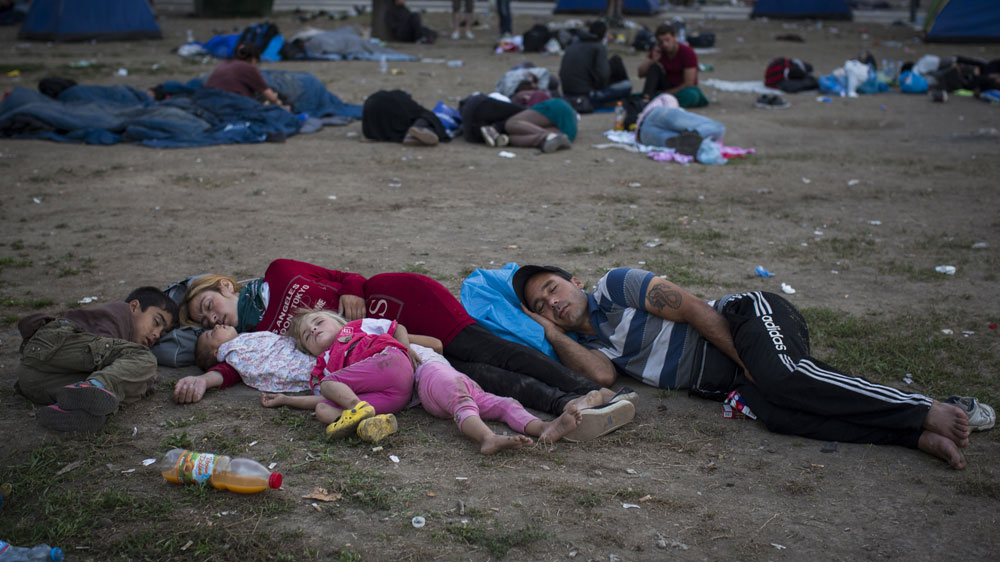
We’ve been thinking during this Lenten season about sanctuary – what is sanctuary physically and spiritually? The rich man is safe and sound behind the sanctuary of his gates. The poor man, on the other hand, lies completely exposed without any shelter, like the picture on the front of your bulletins of the refugee family lying without any shelter in the middle of a field. They look so vulnerable and at risk. The rich man could have provided Lazarus with shelter and care. In the end, it is Lazarus who is given shelter and comfort and sanctuary…in the bosom of Abraham.
If you were listening carefully, you perhaps noticed that our translation of Luke’s text did not use the word “bosom”. Lazarus was carried to “Abraham’s side”. When the rich man sees him, he is “at Abraham’s side”. The difference in translations caused me to do some research. The King James Version reads “bosom”. The New English Bible reads “to be with” and “close beside him.” Eugene Peterson’s contemporary translation reads “lap” as does the New International version of the text. Why this discrepancy?
The Bosom of Abraham has very ancient usage. Up until about 1583 CE the use of the phrase referred to the custom of parents holding their children on their laps. Even earlier than this, it is believed that the bosom of Abraham referred to the custom of eating meals in a reclining position, leaning on the chest of the person next to you. If the usage of the Bosom of Abraham has such a long history, why change the translation into something less physical, less intimate? I mean, does “close beside him” have the same meaning as “in the bosom of”? Is it because bosom seems feminine? Is it because bosom seems just a little too close for comfort? A little too intimate for our likes? Too touchy touchy feely feely for us frozen chosen?
Or does changing bosom of Abraham for a description less intimate suggest who we think God is? Are we worried about getting too close to God? Do we think God does not care enough about us to grasp us and hold us tight to God’s self?
There are some beautiful depictions of the bosom of Abraham on the stone columns of Romanesque and Gothic churches in which Abraham is depicted holding a sort of blanket with the souls of the departed close to his chest. These images tell us something about who God is. God is compassionate and nurturing and wants nothing more than to hold us tightly in God’s strong arms.
I love the idea that, in Baptism, God has taken little William Nixon in God’s arms and holds him tight…to the bosom of God.
Why wouldn’t we want that God? Why would we want to change the words from bosom to simply standing nearby? I will tell you what I think. I think we may not want God to be so intimately caring because that means we might have to be so intimately caring. If God is like that…then we should be like that…while we are alive – before it is too late.
Who is outside our gates? Who is outside our church doors? Who is outside…right in front of us that we do not see…this morning? This morning…it is not too late!
A Woman’s Work Is Never Done!
A Woman’s Work Is Never Done!
Rev. Christa Fuller Burns
Faith Presbyterian Church (USA) Baltimore
Luke 18:25-42 – 5 March 2017
First Sunday of Lent
The dictionary defines “sanctuary” as 1) a holy place set aside for worship and 2) a place of refuge or protection; originally, fugitives from justice were immune from arrest in churches or other sacred places.
I am guessing most of us are familiar with the idea of church as a place for worship and even refuge from the cares of the world. Indeed, one of the most frequently used arguments against churches taking part in the affairs of the outside world is that the church ought to be a spiritual refuge from the affairs of the world. We may not be so familiar with the idea of church as a place of safety for those in trouble with the law. However, the idea that there should be such places is intrinsic to our identity as people of God. As I pointed out in my Voice of Faith letter, Moses was instructed by God to set apart certain cities of refuge, sanctuary cities, for those in need of a safe place (Numbers 35:15). Through-out it’s history, the church has provided refuge to people in danger. Christians during the Holocaust were simply enacting their faith when they took in Jews in defiance of Hitler’s laws.
God is often described in the Psalms as providing refuge for us: Psalm 91: “You who live in the shelter of the Most High, who abide in the shadow of the Almighty, will say to the Lord, ‘My refuge and my fortress; my god in whom I trust.’ For he will deliver you from the snare of the fowler and from the deadly pestilence; he will cover you with his pinions, and under his wings you will find refuge; his faithfulness is a shield and buckler.” (v 1-4)
The author of Hebrews describes Christ as a high priest who gives us a sanctuary “not made with hands”. ..eternal in the heavens (Hebrews 9:11).
This idea of sanctuary, then, is a foundational one in our faith whether we are talking about a physical place of sanctuary or the sanctuary of the heart, a spiritual sanctuary.
During our Lenten season I would like to explore the meaning of sanctuary, both physical and spiritual. As you may know by now, Susan Minor and I have been attending meetings at St. Matthews Church. A variety of faith communities, the number of which grows each time we meet, are coming together to think about what it means to provide sanctuary for immigrants who are being rounded up by the authorities and detained. What would it mean if Faith declared itself a “Sanctuary Church”?
As I looked at our lectionary for Lent it occurred to me that the stories Jesus told are so often about refuge of one sort or another.
Let’s begin by considering the very familiar story of The Good Samaritan. You know the story. A lawyer comes up to Jesus, as Luke puts it, to test him. He wants to know what he has to do to inherit eternal life. Jesus responds: Well, you know the law. You tell me. The lawyer knows his law and his faith. He answers “You shall love the Lord your God with all your heart, and with all your soul, and with all your strength, and with all your mind; and your neighbor as yourself.” Jesus tells him that he has the right answer. If he can do this, love God with all that he is and his neighbor as himself, he will live.
The lawyer persists and asks Jesus who is his neighbor at which point Jesus tells the story of the Good Samaritan. A man was going down the road from Jerusalem to Jericho when he was stripped, robbed and beaten by a gang. It seems to me, part of the problem with our modern hearing of this story is that it is so familiar. We know the story – not just the Biblical account of the story. We know it because everyday we hear on the news or see on Facebook accounts of people who are robbed and beaten and left for dead. We know this story.When we are daily bombarded with horrific accounts of people left for dead, we run the risk of being the ones who walk by on the other side. After all, there is just so much misery we can take. Maybe we are numb to the story.
And, we also know the part about those who walk by and do nothing because…why? Because we are rushing somewhere and don’t have time? Because we feel inadequate to help? Because it might be dangerous? Because our religious obligations forbid touching someone like that? Our excuses are too numerous to mention.
We know, too, the Samaritans in our world. The Samaritans are not simply those we think of as “other”. They are the enemy. Jews thought Samaritans were something as vile as terrorists. We probably cannot overestimate the antipathy Jews felt toward Samaritans. None the less, Jesus felt the obligation to reach out to them. In chapter 9 of Luke, Jesus sends his messengers into a Samaritan village where they are not met with a welcome committee, to put it mildly. They refused to welcome Jesus and the disciples want to know if Jesus wants that they should command fire to come down from heaven and wipe ‘em all out! Of course, Jesus says no, and they move on.
The Samaritans – they were not just bad neighbors. They were despised. They were hated, which makes Jesus’ telling of this parable all the more remarkable.
The priest walks by. The holy, prestigious Levite walks by. But the hated and despised Samaritan stops. He doesn’t just stop. Moved with pity, he bandages the victim’s wound, he hoists him up on his donkey, and he takes him to an inn where he gives the inn keeper some money and instructions to take care of him.
We know this story…because it is about all of us. At some point, haven’t we found ourselves in the ditch? At some point, haven’t we been the ones who just kept going? At some point, hopefully, were we the ones who stopped and gave refuge to the wounded, the vulnerable, the refugee?
The Good Samaritan, after all, is a story about loving our neighbors to the point where we pick them up out of the ditch and offer them safety. The Good Samaritan is a story about providing sanctuary. The second story we heard this morning is perhaps less clearly about sanctuary.
The story about the two sisters, Mary and Martha, is also familiar. As Jesus and his friends kept going they come to a village where a woman, Martha, welcomes them into her home. That’s about sanctuary isn’t it? Martha provides a safe place that is warm and where there is food for the travelers on their way to Jerusalem. While Martha busily works in the kitchen fixing dinner, her sister Mary sits at Jesus’ feet, listening to what Jesus says. Martha gets upset and wants to know why Jesus doesn’t tell her sister to help her whereupon Jesus says, “Martha, Martha, you are worried and distracted by many things; there is need of only one thing. Mary has chosen the better part, which will not be taken away from her.” (v.41-41)
Traditionally, we women have been asked, “Are you a Mary or a Martha?” Are we the one who keep everything working and in order? Or are we the dreamy one who spends her days in contemplation? I have decided that this choice is unfair and may not have been Jesus’ intended point at all. Perhaps the story about Mary and Martha isn’t about how one role is better than the other. Perhaps it is a story about defending a woman’s right to choose. Martha’s work was traditional for her day, maybe even for ours. The fact that Mary is allowed to sit at Jesus’ feet, to be a student of Jesus was unthinkable in Jesus’ time. It was unthinkable that a woman would be allowed to sit at the teacher’s feet. Jesus defends Mary’s right to choose.
And, what is it that Mary chooses? Howard Thurman, the great American spiritual mentor who we just studied in our adult forum, writes that we have an outer life and an inner sanctuary. Sometimes, he writes, it is hard to know that we are in fact one: the outer life is made up of things we do – our relationships, our work and play, job, people and things. Martha represent an outer life. On the other hand, the inward sanctuary “is the place where I keep my trust with all my meanings and my values. It is the quiet place where the ultimate issues of my life are determined. What I know of myself, my meaning; what I know of God, His meaning; all this, and much more, is made clear in my secret place.” (P.173-4 Meditations of the Heart) Thurman concludes that we need both the outer sanctuary and the inner one because the outer one will have no meaning without the inner one. In other words, we need to be both Martha and Mary – the one who provides physical sanctuary and the one who has the sanctuary within.
I always think of the writer, Frederick Buechner’s story about his father who committed suicide when Buechner was a small boy. Later, Buechner came to realize that, as accomplished and intelligent as he was, his father had no real home within himself. In other words, he had no inner sanctuary, no inner refuge that gave meaning to his life. Or, as the great poet, Billy Joel, put it in his song, And So It Goes: “In every heart there is a room; A sanctuary safe and strong to heal the wounds from lovers past until a new one comes along”. Perhaps that is what Mary found when she sat at Jesus’ feet: A sanctuary safe and strong to heal the wounds.
The fact is that what the Good Samaritan did, what Martha did and what Mary did was all work. There is the work of physically rescuing the person in the ditch. There is the work of making our homes places of welcome. There is the work of tending our inner homes, our sanctuaries of the heart. That work…is never done!
The View from Here

The View from Here
Rev. Christa Fuller Burns
Faith Presbyterian Church (USA) Baltimore
Luke 9:28-45 – 26 – February 2017
Transfiguration
What would you say if Jesus came up to you and tapped you on the shoulder and said, “Hey, I’m going to hike up that mountain for some quiet time. You want to go with me?” What would you say?
I, for one, find the suggestion of getting away, finding a quiet place, a change of scenery, very attractive.
This past week-end, I met up with my son Cal for my nephew’s wedding in Texarkana, Texas. Anyone ever been to Texarkana? As Randy will tell you, there is not much in Texarkana – not much at all! Nonetheless, the weekend excursion offered me a welcome change of scene. For one thing, there was no talk of politics at the wedding. In fact, it was kind of like being in a different world – far removed from the daily grind, the bleary bombardment of bad news, the every-present reminders of what is wrong with the world.
It is comforting, is it not, to know that Jesus may have shared our fatigue with worldly worries? After all, Jesus’ daily encounters were with the poor that you have with you always, the demonpossessed and all those despairing women. The woes of the world crowded around Jesus and there was no respite. His feet were covered with the dirt of the world. It must have been oppressive to ever be in demand, to always fell surrounded by hunger and need, to always be reminded of the work to be done as the poet described it:
And all is seared with trade;
bleared, smeared with toil;
And wears man’s smudge and shares man’s smell;
the soil Is bare now, nor can foot feel, being shod.
-(Gerard Manley Hopkins)
Yes, our world too is seared with trade, bleared, smeared with toil. So. If Jesus asks us if we’d like a change of scenery, if we’d like to hike up a mountain, would you stay or would you go?
The fact is, we don’t know why only the three went with Jesus: Peter, John, and James. However, I appreciate the possibility that Jesus simply asked who wanted to go hike to a quiet place where they could pray uninterrupted and they were the ones who agreed.
Of course, the irony is, when the four men get to the top of the mountain, they are interrupted. There are other people up there. Moses and Elijah are up there and, doggone it, they are talking! We never get the idea that much praying happens! Isn’t that the way life so often goes? Our best laid plans are interrupted and what we’d hoped was going to be quiet solitude gets interrupted.
We have to point out that it is not just anybody who is up there on that mountain. It’s none other than Moses and Elijah. They appear just as Jesus has been illuminated – his face shone and his clothes “flashed white like lightening”. Moses and Elijah appeared in heavenly splendor too.
Even this occurrence may seem familiar to us. We are in a place where we think we know what to do. We think we know the place. We are praying, maybe, and we are with people we know and it’s manageable. Something happens that totally changes the way we see things, the way we see ourselves, the way we see Jesus. It may not have been a blinding light… or maybe it was.
One of my favorite short stories is by Flannery O’Connor and it is about a southern woman who is set in her ways. Her world is predictable and she works hard at keeping it that way – nothing to make her upset, nothing out of order. Blacks are in their place and whites are in their place until one day, our of the blue, just as Mrs. Turpin is doing an ordinary thing – visiting a doctor’s office – a young woman has an outburst and throws a book at Mrs. Turpin. When Mrs. Turpin gets home it is if she seeks to put her life back where is should be, predictable. She goes out to feed the pigs and suddenly there is a kind of blinding light and she sees folks in long white robes marching up the heaven….except it is not the way it should be…it is out of order. The people in front of the line are all black! The misfits are also at the front of the line. Mrs. Turpin’s world view is transfigured and her tidy order of things is disrupted.
(Revelation)
“The world is charged with the grandeur of God.
It will flame out, like shining from shook foil;
It gathers to a greatness, like the ooze of oil Crushed.”
Sometimes it happens that way…sometimes…if we manage, like Jesus’ friends in the story, to stay awake and we are not overcome by sleep. That is the risk for us, it seems, in these days – when we have the chance to get away and we relax. We catch up on our sleep and we can totally miss the shining like shook foil that has the potential to totally change our view of things…from up here.
Peter and his friends see the shining but they respond in predictable fashion. Jesus, they say, it sure is a good thing we are up here! We can build something to contain this experience. We can manage it. We can make it fit our human expectations or order where everyone is where they should be. We want to do something because that is our way to manage the shining shook from foil.
And, that is when the cloud comes! That is when, I figure, God has to say something. The cloud comes and completely covers everyone on the mountain and you can’t see anything. Have you ever been swallowed up in fog? Maybe you’ve been on a plane and one minute you can see the earth below and the next minute all you can see is the dense, impenetrable whiteness, I grew up in Southern California. We’d be a football game at night watching our team, the Corona Del Mar Sea Kings, and the fog would roll in and you couldn’t see a darn thing! We could hear the whistles blowing but we couldn’t see anything. The amazing thing to me now is that we stayed for the whole game…in the fog. That is High School for you!
It is no wonder then that Jesus’ friends were overcome with awe or fear, as some translations have it. The shining was one thing – they could manage that – or so they thought. The shining. But that cloud, that is a different thing. God is close in the cloud.
My grandmother and I used to have a running debate about where we felt closest to God. My choice was always the ocean. My grandmother on the other hand always went for the mountain…She did have the Bible on her side!
And then….God speaks: “This is my son, my chosen one. Listen to him.” It is one thing to see Jesus – to really see him for who he is. It is another thing to listen to him.
Sadly, the disciples, and we, cannot stay up there on the mountain. We have to come down to the world, which is as we left it. The large crowd is waiting. The epileptic boy needs healing. The disciples either couldn’t or wouldn’t heal him and we are the faithless and crooked generation.
The world is as we left it – still violence-ridden, still rude, still unjust. And Jesus? Jesus will be put to death by this faithless and crooked generation.
It is as if all the shining wore off on the way back down the mountain. All the awe evaporated.
You see, I believe that it wasn’t just Jesus who was transfigured up there on the mountain. What difference would it make if it was just Jesus- like a tree in a forest – and no one saw him? I think Peter, John and James were also changed – they had to be – by the reflected light and the sound of god’s voice.
However, something happened in the descent. Something happened to cause Jesus’ comment on their faithlessness. They lost their shine. They lost their confidence. They lost their vision of who Jesus is. Did they forget what happened and how they felt? Did the misery of the world, like a magic eraser, simply wipe the shine off?
Our task, it seems to me, on this Transfiguration Sunday – the Sunday before we enter the wilderness that is Lent – before we go out into our grimy and hurting world is to remember what we’ve seen and heard. Our task is to look at ourselves in the mirror and see the incandescent light that Jesus gives to us. I am not talking about a cosmetic blush here. I am not talking about simply putting on a happy face. I am talking about shining with the light of truth. I am talking about shining with the light of justice. I am talking about shining with the light of endurance and courage. Our task this morning is to go out into the world….and shine!
It Takes Guts!

It Takes Guts!
Rev. Christa Fuller Burns
Faith Presbyterian Church (USA) Baltimore
Luke 7: 1-17 – 5 February, 2017
Fifth Sunday in Ordinary Time
Many of you know that I have been on an administrative commission for a church in Bel Air. “Administrative commission” is Presbyterian speak for a group of folks who go to be with a church that is split up. Consequently, I find myself driving out to Bel Air, sometimes at odd times; most of the time at night. Now, as you know, we’ve got Faith people who live out that way and who drive in to church all the time. But I am a city girl. You get me out there on those dark roads at night and I feel disoriented and lonely. I mean, Bel Air feels like another state! I am coming to the idea that my little excursions out into the county are teaching me things.
This morning I invite you to think, first of all, about the geography of the two stories we heard this morning. Let’s imagine we are among those who have been walking with Jesus. Our numbers have grown. We’ve pretty much stayed close to home. Jesus is from Galilee, right? His disciples are from Galilee. Galilee is, at the time of Jesus, considered something of a backwater place. It lacks the culture and the commerce and sophistication of the area around Jerusalem, for example.
So far, we’ve been in familiar surroundings, more or less around the Sea of Galilee. We know this place, this land, these people.
When Jesus goes to Capernaum, right there as it is on the lake, it is “our people” he speaks to. We know this place.
However, this time, when we get to Capernaum, after Jesus does his thing teaching, we are met by some Jewish elders who ask him to come to the house of a centurion that is a general in the Roman army who commands a hundred men. The centurion’s slave is gravely ill and he wants Jesus to heal him. We are in a familiar place, but this is not a familiar encounter – a Roman soldier wants Jesus to come to his house? The elders persuade Jesus by telling him that, even though the Romans are hated and despised, even though the Romans are our oppressors, Jesus should go to his house because the guy is a good guy. He loves our people. He even built our synagogue for us.
Jesus, and we, because by this point, where Jesus goes, we go, we start for the centurion’s house. When we are most of the way there, we are met by some of the centurion’s friends who tell Jesus that the centurion feels unworthy to have Jesus come all that way. If he just says the word, his beloved servant will be healed. It is as if the centurion recognizes Jesus’ authority. If you just say the word, he says, healing will happen. Jesus turns around to us and tells us, we who have been following him all along, we who have left our homes and families in order to go all over kingdom come, Jesus turns to us and says, “I tell you, not even in Israel have I found such faith”.
It is stunning. All we can hear is the gentle lapping of the Sea of Galilee in the background; it is such a familiar sound to us. We are in our home turf. We are with our friends; people we know. And Jesus is telling us that this foreigner, this wicked Roman has more faith than we do? All because he tells Jesus that all he has to do is issue a command and his servant will be healed. And who is this servant anyway? Whoever heard of a Roman commander caring that much for an Israelite slave – so much so that he built him a synagogue, so much so that he goes to a Galilean healer man on behalf of his slave? Makes you wonder, doesn’t it? Maybe their relationship is more than meets the eye. Maybe they are more than master and slave. Just thinking. And, this Roman has more faith than we do? Just thinking. The slave, by the way, he is healed.
Soon after this encounter, we leave the familiar and head some twenty or so miles south to a place called Nain…kind of like going from Baltimore to Bel Air. Now, we are out of our comfort zone. Nain is a fair piece from Capernaum. We get to this town, and there is a huge procession coming out of the gates of the town. It is quickly apparent that it is a funeral procession. It seems a widow has lost her only son. It is a heart-wrenching scene – a mother completely bereft. She has nothing. Nothing. There is no future for her. And, she is inconsolable. As the crowd slowly moves toward the rock-hewn tombs on the outskirts of town, Jesus sees this widow. No one else really sees her. After all, it is a common enough sight, a crying mother. But Jesus sees her. Not only that, but Jesus feels for her. He has compassion for her. When we say “compassion”, we are actually using a word that means coming from our gut, wrenching our guts, our innermost selves.
Jesus tells the widow not to cry, at which point the crowd stops moving, and Jesus reaches out and touches the coffin. “Young man”, he says, “I say to you, rise!” The son sits up in that coffin and starts talking! Jesus takes the young man and gives him to his mother. The crowd, as you can imagine, is awe-struck. We are both scared and amazed. What kind of power does this man have that he can heal from a distance and raise a kid from the dead?
Here is what we learn when we walk with Jesus: He takes us out of our comfort zone. He tells us that just because we are baptized, good church folk who are in church on Sunday morning, we don’t necessarily have the faith that someone we may despise has. Oh, my – there are all those people outside this church that are living…faithfully…we’ve got to open our doors to them. Not only that. We have to be open to those who disagree with us; those who define faith differently than us.
William Willimon tells a story about a church that was dying and trying to decide what to do with their church building. They got a new pastor that convinced the church that what they should was just keep the church open to anyone who wanted to come in. And, so they did. They kept the church open all the time and never locked the doors and soon there were regular homeless people who slept there at night and there were people who hung out there during the day because it was warm. However, the insurance people soon warned the church that they could not keep their insurance and not lock the doors. So, the congregation regretfully locked the doors to the church. However, they put the keys under a rock where all could see it. The rock had big bold letters: “KEY”. Don’t you know that church came to life again because it opened itself to the others in its neighborhood!
Second, if we walk with Jesus, we learn something about trusting our gut. In both the story of the centurion and the story of the widow and her son, Jesus had compassion for the plight of otherwise ignored people. I fear one of the things I am seeing in our country today is the inability to feel what another is feeling. We keep hearing that this past election was all about “my” pocketbook, “my” security, “my” job, “my” doctor. Have we lost the ability to feel compassion for the other – that ability to feel from our innermost selves, not what I am feeling, but what the other is feeling – whether it is the steelworker in Ohio or the Syrian child with no place to go? When Jesus tells that story about the folk who pass by the fellow lying in the ditch is he talking about us – the Levite and the priest – the good guys who go to church? And, who is it that has compassion for the robbed and beaten man? A foreigner? A Samaritan? Might as well have been a Roman army officer. If we say we are going to walk with Jesus, if we say that, yes, there is a balm in Gilead, then we are going to have to tell the love of Jesus…and, that is going to take guts!
The Church of the Outstretched Hand
The Church of the Outstretched Hand
Rev. Christa Fuller Burns
Faith Presbyterian Church (USA) Baltimore
Luke 6:1-16 – 29 January 2017
Fourth Sunday after Epiphany
So, who cares? In our contemporary culture in which anything goes on Sunday and Sunday is simply a day like every other day, who cares about Jesus’ debate over what is the best way of keeping Sabbath? Who cares?
However, those of us of a certain age remember when nothing was open on Sundays, no sports were played on Sundays; families had Sunday dinners on Sundays. If we didn’t actually experience Sunday as different day, my guess is that we remember our grandparents talking about blue laws, and how, in some places, there was no dancing or card playing or anything on Sunday.
Be that as it may, I am not really sure the story about Jesus and his disciples eating grain and healing a man with a withered hand is about keeping Sabbath. Scholars suggest that there are some problems with this passage and that may explain why, until now, it hasn’t been in any of our schedule of readings. We can point out that it is pretty unlikely the Pharisees would have been out in a grain field on the Sabbath. We can also point out that if you were really hungry, eating that grain wouldn’t have been considered a violation of the Sabbath. Healing the man with the withered hand was not work, Jesus doesn’t even touch him, and therefore not an infraction of the rules. We can point out that Jesus, most of the time, was a defender of Sabbath law. In fact, our interpretation of this story and others as about how the Pharisees were out to get Jesus, eventually leading to his death, have contributed to, at least, a distorted view of the Pharisees and, at most, a dangerously anti-Jewish depiction of the Pharisees.
I propose, then, that we think of this passage from Luke, which, by the way, is also included in Matthew and Mark’s gospel, not so much as a run in between Jesus and the Pharisees about how to observe the Sabbath leading us to consider how we observe the Sabbath. I suggest we consider what Jesus says to us about the whole point of religious community. Instead of who cares about the Sabbath, maybe we should be asking who cares about the church, this bunch of people who just happen to get together on Sundays. Who cares…about the church?
After all, everywhere we look, there are those who tell us how obsolete the church is. Our numbers are dwindling. Our voice is fractured, split up as it is over hotly debated issues. Our voice is rarely heard as authoritative or of consequence. No less than the columnist David Brooks suggests that one of the reasons for the moral vacuum in our country these days is that the voice of clergy is no longer heard in the public square. Churches fall all over themselves trying to be relevant, doing away with old hymns, showing videos, praise bands, worshipping in warehouses or in bars, (now that is an idea we maybe should look more closely at). All the while, I fear churches are missing the point.
Jesus is walking with his disciples on the Sabbath. They are walking through a grain field and the disciples start eating the grain they pick from the stalks. I cannot picture this scene without remembering visiting the farm belonging to one of my mother’s friends. I was a child and the farmer invited me to go out early in the morning to help milk the cows. I thought it was magical. I remember filling the buckets with grain to feed the cows and tasting it as I did. It was – well – rather dry and rather oaty and very crunchy. I can imagine that disciples were hungry so they picked off those grains and ate them, tasteless as they must have been.
There was a remarkable story in the paper this week about the death of a survivor of a secret World War II mission. It seems Harold Hayes, who was only 21 at the time, was one of 13 male medics and 13 female nurses who were to have been air-dropped into Italy as the Allied forces were moving into that country to oust Hitler’s army.
A wicked storm blew their plane off course. Eventually, the plane crashed in a rural marsh in Albania. At times, the Americans were given shelter and food by sympathetic Albanians. However, at other times they were unable to find food and they existed by making tea by boiling straw and by eating berries. Miraculously, all of the medics and the nurses survived. We can imagine, then, how life-giving those grains of wheat might have been.
On another Sabbath day, Jesus goes to the synagogue where he teaches. In the synagogue that day was man with a withered hand. To be precise, his right hand was withered which probably meant that he could not work. It also meant that he was unable to fully participate in worship as he would have been ritually unclean. Jesus asks him to come forward. The man stands up and comes forward. Jesus asks, is it lawful to do good or to do harm on the Sabbath, to save life or to destroy it? Jesus pauses, and looks around at the congregation. Then he tells the man to stretch out his hand. When the man does so, his hand is healed. Now he can fully participate in the worship life of his congregation. Now he can be a productive member of his community.
Here is my question this morning: Are we as a church in the business of saving life…or destroying it? Are we in the business of giving life or denying it? This may be the real question of this story.
If we accept the possibility that this story comes from the early church which many argue, it comes from a time when the followers of Jesus were suspected of not being really Jewish. I wonder if that isn’t an argument we have today. What does it mean to really be the church? What does it mean to be really Christian? I was in a conversation just this week with clergy who talked about being under fire for not reciting the Apostles Creed every Sunday or not saying the Lord’s Prayer every Sunday or not singing the Doxology or the Gloria Patri every Sunday. Really? In this time when the church is regarded as irrelevant, are we arguing about not singing the Doxology?
Maybe, just maybe, we as the church should be asking ourselves: Are we destroying life? Or are we giving life?
A fellow pastor tells the story about his church. Their roof had a leak. The church finally fixed the leak with the help of an “architect, a structural engineer, three bids, ten meetings, four subcontractors and a small fortune”. (Matt Fitzgerald, Daily Devotional, Jan.22, ’17) However, even though the leaks stopped, the damage from them remained. Every Sunday, as the pastor looks out at his congregation, he can still see the stains which prompt him to ask himself about the priorities of being church. William Kitt was a homeless man. He’d been homeless for more than 30 years. He was addicted. He was plagued by violent nightmares. He slept in boxes.
On Christmas Eve of 2003 he went to worship in the church with the stains. Sitting under the arched wooden ceiling, something happened to him. ‘I looked around the church and saw the faces of the congregation, from the kids up to the adults. I wanted what they had.’” Soon after that, Mr. Kitt moved into transitional housing where he has a sun-lit apartment. Today he is sober and he makes a living selling his oil paintings. The transformation of Mr. Kitt happened, I would argue, in church…in a church that was life-giving.
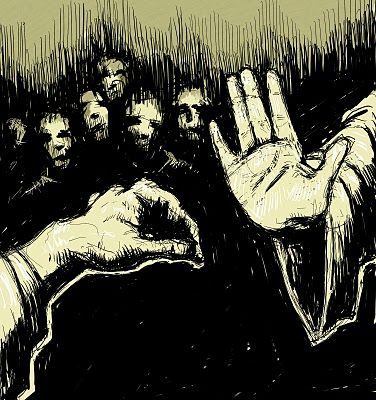
My prayer is that Faith Church will be known as the church of the withered hand because, let’s face, aren’t we all people with withered hands? Don’t we all have one infirmity or another? Are any of us truly worthy of the love God has shown us? Aren’t we all refugees of some sort? Aren’t we all afflicted with some sort of suffering? A life-giving church offers healing and acceptance.
I think it is worth noting that the man with the withered hand only has to reach out his hand, to offer who he is, in order to be healed. May we be a place where people are not afraid to offer who they are.
In a recent article entitled “Want millennials Back in the pews? Stop trying to make church ‘cool’” (Rachel Held Evans), the author argues that what brought her back to the church “after years of running away, wasn’t lattes or skinny jeans; it was the sacraments. Baptism, confession, Communion, preaching the Word, anointing the sick – you know, those strange rituals and traditions Christians have been practicing for the past 2,000 years. The sacraments are what make the church relevant, no matter the culture or era.” She doesn’t say it but I think she would agree that the sacraments are important because they are life-giving. Yesterday we thanked God for one of God’s saints, Edith Elliot. Today we will lay our hands on a new leader for our church. These occasions are life-giving. Of course, our sacraments are most important when we offer them to everybody – the man with the withered hand, the left out, the poor, the gay and the lesbian, those of a different race, the immigrant, those otherwise left out in our culture.
I offer an incomplete list of ways that our church can be life-giving. Perhaps you will think of additional ways we can give life. However, today I cannot, leave out this final thought. My Biblical scholar consultant has written a book about Sabbath as resistance in which he argues that “Worship that does not lead to neighborly compassion and justice cannot be faithful worship of YHWH. The offer is a phony Sabbath!” (Walter Brueggemann, Sabbath as Resistance: Saying No to the Culture of Now )
Have you ever thought about that? That what we do here on Sunday morning is resistance – resistance to a dominant culture of deathly priorities?
On Friday afternoon, Shabbat, a group of suburban synagogue members met at O’Hare International Airport, waiting to meet one of the last Syrian refugee families to be accepted into the US. They waited to welcome, in the warmest way they could, people our country has said it no longer wants. Some of the Jews in the welcome party were the children and grandchildren of refugees – people who had come to this country during the Holocaust in order to find life. The Syrians were arriving on Shabbat. They were also arriving on the International Holocaust Remembrance Day. These Jews were observing the Sabbath by resisting our country’s attitude toward refugees.
Jesus said I came so that you may have life and have it abundantly. Sometimes, giving abundant life means saying “no” to the state and it’s policies of death. Today, January 29, 2017, the world is asking are we the church of the gospel of Jesus Christ…or not? Are we the church of life…or not? Are we the church of the withered hand… or not?